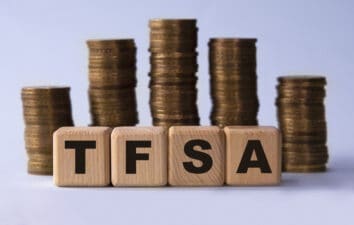
The TFSA (Tax-Free Savings Account) is an excellent place to hold investments because income and gains earned inside the account are not taxed. Since you don’t pay tax in the account, you don’t need to report any income. That really takes the stress out of tax season.
Likewise, when you withdraw from the account, there is no tax liability. As a result, the TFSA is really one of the most flexible Canadian registered accounts. That flexible tax advantage can be used in a wide array of applications, including for an emergency fund.
An emergency fund needs to be safe and relatively easy to liquidate. You want to be able to grow savings in the account, but you also want those savings to be accessible for unexpected events.
Most financial experts suggest three to six months of income is as a good benchmark for emergency savings. Yet, everyone has different levels of risk and nuance in their financial plan.

Source: Getty Images
The bear case for TFSA emergency funds
Some people may not be entirely comfortable unless their rainy-day savings allocation is only in cash or very low/no-risk investments like guaranteed investment certificates (GICs). If that is the case, a TFSA is likely not the ideal place to invest.
You get such little return from GICs and “high interest” TFSA savings accounts (between 2% and 3%) that you don’t really accrue any benefits from putting the emergency savings in the TFSA.
Sure, you save a little bit of tax on your interest income, but it is nominal. That emergency savings takes up contribution room in your TFSA, where you could be investing for higher tax-free returns.
The bull case for TFSA emergency funds
At least a month or two of savings held in cash is a good idea. I would keep that outside of the TFSA. However, four to six months of income is a lot of TFSA capital to tie up. For many Canadians, that could be between $10,000 and $40,000 of savings earning only nominal returns.
The alternative is to find some low-risk TFSA stocks to hold onto for dividend income and modest gains. The BMO Low Volatility Canadian Equity ETF (TSX: ZLB) is a basket of 52 of the lowest Beta (lowest volatility) stocks in Canada. It pays a 1.9% yield and has a modest 0.4% management fee. Over the past three years, the Index is up 61%. A $10,000 investment would be worth $15,785 today.
If you want an individual stock to hold, Fortis (TSX: FTS) is about the best you will find. This is the closest stock you will find to a bond, but with complete liquidity unlike a bond.
Fortis has a very low Beta and earns a 3.4% dividend yield. Its regulated utility portfolio should deliver foreseeable mid-single-digit growth ahead. The best part is it has a 52-year record of consecutively growing its dividend.
The Foolish takeaway
If I wanted low-risk investments in my TFSA for an emergency fund, Fortis would be a top choice. However, one must recognize that stocks can fluctuate up and down over the short term.
You must be comfortable with that risk when buying stocks for a TFSA emergency fund. Ideally, the TFSA wouldn’t be used for emergency savings. However, if that fund was substantial, I’d consider some very low-risk stocks held inside a portion of the TFSA.