Predicting “hundreds of trillions of dollars about to be set in motion”… Motley Fool CEO Tom Gardner is staking US$2.5 MILLION on the AI breakthrough he declares “will reset the global economy”
Tom’s AGI pick
Accept this Charter Member invitation today and you’ll receive:
- The AGI Portfolio, Tom’s top 40 winners of the AGI era spread across US$2.5M of The Motley Fool’s own capital.
- Special Reports:
- “Warning Shots: The 46 Stocks MOST Threatened by AGI”
- “Sell Off: 48 US Hidden Gems Sells from Tom Gardner” [2-year exclusive]
- “AGI Options Lab: 10 Strategies for Playing Both Sides of the AGI Future” [2-year exclusive]
- AGI: Active Oversight, 90-minute “state of AGI” sessions with Tom himself happening every quarter (total of 8 sessions). [2-year exclusive]
This 73% discount will expire on Saturday at midnight. Read on to get the insight on Tom’s full AGI investing plan.
“This represents unquestionably the single biggest shift in investing. It is the biggest shift for the public markets. Ever. There has never been a transformation like the one we’re sitting on right now.”
— Motley Fool CEO, Tom Gardner
- Nvidia CEO Jensen Huang just publicly heralded that “AGI is here”, and now Tom’s making one of the biggest moves of his career with the single biggest public stock allocation in Motley Fool history.
- Famed technology investor Cathie Wood previously said it could 10X the growth rate of the global GDP!
- Read on to discover the three letters that could transform society “like the advent of fire or electricity” — including full details on the 40 stocks Tom’s stacking US$2.5M behind to take advantage.

From the Desk of
Dear fellow investor,
On September 6, Nvidia CEO Jensen Huang made an unexpected declaration that left most of the investing world stunned.
I say “most” for a very good reason…
Because behind the scenes at The Motley Fool, it kicked off the most intense two-month sprint I’ve seen in my nearly decade-long tenure with the company.
Not because we were caught flat-footed, mind you…
Quite the opposite.
You see, Motley Fool CEO Tom Gardner has spent the past two years — not to mention tens of millions of dollars worth of Motley Fool capital — quietly preparing for this exact moment to arrive.
The stakes?
Nothing short of a comprehensive “reset of the global economy,” according to Tom himself.
Boil it down to its bones, and you’re looking at a mere three letters causing all of this uproar.
Hard to imagine at first blush…
But if you take it from some of the brightest minds on the face of planet Earth today, this latest advancement in artificial intelligence could very well be the single most impactful development in human history:
- Anthropic CEO Dario Amodei claimed it could “compress roughly 50-100 years of biological progress into 5-10 years.”
- Google DeepMind Chairman Demis Hassabis calls it “10 times the industrial revolution at 10 times the speed” and “probably something more like the advent of fire or electricity.”
- Prominent Ark Invest CEO Cathie Wood has previously said it could 10X global GDP growth per year.
- Alphabet CEO Sundar Pichai calls it “the foundation for everything we do.”
- Goldman Sachs just projected that tokens — basically the “AI currency” — will skyrocket 24X in usage by 2030!
And Tom Gardner himself recently stated:
“I believe it will reset the global economy. Putting hundreds of trillions of dollars of value in motion in the next decade. Starting now.”
— Motley Fool CEO, Tom Gardner
After reading that, it’s little wonder Tom’s decided to stake a mind-boggling US$2,500,000 on this recent AI breakthrough.
The single biggest move of his investing career, not to mention the largest one-time public stock allocation in our company’s 33-year history.
And he wants you to join him.
In just a bit, I’m going to show you how to do so, if you’re so inclined.
But first, what are three letters that represent the AI breakthrough that has the world’s brightest thought leaders salivating?
Take it from Tom Gardner himself…
“I believe all that we’ve experienced in the 33 years of Motley Fool history, all of it combined, is about to be dwarfed by where we’re heading together. And where we’re heading is to a place called artificial general intelligence, or AGI.”
— Motley Fool CEO, Tom Gardner
In fact, Tom recently told me: “I believe AGI will rewrite the rules for our industry… our company… and virtually every other industry and company in the world.”
It’s heady stuff, to be sure. Even bordering on science fiction.
And recently, many would claim it to be more theoretical than reality.
Then September 6, 2026, happened.
That’s the fateful day Nvidia CEO Jensen Huang took to Twitter to publicly declare: “AGI is here.”
If you saw our AGI Summit event, you already know Tom believes the arrival of AGI will fundamentally change investing as we know it.
Or, in his words, “There really will be no business as usual. There is going to be no status in the status quo.”
But before we get too far down the wormhole of the implications of AGI, let’s make certain we agree what it is.
What exactly is Artificial General Intelligence?
A dictionary definition would read something like: “AI that can match or surpass human capabilities across any cognitive task, learn, and reason in new situations without custom programming.”
Strip away the jargon and it’s AI that can do what humans do without needing guidance or oversight.
The easiest way to understand it is to compare it to what we’ve had for a while now, which you may know is called generative AI.
You’ve probably used ChatGPT, Claude, or something like them.
Even if you didn’t know you were using it, the top of Google’s search results these days are powered by their Gemini AI. Same basic idea.
You know how it works: You type a question, and it gives you an answer.
Then it stops and just… waits for you.
Again, that’s generative AI, the technology behind Nvidia’s historic run and the reason “AI this” and “AI that” is on every earnings call in America.
It’s amazing, but it has one glaring limitation: It can’t do anything on its own.
It’s like the most well-read assistant in the world, sitting by the phone, waiting for you to call.
It knows a little about everything, but it doesn’t actually pick up a task unless you hand it one.
You tell it exactly what you want… check its work… and then you tell it what to do next. Again and again and again.
It’s a phenomenal tool… but it’s still a tool.
AGI, well… AGI is something else entirely.
As experts envision it, instead of giving AGI instructions, you give it a goal. Then you walk away and come back to finished work.
If generative AI is a very fast typist, AGI is the person who decides what to type.
And here’s what separates them.
AGI Difference #1: It doesn’t wait to be asked
Generative AI is reactive. If you don’t prompt it, there’s no action.
AGI takes a goal, breaks it into steps, carries out each step, checks its own results, and — this is important — changes course when something goes wrong.
Nobody has to stand over its shoulder the entire time.
AGI Difference #2: It doesn’t stay in its lane
Today’s generative AI can be excellent at a specific task and then fall apart the moment the problem changes form.
AGI is called general intelligence for a reason — it can theoretically work outside the original parameters.
Think about that smart new hire at work. You can drop them into pretty much any department, and they’ll eventually figure things out. Similar deal with AGI.
It reads a contract, builds the spreadsheet, writes the code, and drafts the memo to the board.
AGI Difference #3: It doesn’t clock out after a few minutes
Unlike a chat bot you prompt that will get back to you within anywhere from a couple seconds to a few minutes, agents can increasingly take on tasks up to 10+ hours long.
And that’s rapidly expanding, too. Soon, experts expect AI agents to be able to take on tasks in the days… weeks… even months in duration.
That’s the bridge from a chatbot that basically functions like a souped-up Google search to effectively having a whole new employee.
| Comparison | Generative AI (today) | AGI (maybe today!?) |
|---|---|---|
| How it works | Waits for your prompt | Takes a stated goal and runs with it |
| Range | Strong at specific tasks | Works across any domain |
| Time on task | Minutes | Hours, then days, weeks, even months |
| Role | A tool you operate | A worker you delegate to |
| What it’s sold as | A software subscription | Labor |
Generative AI made software a whole lot smarter. But ultimately, it’s just a step en route to AI’s originally intended purpose: productivity.
AGI turns software into an actual workforce. It does the labor for you.
And here’s the important part for investors, as well as why we’re here today…
When that happens, the money in this economy starts flowing somewhere completely different.
Or as Tom says:
“What it’s absolutely going to mean is significant changes in the companies that we’re invested in, in the industries that we’re invested in, and in the way that we invest.”
— Motley Fool CEO, Tom Gardner
So what changed… and, more important, why should you care?
It’s a fair question, and deserves a thorough answer.
(Especially if the switch that’s been flipped is going to “reset the global economy.”)
Until now, “intelligence” has been scarce.
It’s probably the single biggest limiter on companies in the history of the world. After all, every company has been limited by how many smart people it can hire.
They’re rare, are in sky-high demand, are more difficult to identify, and they cost a lot more.
AGI seemingly removes that limit.
AI agents designed by experts can now learn a new field in days, finish that work on their own, and match or even surpass the results of humans.
This will forever change how work is designed, how organizations are structured, how companies use capital, and what customers are willing to pay.
And it will cut both ways.
Some companies will use cheap intelligence to grow faster than ever. Other companies will falter, having balanced their entire product suite on work that agents can now do for free.
Okay, so if intelligence itself is no longer limited, what are we “charging for” now? Where’s the money getting made?
The answer is something you’ve almost assuredly heard of, but may not entirely understand yet: tokens.
Nvidia defines a token as:
“The basic unit of data that an artificial intelligence model reads, processes, and generates. It can be a full word, a part of a word (a subword), a single character, or a punctuation mark.”
Here’s a rule of thumb.
In English, one token is roughly four characters, or about 0.75 words.
Therefore 100 tokens equal about 75 words.
Simple enough, but why am I telling you this?
Okay, lean in for a second because this is the single most important thing you’ll read in this message…
And when you set all the noise and all the hype aside, it’s the root of ALL of the economics involved here.
In its purest form, a token is simply money — the currency of AI.
Every time you ask ChatGPT for a homemade pie recipe or argue with Claude about a faulty itinerary it created for you, there’s a cost to bear.
That’s right. For every… single… word.
At present, it’s a minuscule cost per token. And companies like OpenAI and Anthropic are charging something like US$20/subscription plans or simply subsidizing the token costs outright to grab market share.
But just consider how many people are prompting more and more with AI these days…
It adds up. Quickly.
I like to compare it to leaving the lights on at your house.
One kitchen light on all the time? Hardly registers.
A house full of lights? That electric bill starts to become noticeable.
But now imagine owning an entire city block. That’s where the costs really start soaring.
And speaking of soaring costs, that brings me to the mother of all inflection points.
Matthew Prince — the CEO of Cloudflare, which many Fools will recognize as a successful longtime Motley Fool US recommendation — recently tweeted out a jaw-dropping revelation about their business.
For the first time ever, autonomous traffic like bots and AI agents had surpassed that of humans
And it now makes up around 57% of Cloudflare’s total recorded traffic.
If you know anything about Cloudflare as a company, you know they’re basically like an internet usage toll booth.
The more internet traffic there is, the more Cloudflare gets paid. So if anybody would know about this, it’d be them.
And to show how fast all of this is accelerating, this actually happened 18 months earlier than Prince expected.
This is important for not one, but TWO reasons…
First, as Forbes notes, it creates a “potential repricing event across every category that monetizes human attention, as every media asset, e-commerce site and brand was built for humans — not bots.”
Simply put, the internet was built to be read by humans, but we’ve now surpassed a threshold where that’s no longer its primary usage.
That means that content on the internet… even the very nature of the internet will be created in a vastly different manner going forward.
Why?
Because the audience itself is different. AI models are intaking information on the internet for distinctly different reasons than human beings are.
And that brings us to point No. 2, which is even more important and harkens back to something I noted earlier: it removes human beings as the limiter.
To put it simply, humans as a whole can only read so much.
Even if you had the entire human population reading 24/7/365, it soon won’t compare to the level of content that AI will be able to process.
We’re likely already past that.
And in an era of AGI, we’re likely only going to see a higher and higher percentage of AI bots reading the internet vs. humans.
Which doesn’t just matter for the sheer number of AI prompts that there are…
But how many more tokens they consume.
Pay attention here, because what follows is why everyone from Silicon Valley hotshots… to Wall St. power suits… to the Oval Office is so single-mindedly obsessed with AI’s economic potential.
Once you see it and comprehend it, you’ll truly begin to understand the heart of everything that’s going on here.
I’m speaking from experience, because it was THE lightbulb moment for me in all of this as well…
Research firm Gartner found that AI agents require up to 30X more tokens per task than simply prompting a simple chat bot.
That means up to 30X the cost from merely the simplest of AI agent tasks.
But the more complex ones? They can range into roughly a thousand times more tokens.
As you’d expect, that’s sent token usage rates absolutely skyrocketing.
Goldman Sachs found that by 2030 — just a little over three years from now — thanks to a massive uptick in agentic AI, token usage is expected to 24X to 120 quadrillion tokens…
Not per year. Per MONTH.
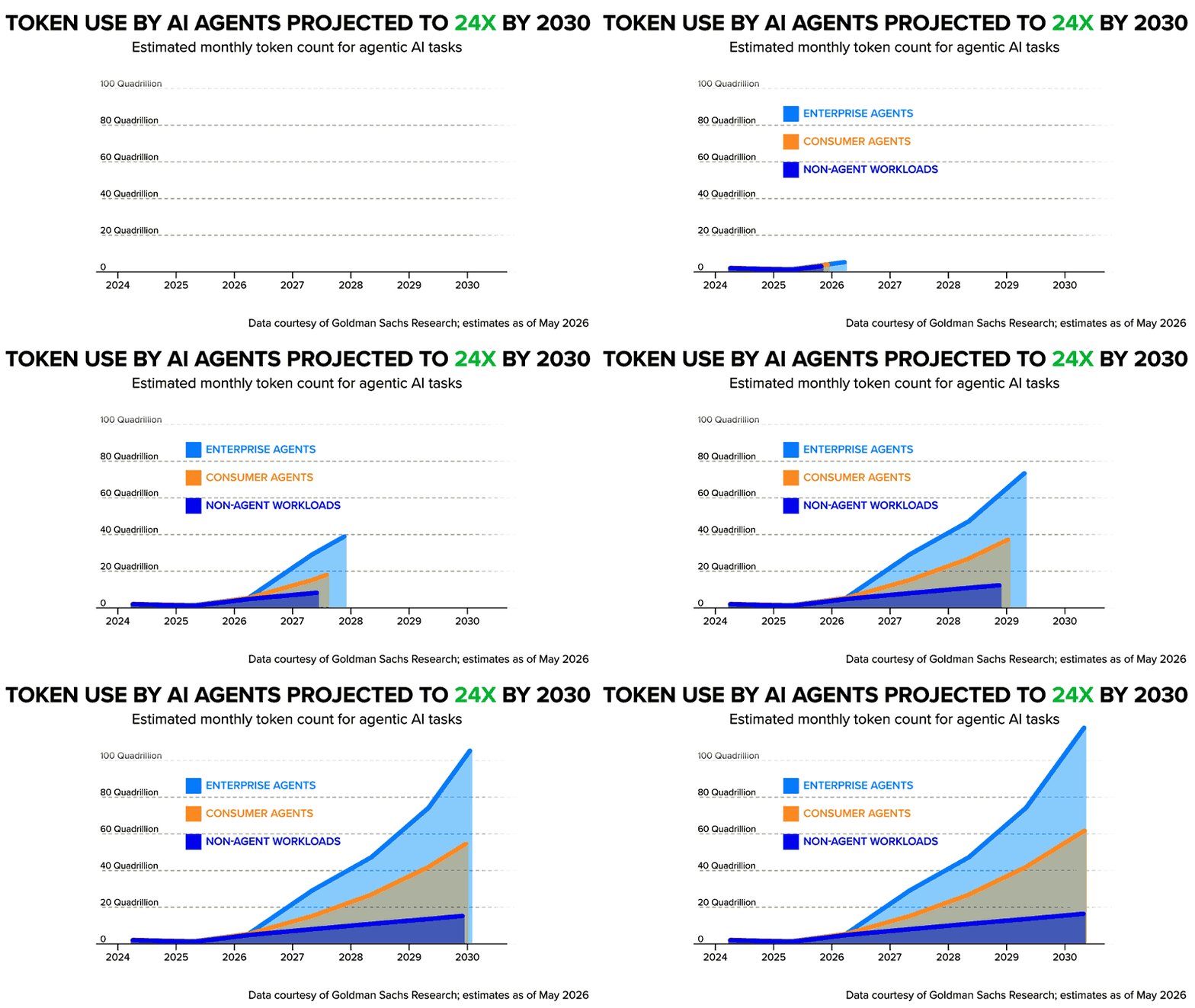
Chart refers to US market and dollars
And here’s the part that I’m guessing by now is beginning to dawn on you…
A lot of the consumer activity is just traditional online queries. Essentially like a suped-up Google search…
But as you can see in the chart above, Goldman projects traditional search falling as a percentage of queries by 2030.
And we think that’s going to get replaced by “always on” AI agents that operate autonomously in the background, like Meta’s recently released Muse agent.
If you’ve used it, you know it can do anything from something as simple as filling out a quote-request form for having your gutters cleaned… to booking you a business class flight to India.
And while these agents are operating in the background — which they’ll do increasingly more and more in society, as Goldman noted above — they’ll likely be using an insane number of tokens in the process.
24X by 2030!
Of course, throughout this entire process, who’s getting paid along the way?
The companies who were anticipating the coming of AGI years in advance, of course!
Let’s go back to the kitchen light analogy real quick.
Do you honestly think utility companies would have spent tens of billions of dollars building out the electrical grid if they knew everybody would only be turning on precisely one light in their homes?
Fat chance.
But when you turn on all the lights…
…then crank the A/C when it’s scorching in July…
…pump the central heating to get you through those long, cold winters…
…plug in those refrigerator-freezers, ovens, and electric stoves…
…along with all your televisions, laptops, desktop computers, phones, tablets…
…run the clothes washer, dryer, and dish-washer multiple times a week…
…and the family takes four hot showers a day like clockwork?
Well, it’s not hard to start adding up the dollar signs that made the initial buildout a blatantly obvious decision to the utility companies in the first place.
They knew the upfront cost would be worth it because the list of conveniences it enabled would become increasingly valuable and continue to expand in scope.
Ultimately, what was once extraordinary became ordinary. The baseline standard for everyday life.
Today, the big brains behind the AI buildout are making the exact same investment.
But they NEED AI to become increasingly smarter to make the payoff worthwhile in the end.
IBM CEO Arvind Krishna described roughly US$8 trillion in global data center buildout commitments as “chasing AGI.”
David Cahn, a Partner at Sequoia Capital, “argues the only way to justify the massive data center buildout… is Artificial General Intelligence (AGI)” — according to a Goldman Sachs research report.
And that’s not all…
“Whoever gets to AGI first will have an incredible competitor advantage over everybody else.”
— Youssef Squali, Truist Securities
“If AI revenue makes up 20% of global GDP, spending 800 trillion yen [$5 trillion USD] a year is a rounding error.”
— Masayoshi Son, SoftBank CEO
“If the country of geniuses comes, but it comes in mid-2028 instead of mid-2027? You go bankrupt.”
— Dario Amodei, Anthropic CEO
As you can plainly see, the stakes here are pretty much…well… everything.
And that’s precisely why Jensen Huang’s prediction that “AGI has arrived” is so important right now.
AGI means vastly superior artificial intelligence… which means more reliance on AI agents… which means higher productivity… which means heavier token usage… which we think ultimately means more MONEY.
Skip a few steps? As we see it, AGI = more money.
For individual companies, yes…
But for the global economy as a whole, too!
So just how much money are we talking about…?
Remember, Demis Hassabis — the head of Google DeepMind — called AGI “10 times the industrial revolution at 10 times the speed.”
And Tom Gardner himself just recently stated, “AGI will reset the global economy, putting hundreds of trillions of dollars of value in motion in the next decade.”
And then there’s Goldman’s confident prediction that token usage will 24X by the end of the decade…
Chart refers to US market and dollars
Amazingly, that pales in comparison to the following 2022 prediction from Cathie Wood — famed CEO of Ark Invest, which owns and manages perhaps the most widely known technology ETF in the world.
“Breakthroughs in AGI could accelerate growth in GDP from 3-5% per year to 30-50% per year.”
— Cathie Wood, Ark Invest CEO in 2022
Essentially, Wood previously has said that the realization of AGI could 10X global GDP growth.
The implications of this are… borderline incomprehensible.
At that post-AGI growth rate, the global economy as a whole would DOUBLE every two years!
Here, I’ll show you.
Have a look at this comparison chart that shows a middle-ground of pre-AGI GDP at 4% growth vs. a similar middle-ground of 40% based on Wood’s post-AGI projection.
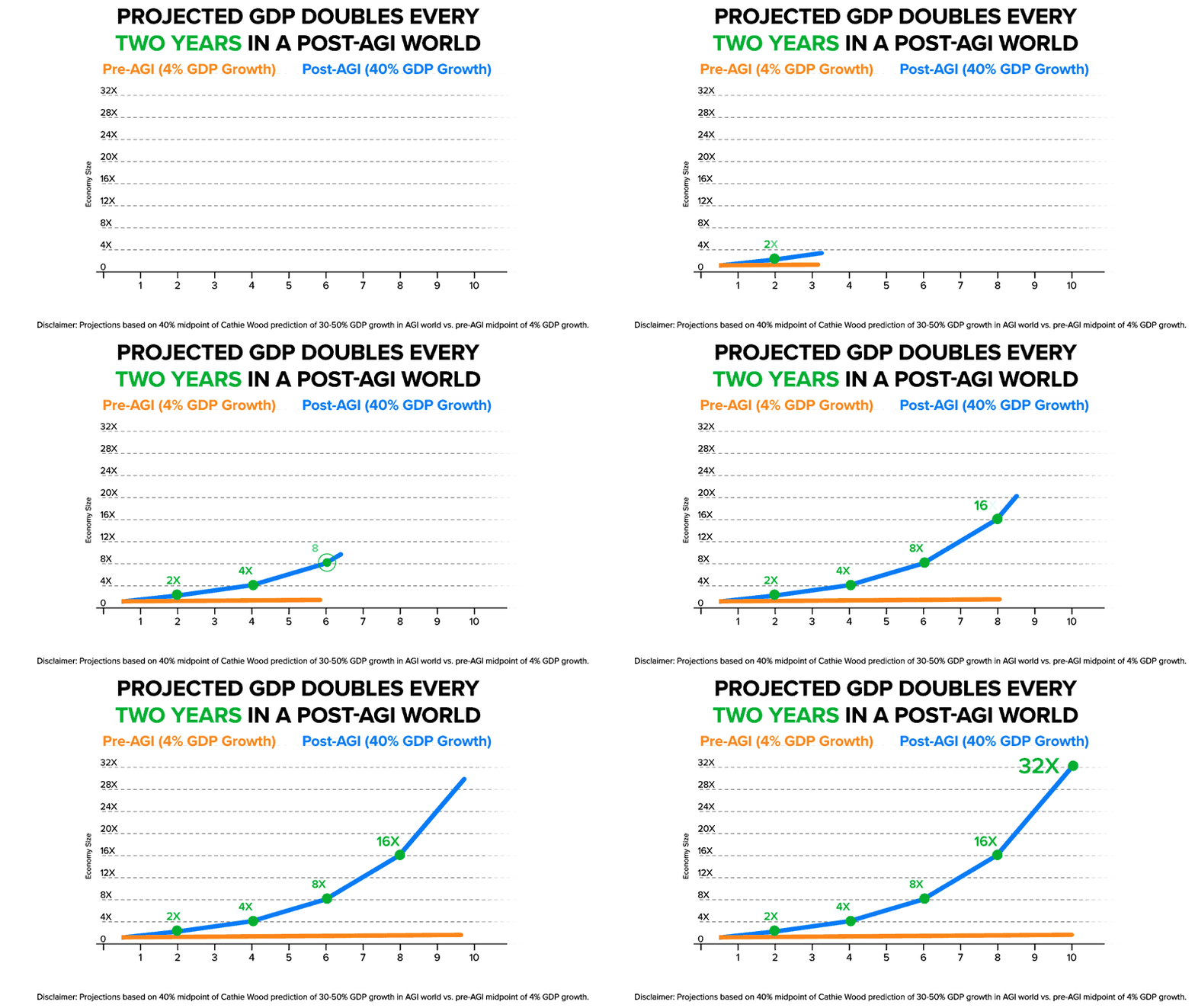
Chart refers to US market and dollars
As unbelievable as that sounds — not to mention looks — highly regarded research institute Epoch AI found something similar.
Their proprietary model predicted that AI automation could lead to GDP growth rates elevated by 2X up to 20X compared to a recent average of 3% growth per year.
From our view, there really does seem to be no ceiling on the upside opportunity here, particularly for early investors…
So when you hear the talking heads in the financial media yammering on about an AI slowdown, it’s important to have your facts straight.
Is the AI buildout slowing down? No, it’s actually speeding up!
But what inning are we truly in?
Noted technology investor Dan Ives told CNBC, “We’re in the third inning of this nine-inning game relative to AI.”
Tom Gardner’s even more bullish, saying over the summer that “We are, for baseball fans, in the bottom of the first inning.”
He thinks we’re just getting started!
The experts at Grandview Research — perhaps the leading authority on market size predictions — agree, projecting a staggering 30.6% compound annual growth rate for the industry through 2033.
Do the math, and that’s 6.5X growth in the AI market as a whole.
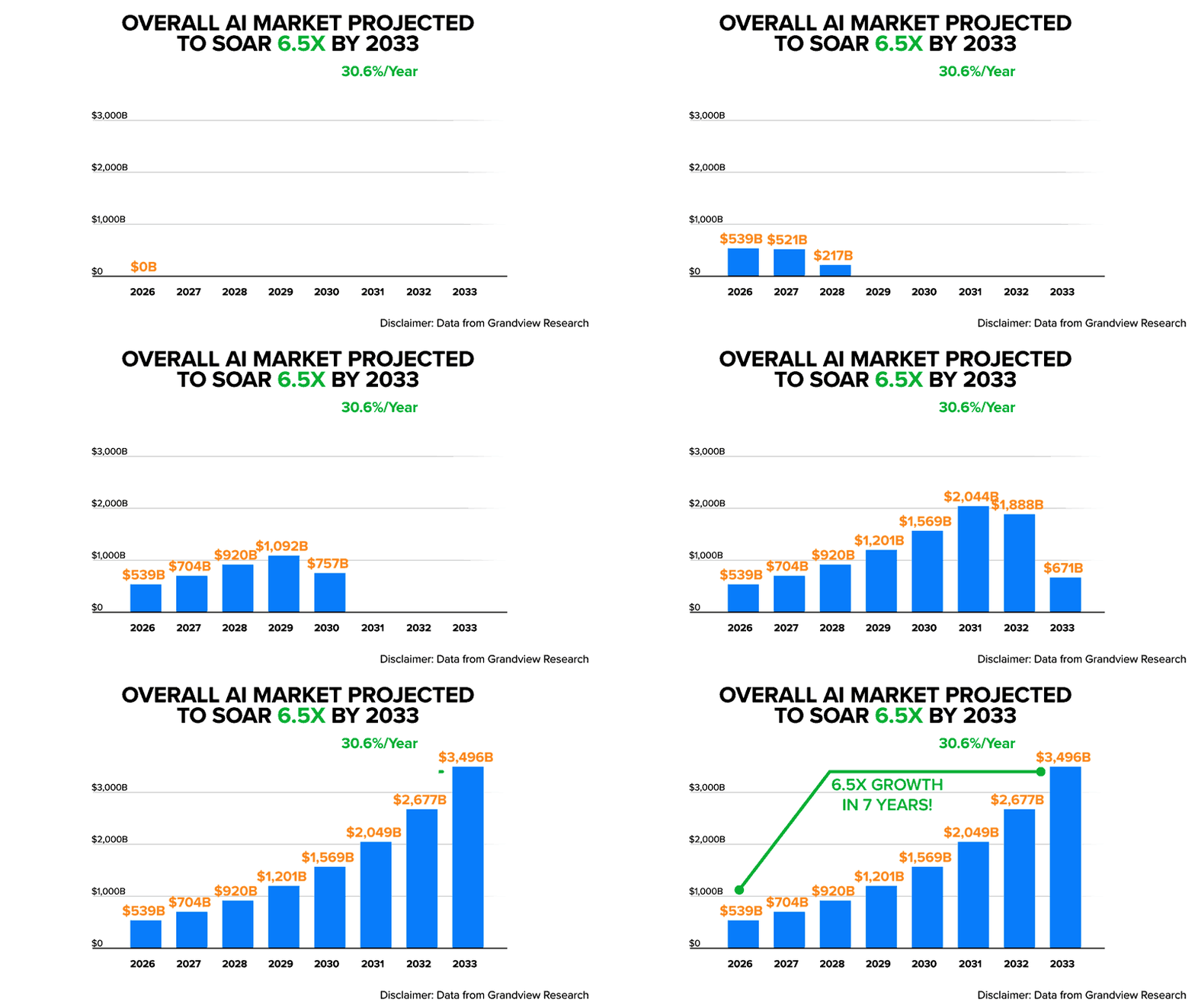
Chart refers to US market and dollars
So much for slowing down…
In fact, I expect Jensen Huang declaring “AGI has arrived” will only speed this process up even more.
I think Tom himself was spot on when he put it as “Jensen Huang has declared AGI is here right now. I don’t think waiting to see if he’s right is a smart move.”
That aggressive approach has served The Motley Fool — not to mention Motley Fool members — exceedingly well over the years when it comes to embracing emerging megatrends just like this.
To put a finer point on it, without tooting our own horn too much…
Has anybody… anywhere… capitalized on generational technology shifts better than we have at The Motley Fool?
Look at every single major technological shift The Motley Fool — and our members — has witnessed in the three-plus decades since Motley Fool US founding in 1993.
The early rise of the internet?
How about search leader Alphabet back in 2009 (31X return)…
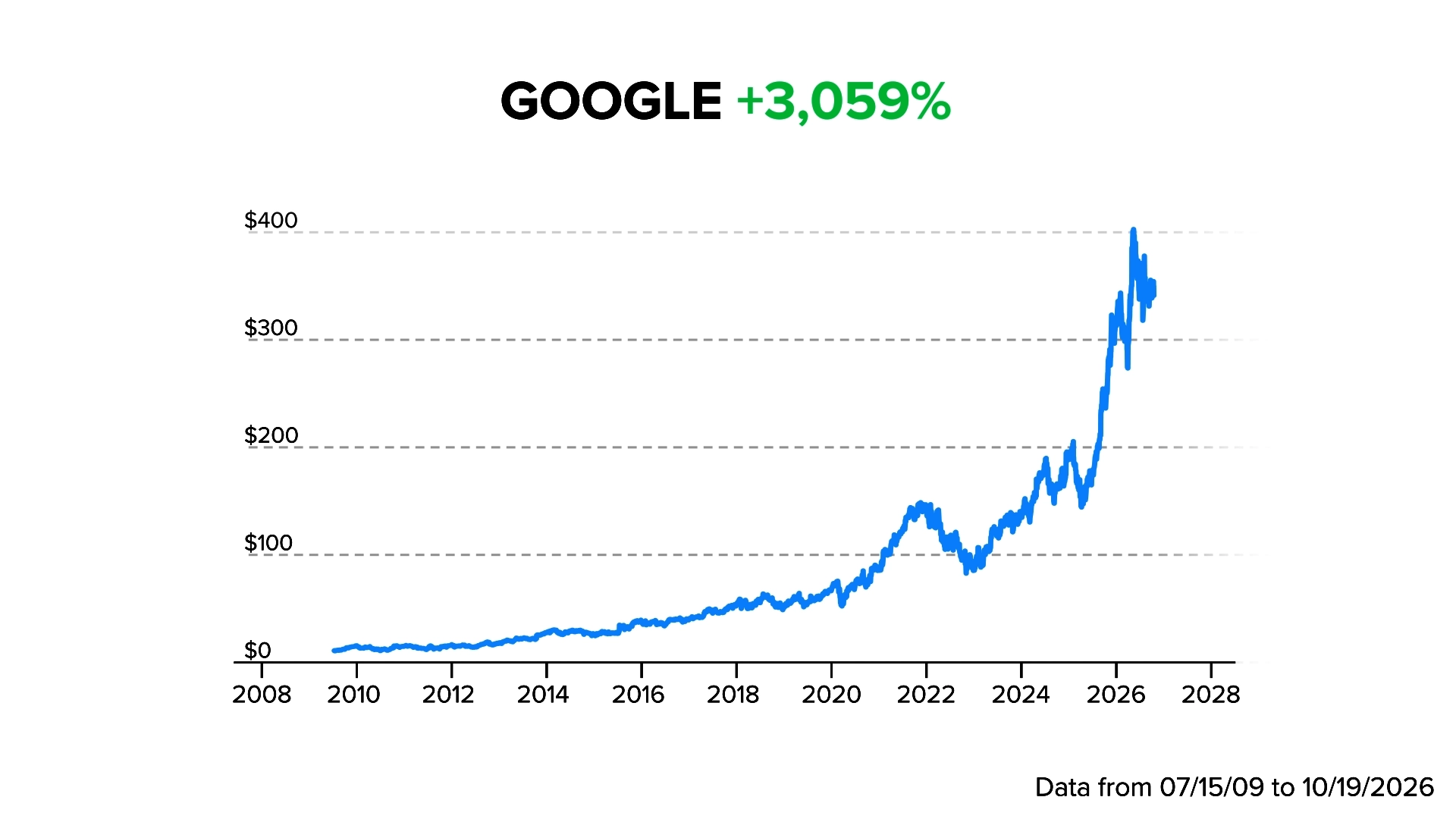
Chart refers to US market and dollars
Or Motley Fool US Booking Holdings pick back in 2004 (175X return) that revolutionized online travel as we know it.
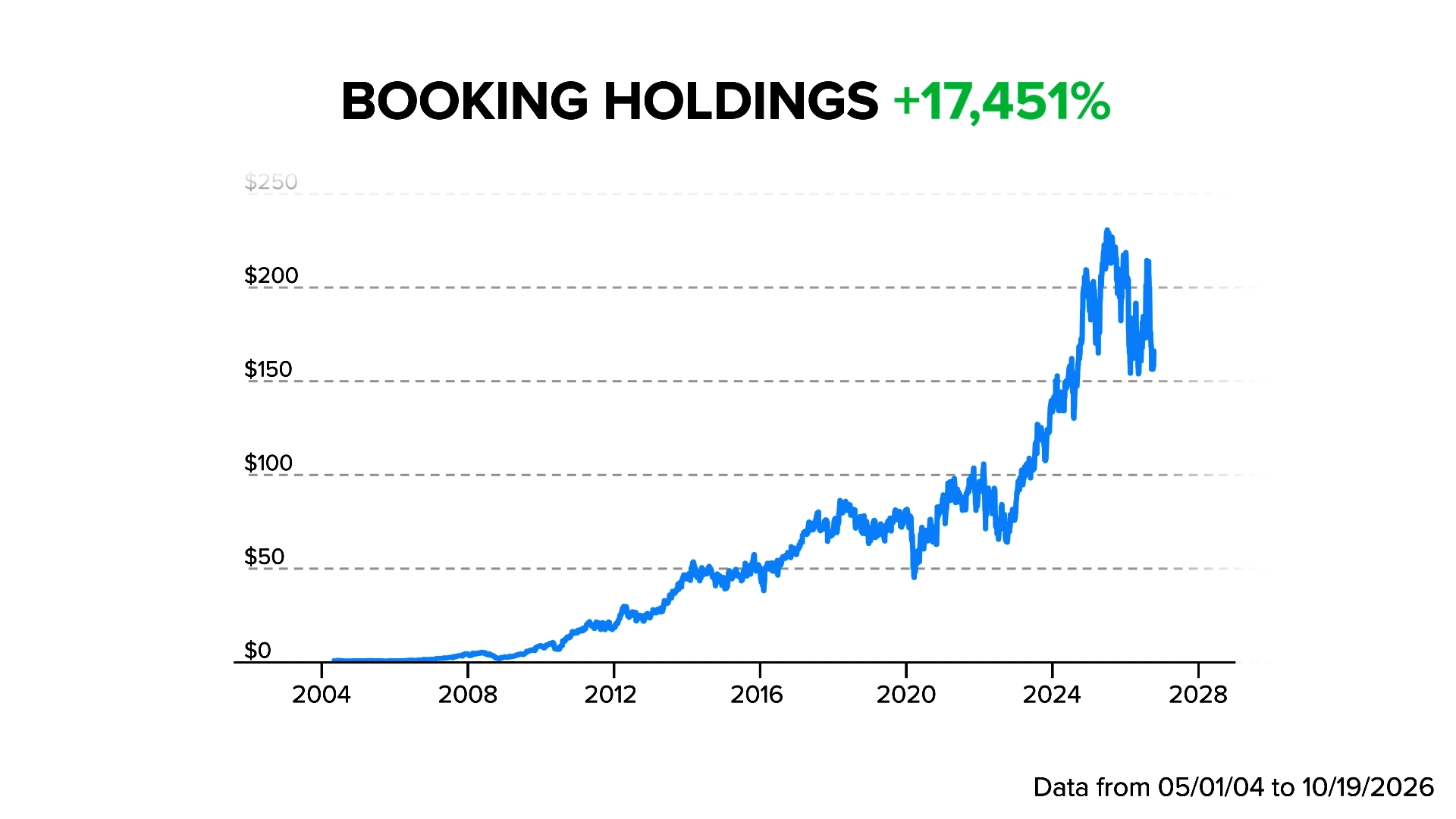
Chart refers to US market and dollars
There was certainly nobody on eCommerce earlier than The Motley Fool US was.
The Motley Fool US were on Amazon all the way back in 2002 (350X return), despite just coming out of the dot-com bubble…
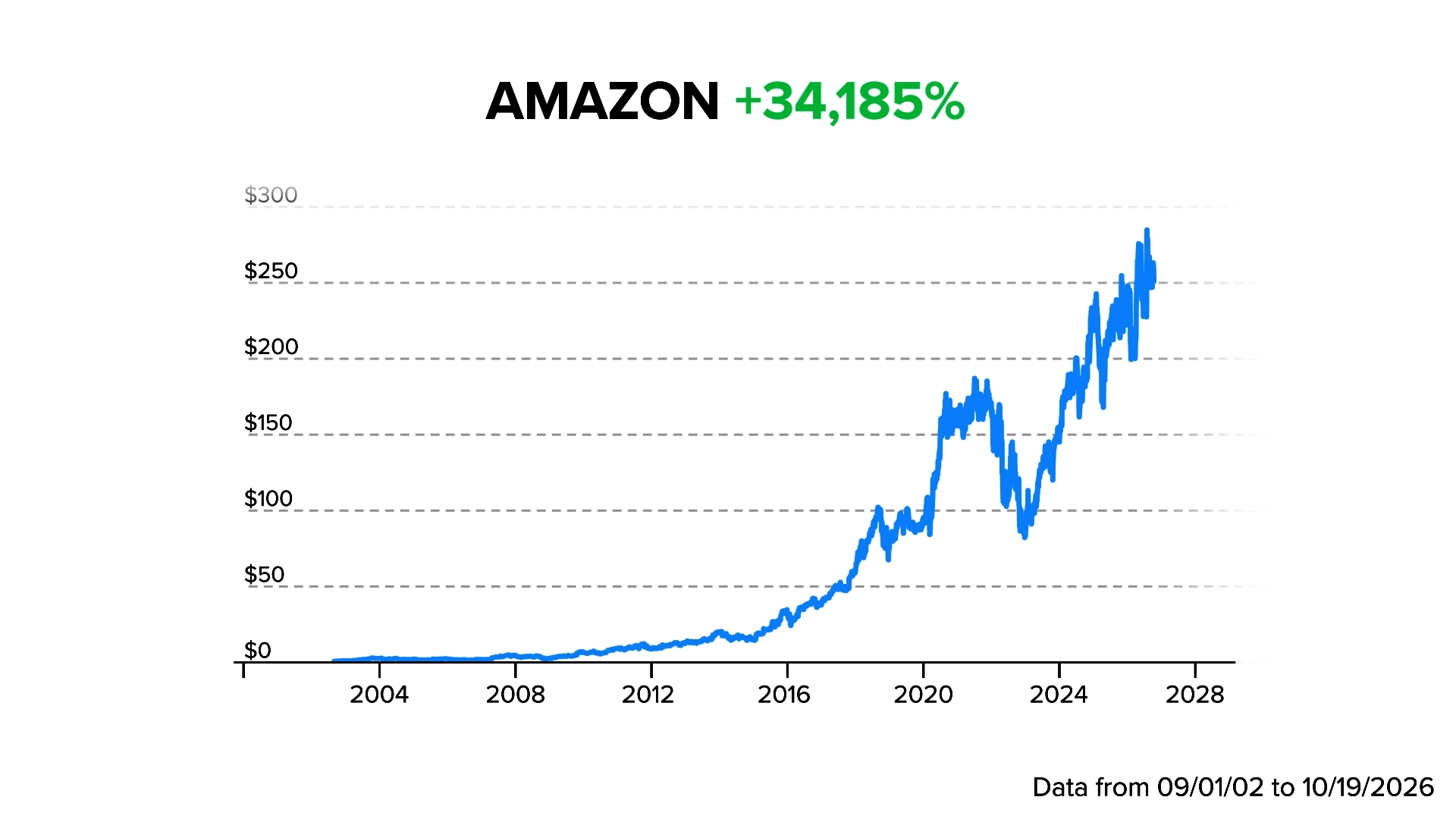
Chart refers to US market and dollars
Made a tremendously bold bet on the “Amazon of Latin America” in MercadoLibre all the way back in 2009 (130X return)…
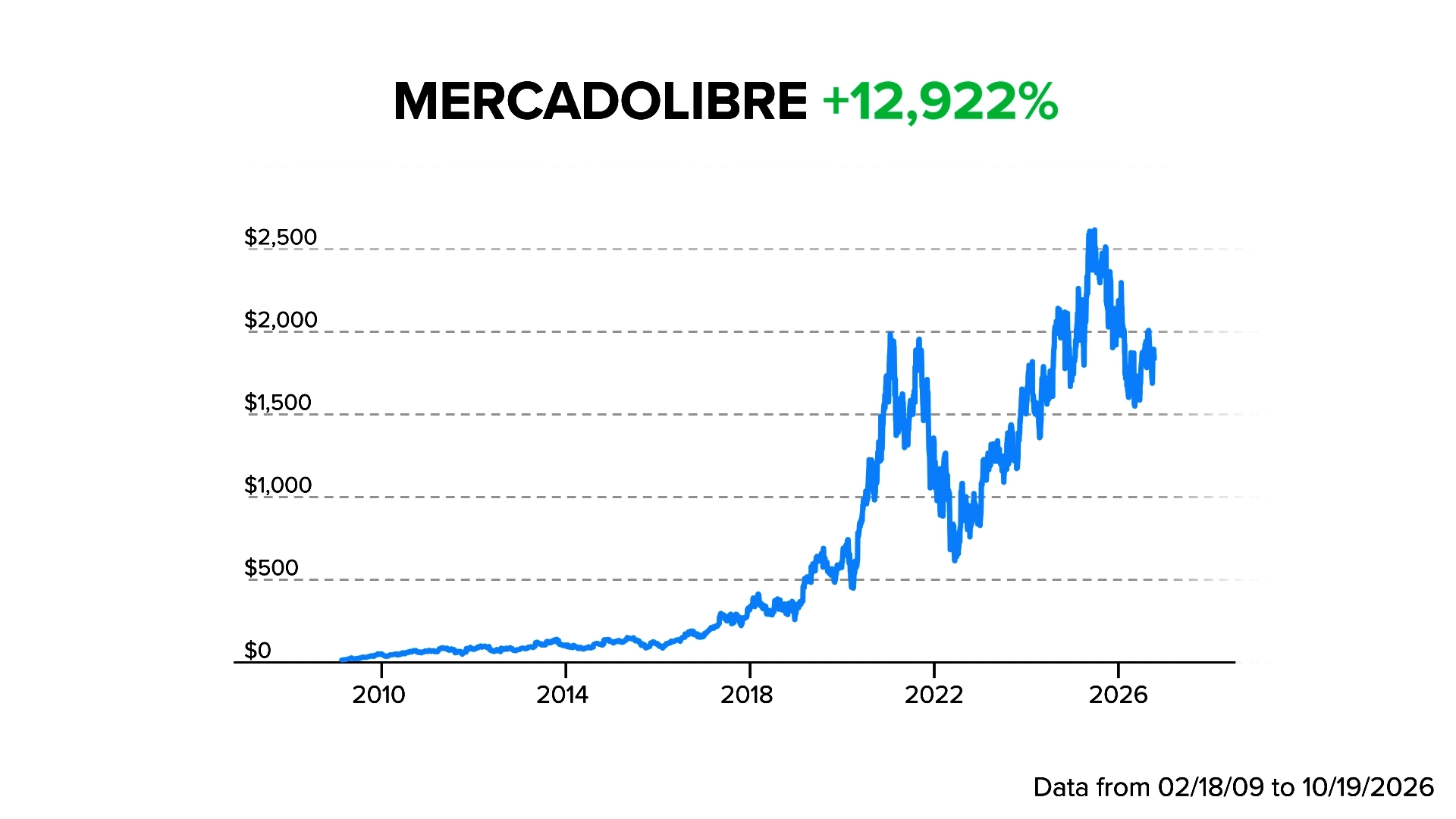
Chart refers to US market and dollars
And later went back for more with Shopify (81X return) back in 2016 when hardly anybody had ever heard of “the Canadian Amazon.”
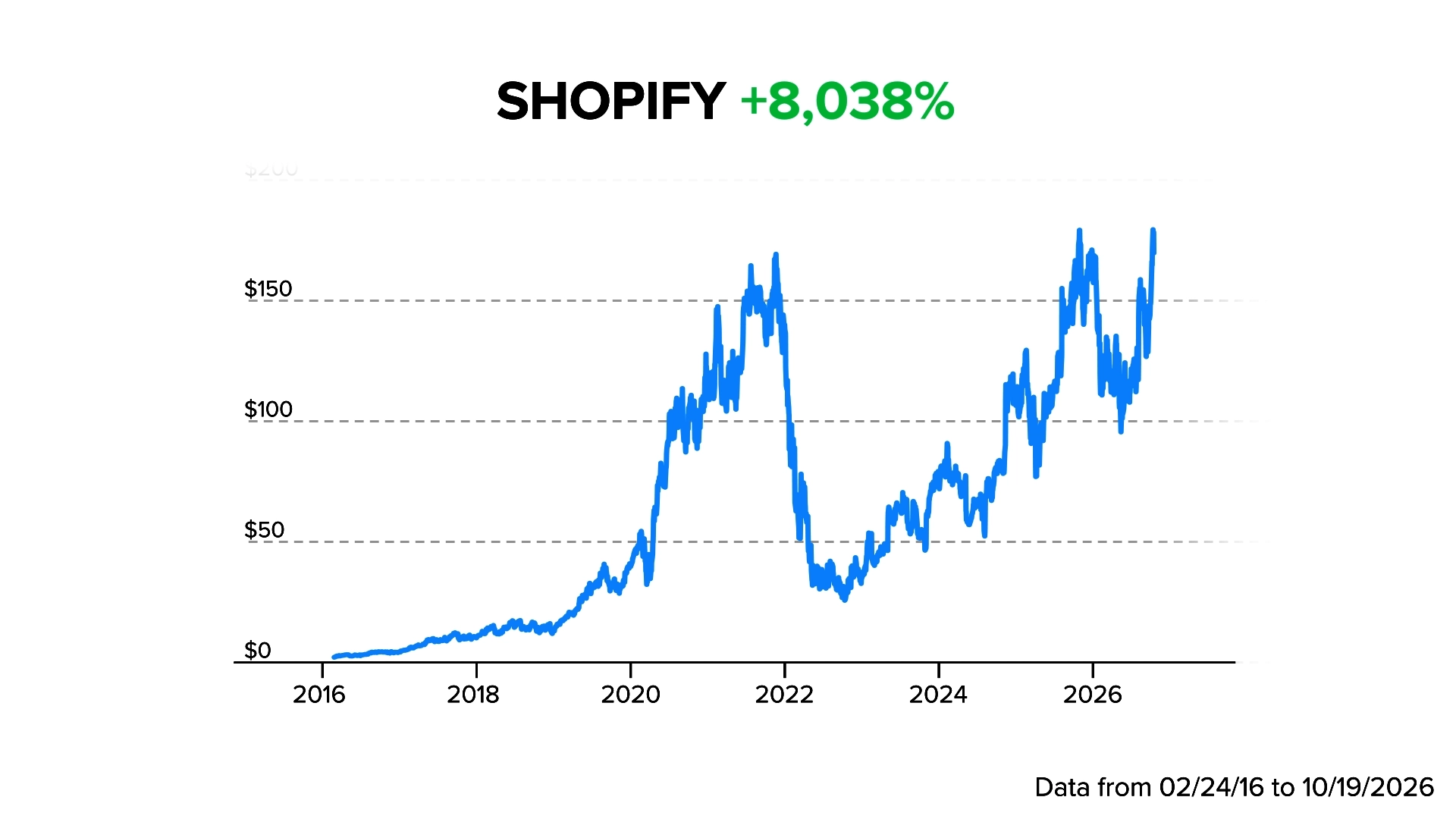
Chart refers to US market and dollars
You could argue that no single invention in recent memory has been bigger than the Smartphone, which we capitalized on with The Motley Fool US 2008 Apple recommendation (71X return).
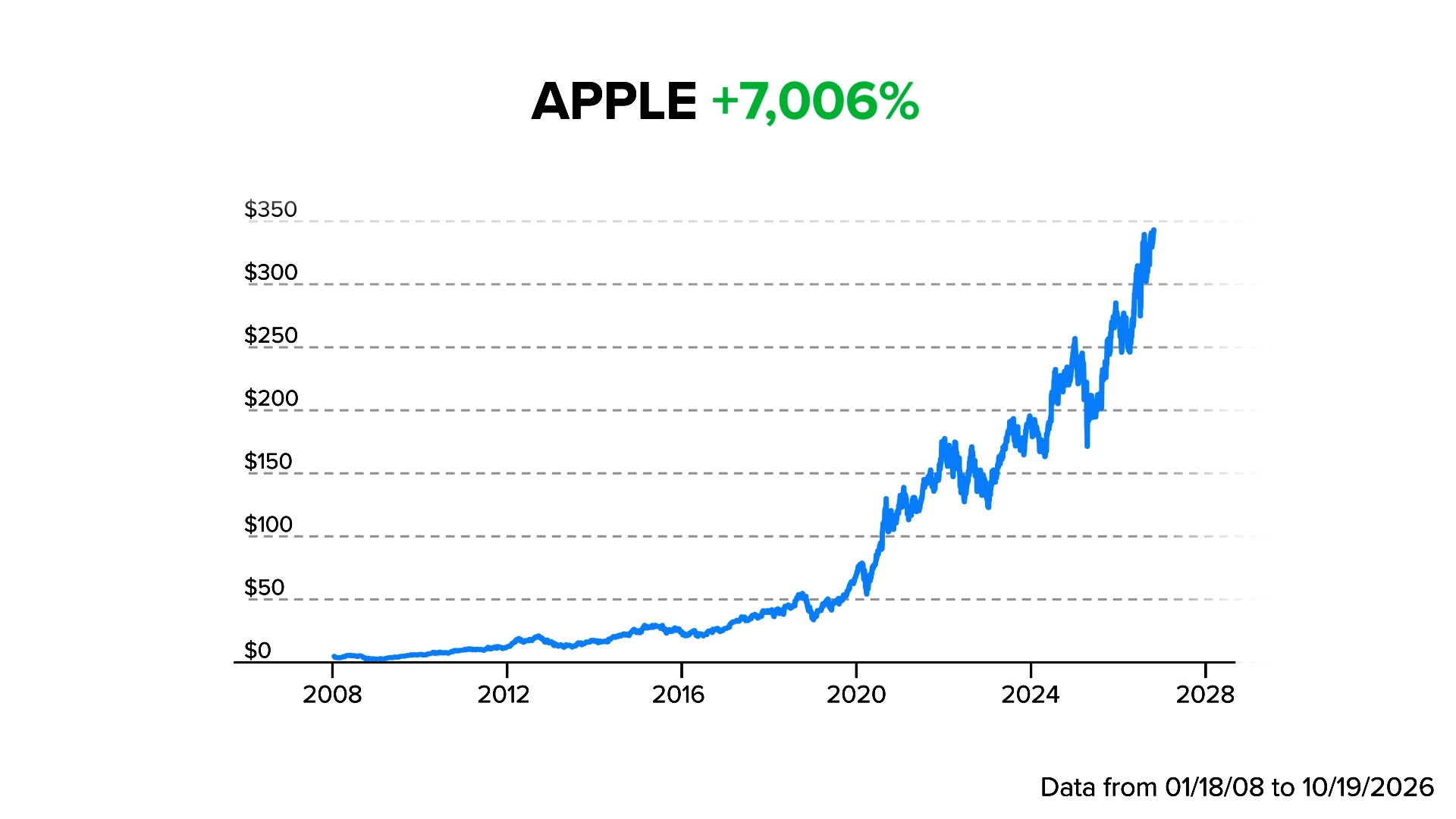
Chart refers to US market and dollars
And Apple’s mobile app buildout actually had a lot to do with the proliferation of Streaming Video, another megatrend the Fool US was way out in front of.
It’s hard to imagine anybody was on Netflix (299X return) earlier than The Motley Fool US back in 2004, even ahead of their move to streaming video.
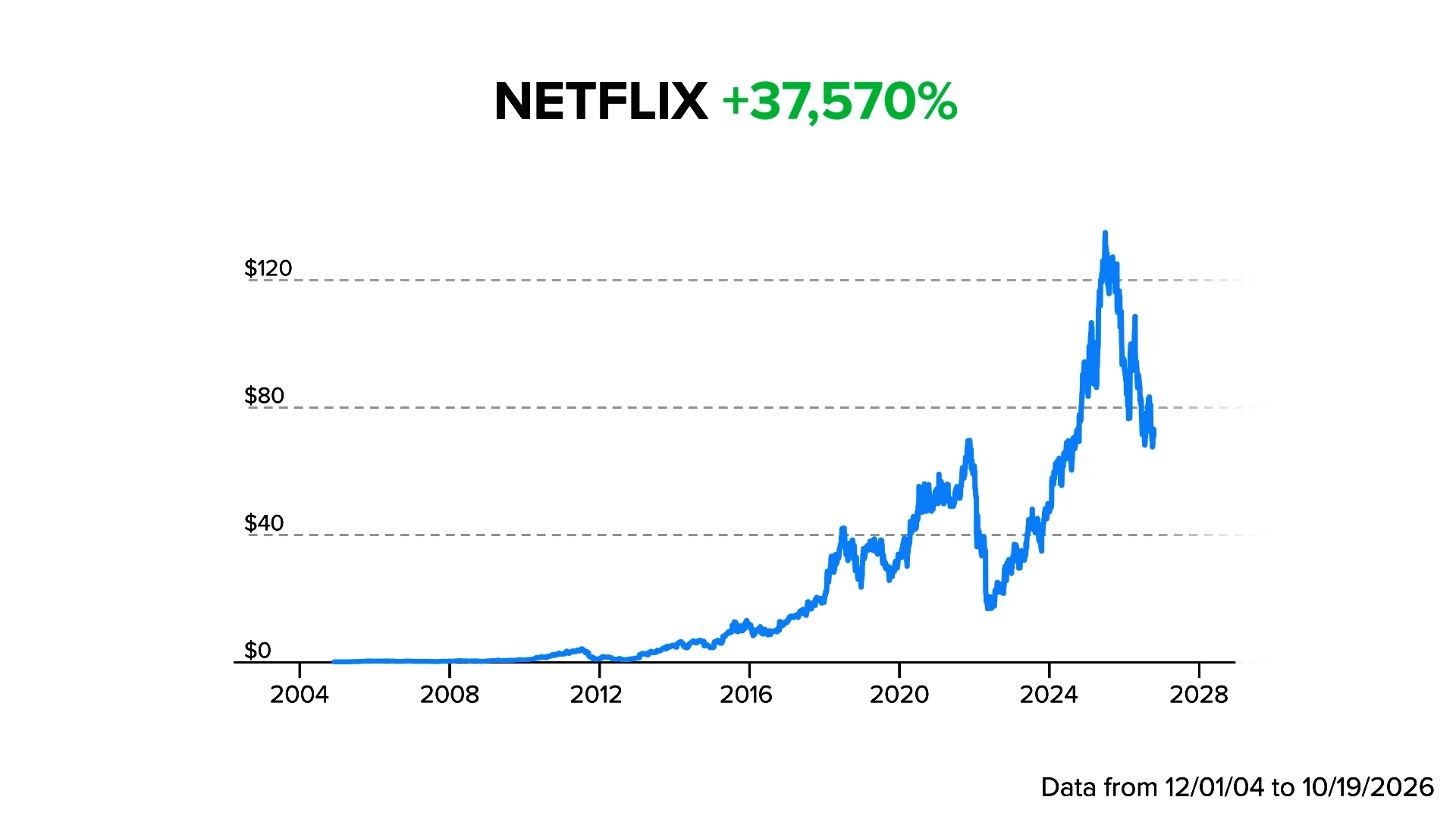
Chart refers to US market and dollars
Not to mention the rise of Social Media, which altered the way we communicate with each other on a daily basis.
Meta — Facebook back then, of course — being the obvious one here, which The Motley Fool US originally recommended back in 2012 (30X return).
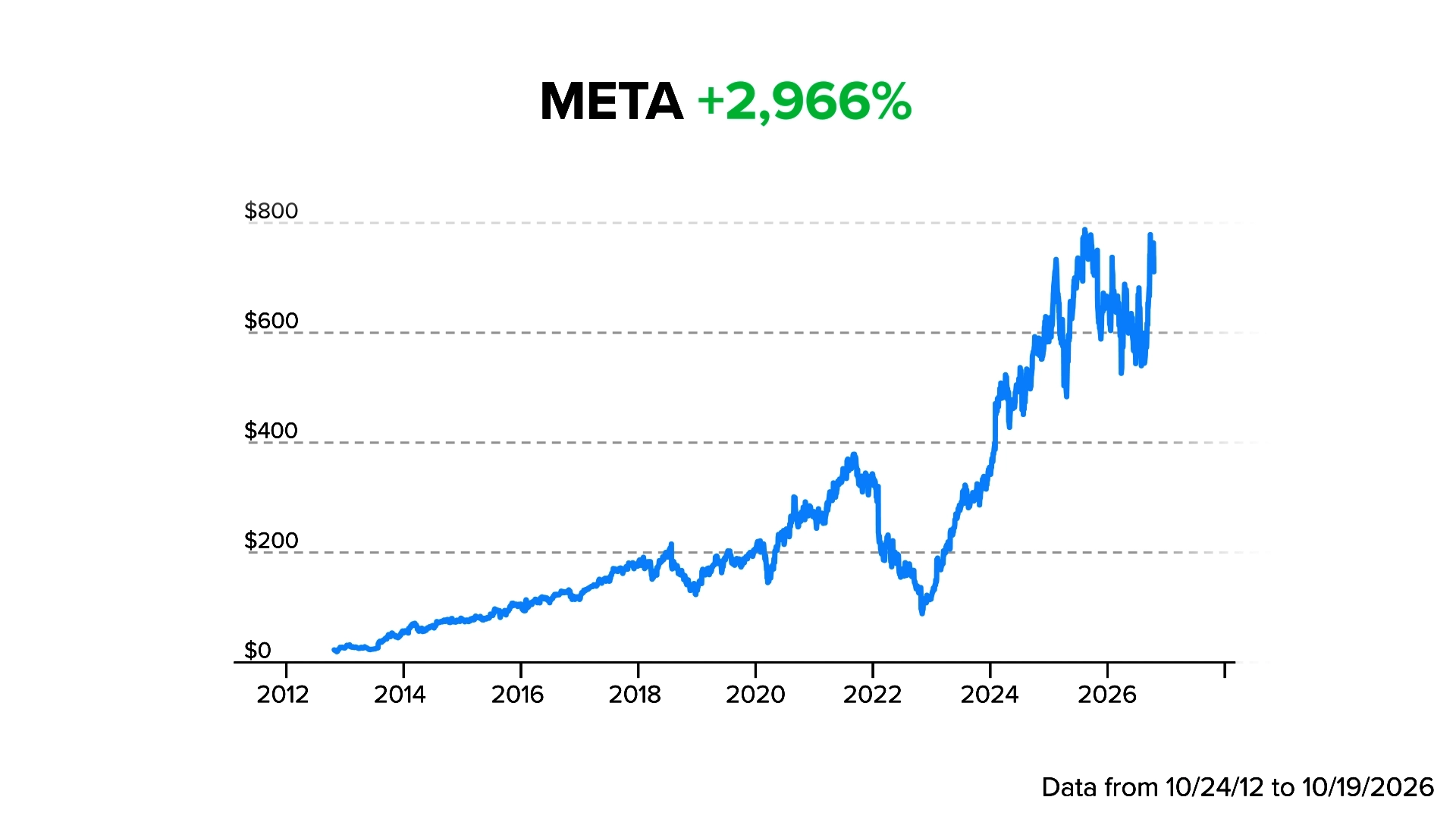
Chart refers to US market and dollars
Of course, all of this internet usage inevitably birthed Cybersecurity to thwart bad actors from stealing your information…
Think about CrowdStrike (8.5X returns)… Fortinet (21X returns)… and even Palo Alto Networks (30X returns)
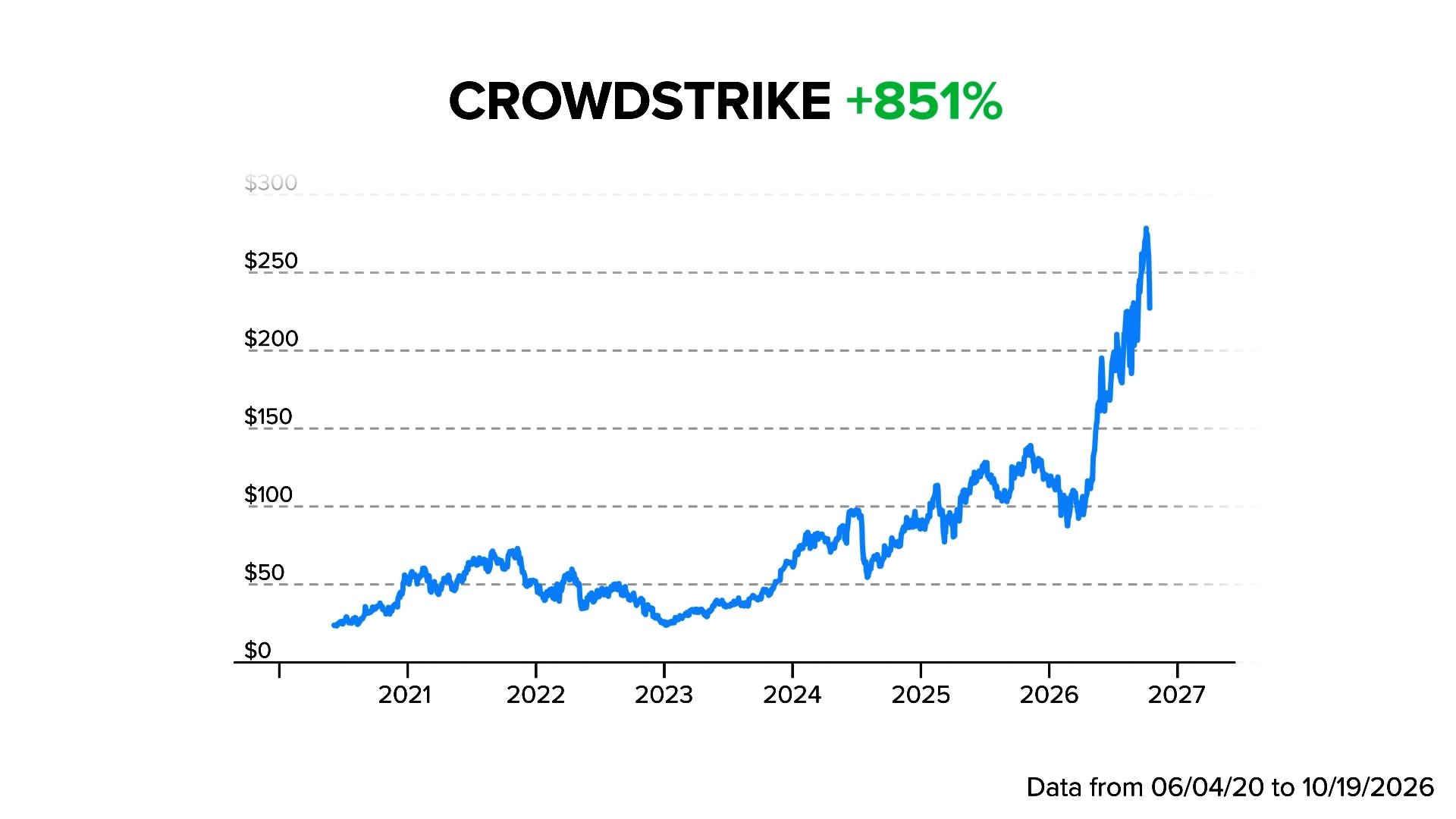
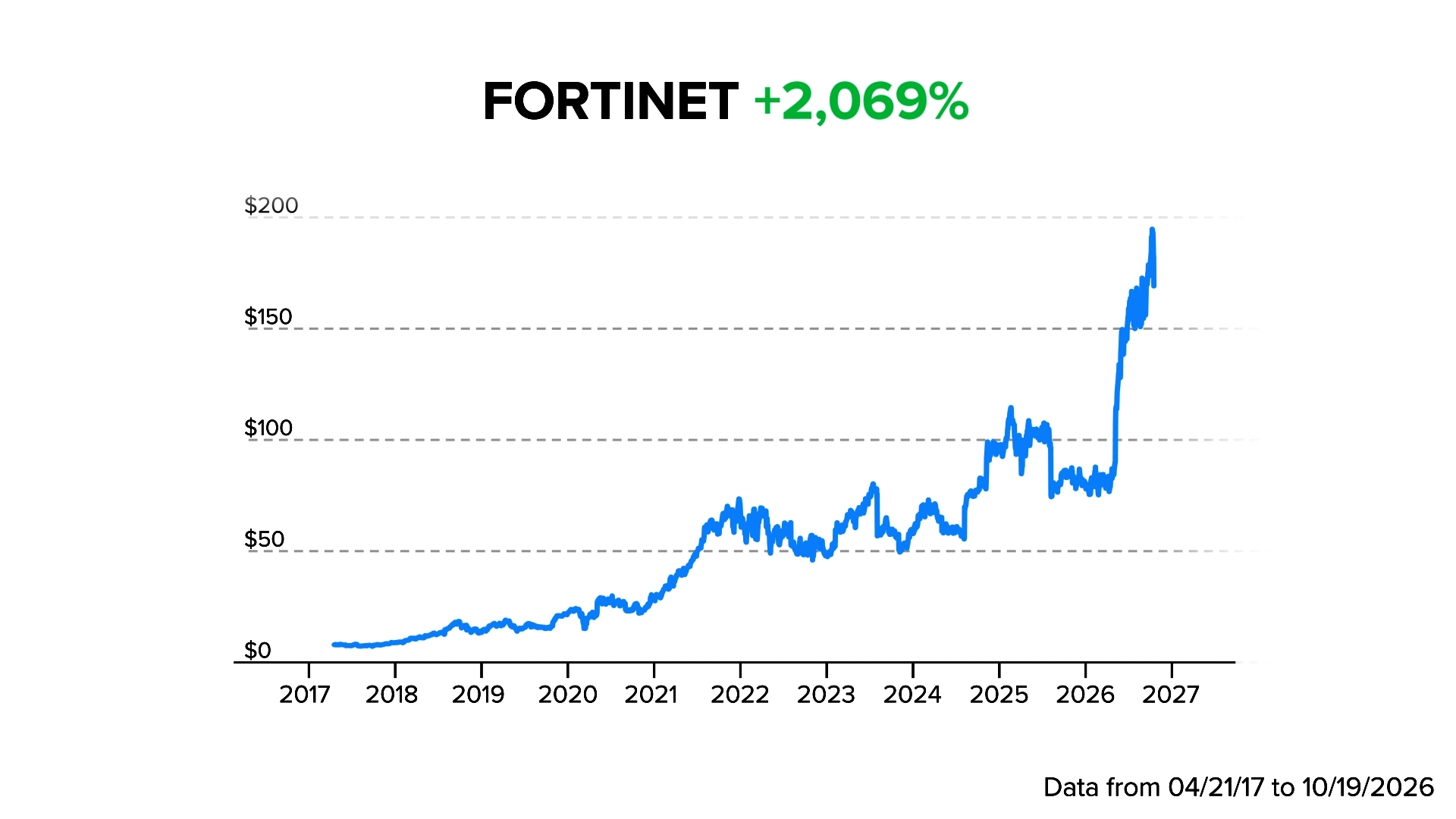
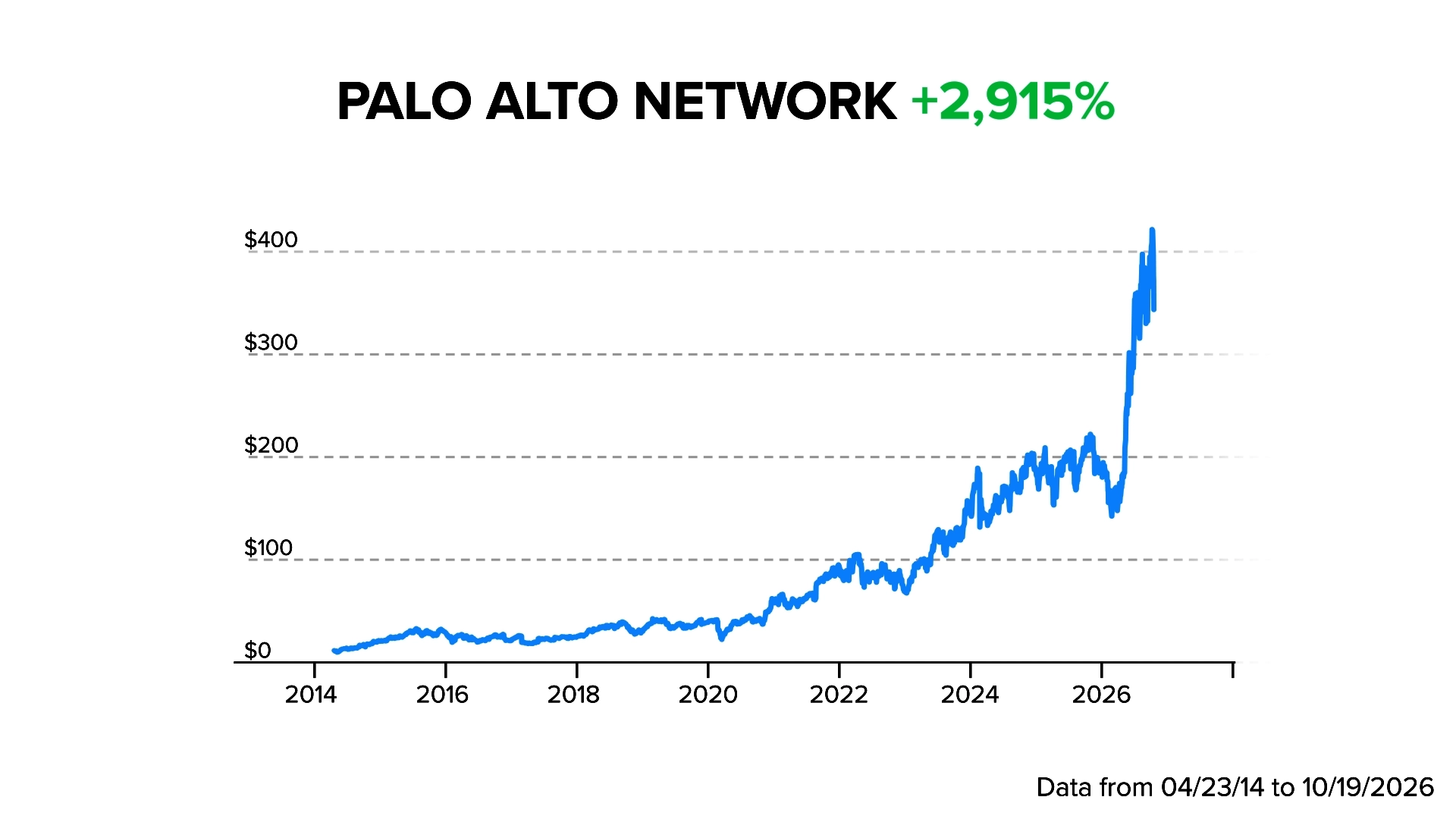
Chart refers to US market and dollars
The list goes on and on.
(Of course, not all of our picks are winners and past results don’t guarantee future outcomes.)
Pardon the victory lap, but I’m doing it for two important reasons:
- Every time there’s been a generational technology shift, Motley Fool members who followed our guidance from the outset have likely profited on our top recommendations for that emerging megatrend.
- Tom Gardner believes “This one will be the most dramatic of all, not just in our lifetime but in human history.”
In fact, he doesn’t even think it’ll be close…
“I believe all that we’ve experienced in the 33 years of Motley Fool history, all of it combined, is about to be dwarfed by where we’re heading together. And where we’re heading is to a place called Artificial General Intelligence.”
— Motley Fool CEO, Tom Gardner
But make no mistake…
Tom isn’t some Johnny-come-lately to the importance of AGI.
As I alluded to earlier, he’s been quietly laying the groundwork for this exact moment to arrive for years now…
In fact, Tom’s spent tens of millions of dollars worth of Motley Fool capital to build out our proprietary AI-scoring systems…
And he’s continued to iterate on them tirelessly, day in and day out.
(Quite successfully, as you’ll see shortly.)
The return on investment, in Tom’s eyes? “So far, I can’t even see a dollar that I wish I hadn’t invested.”
And you can see why, considering our ever-evolving AI systems directly led Tom to recommend all of the following stocks:
Intel at US$20.37 in May 2025 (Up 463%)
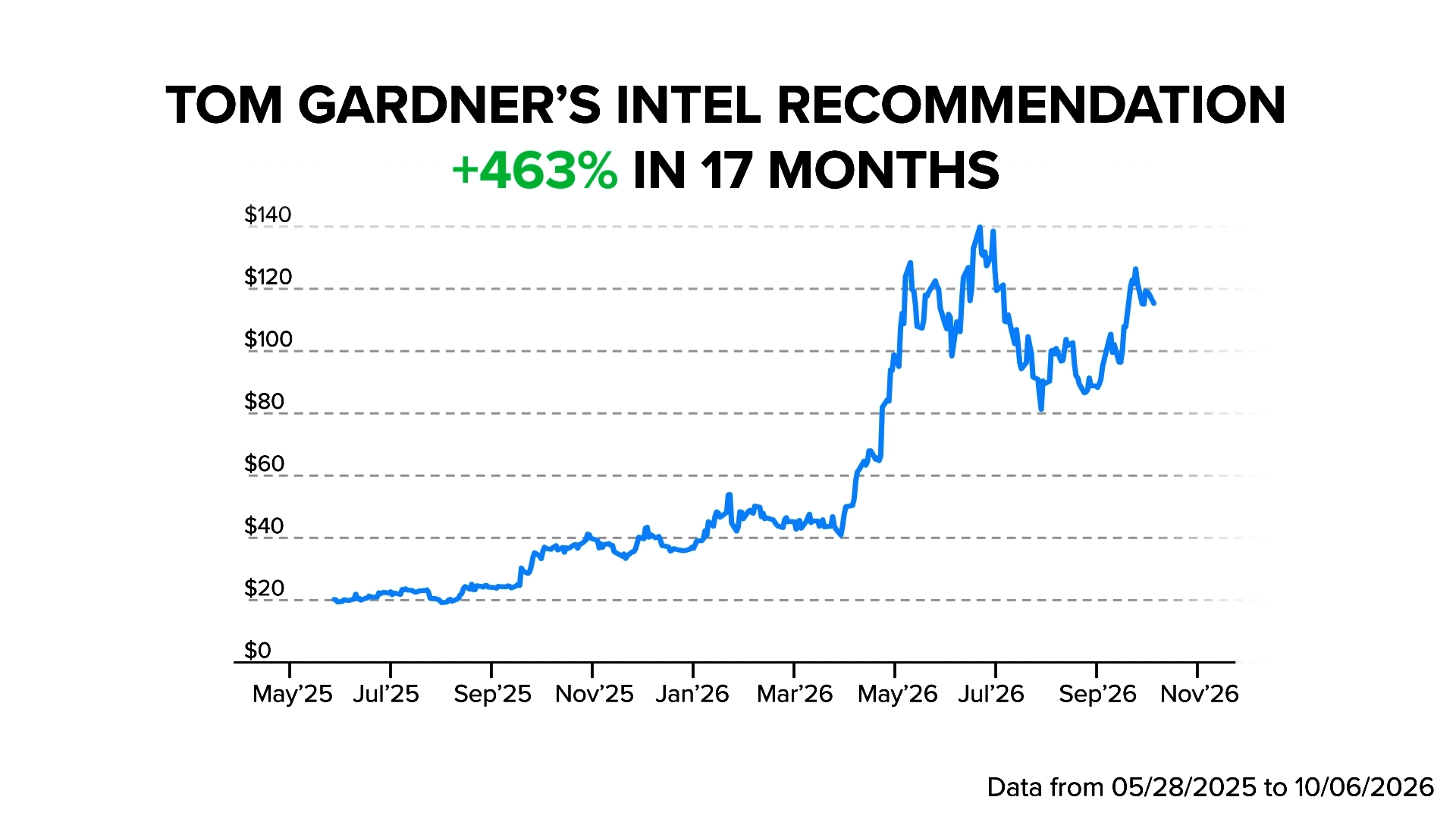
Chart refers to US market and dollars
Moderna at US$24.15 in Nov 2025 (Up 682%)
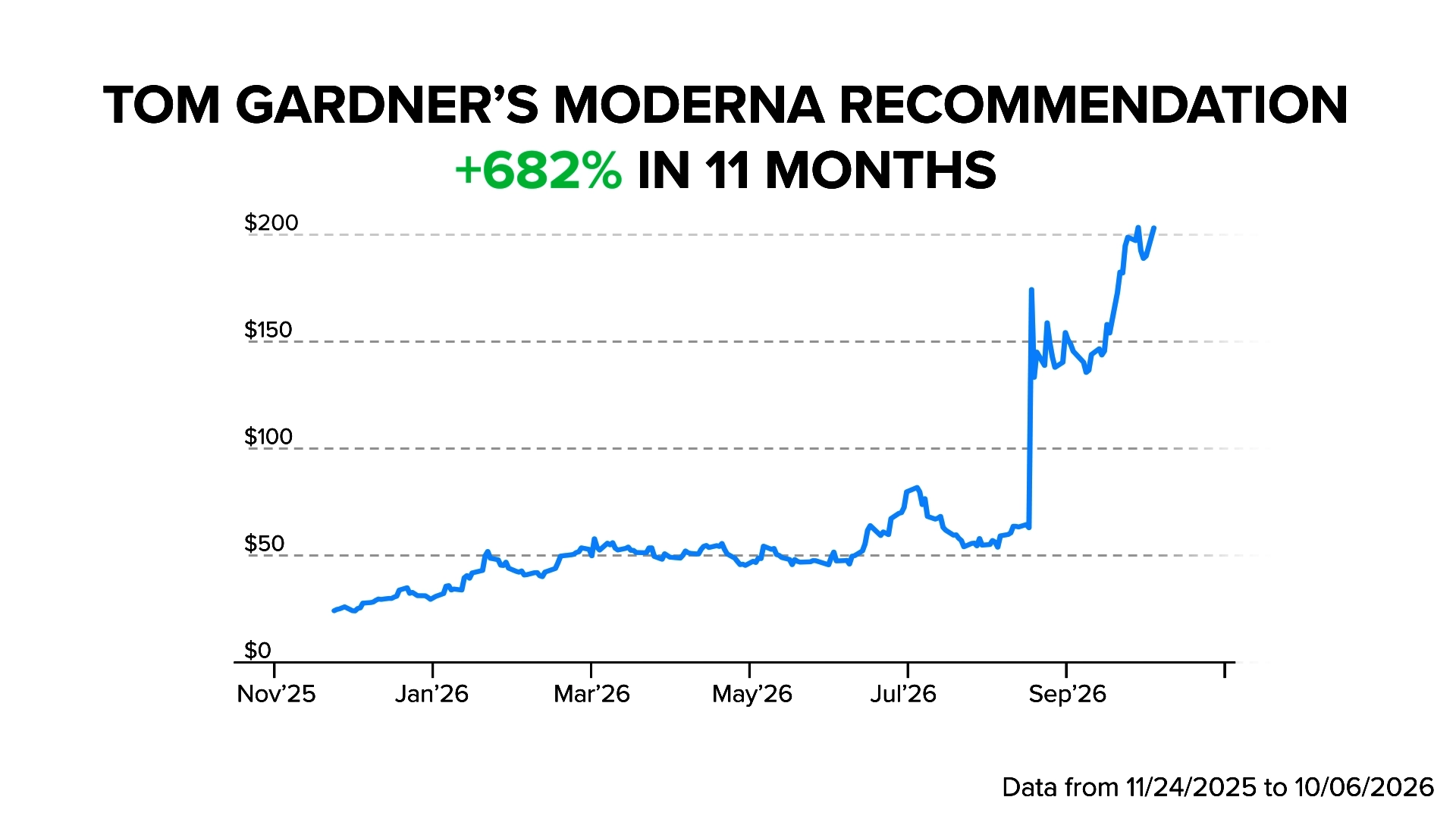
Chart refers to US market and dollars
CrowdStrike at US$67.18 in Sept 2024 (Up 302%)
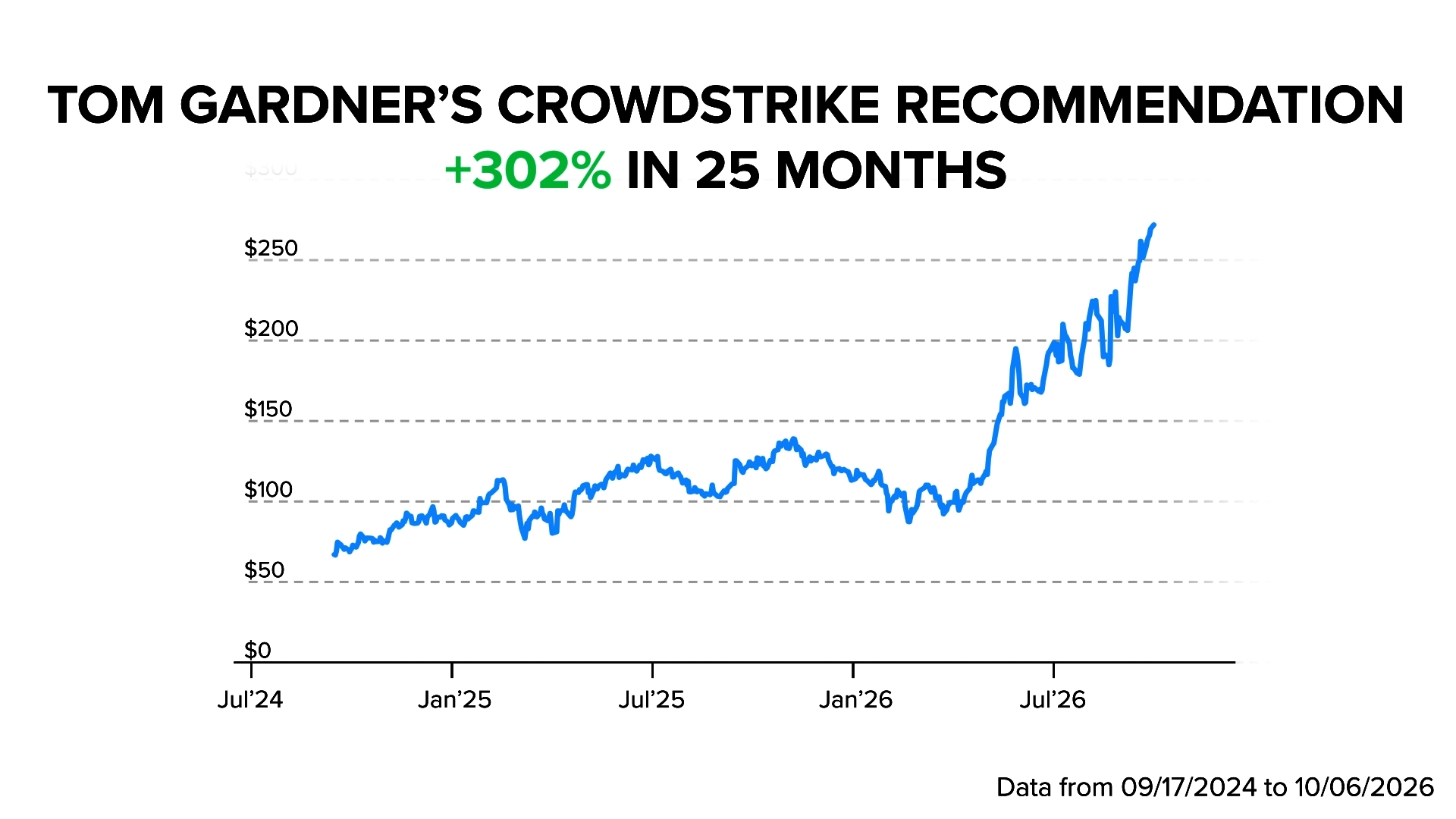
Chart refers to US market and dollars
Sezzle at US$21.32 in August 2024 (Up 430%)
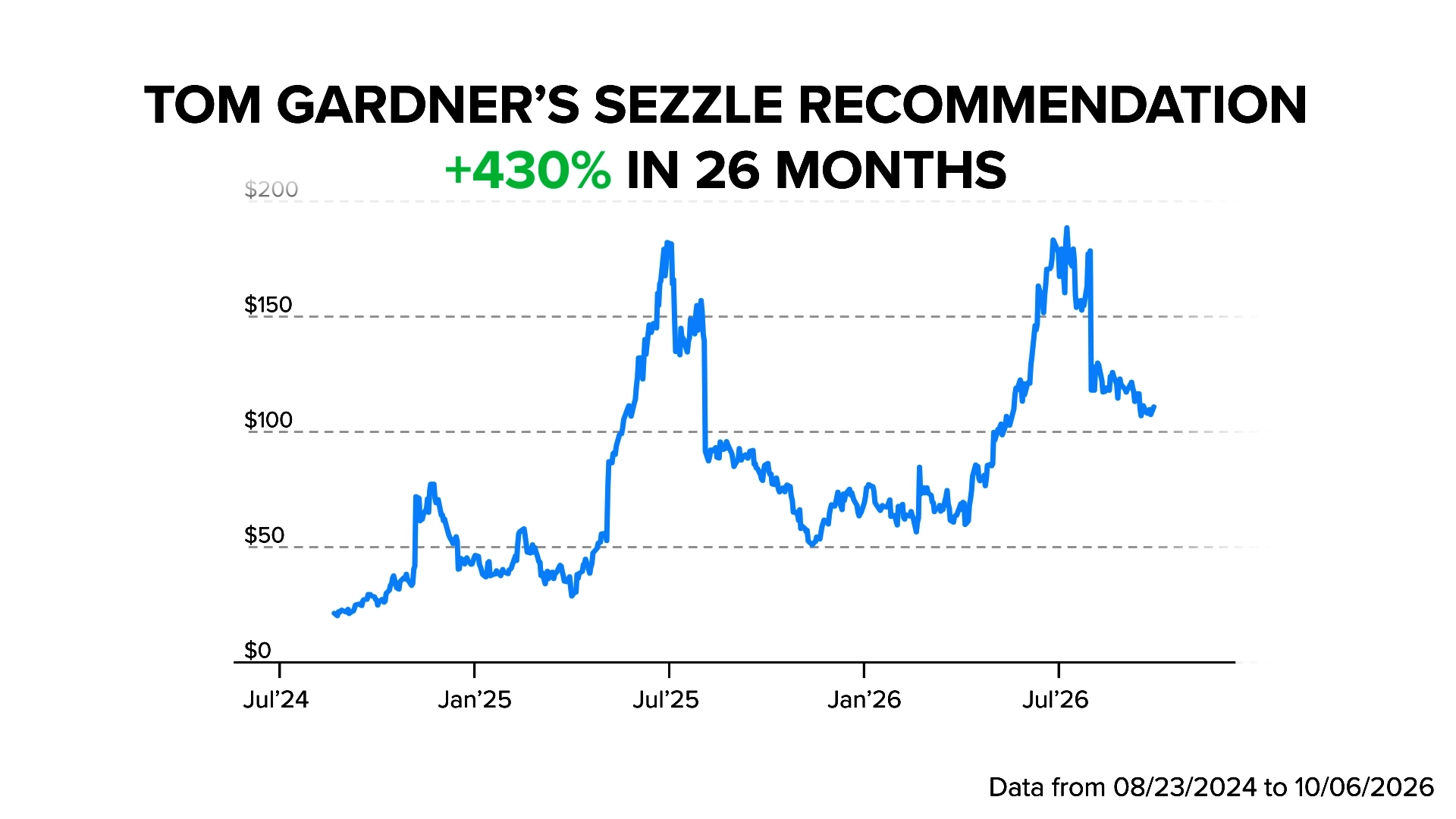
Chart refers to US market and dollars
Paysign at US$2.36 in April 2025 (Up 519%)
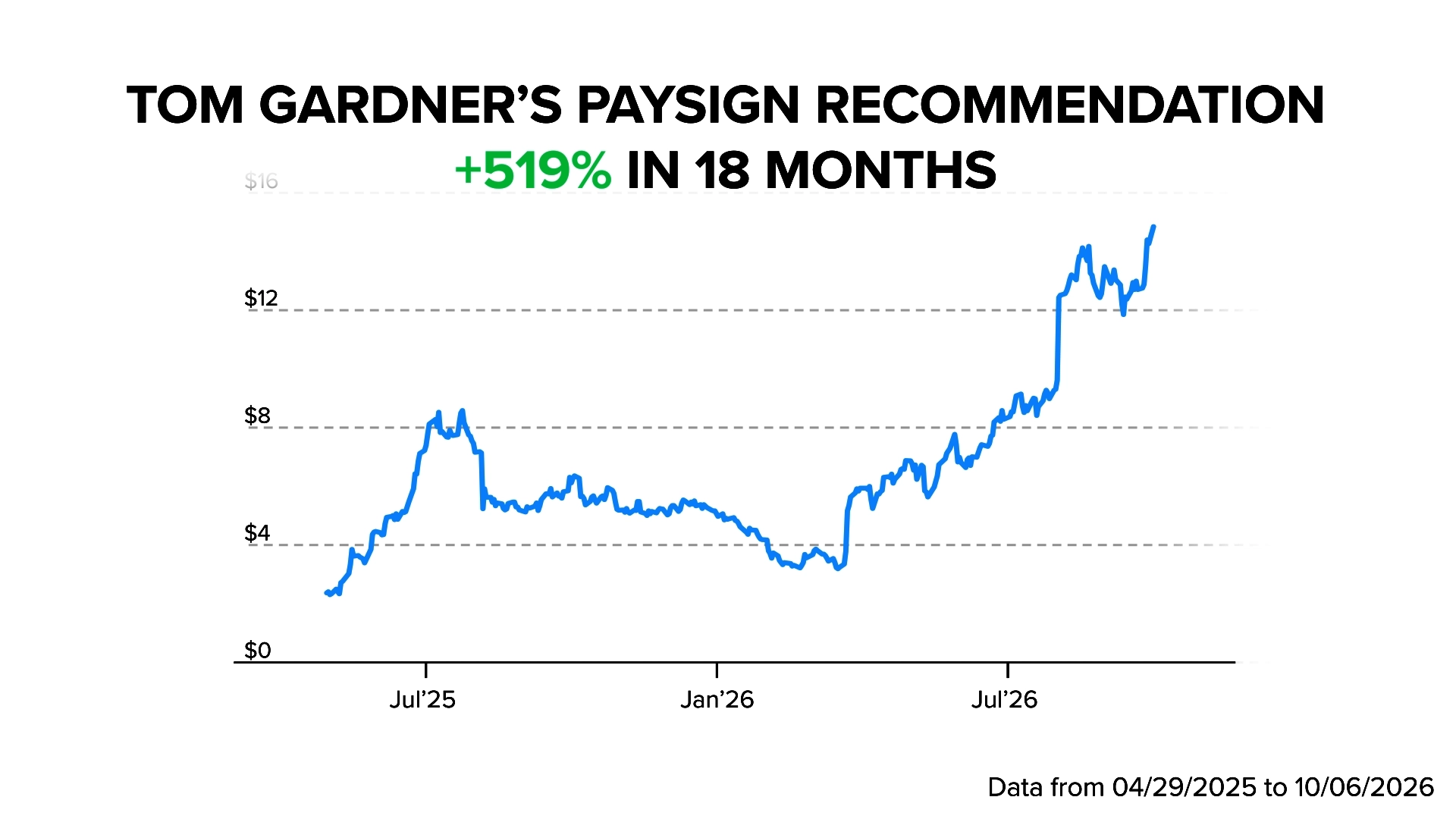
Chart refers to US market and dollars
Respectively, that’s 5X. 7X. 4X. 5X. 6X.
And all within the past couple years or so.
Precisely the timeframe over which Tom really hit the gas on pouring investment dollars into our proprietary AI-scoring systems.
Coincidence? I think not.
And lest you think we’re just cherry-picking winners… get a look at this!
The overarching returns from pretty much all of the AI-powered investing solutions The Motley Fool US launched over the past year or so have largely been astounding.
The US Microball Portfolio: +70% since April 2025, up 20 percentage points on a white-hot market over the same time period.
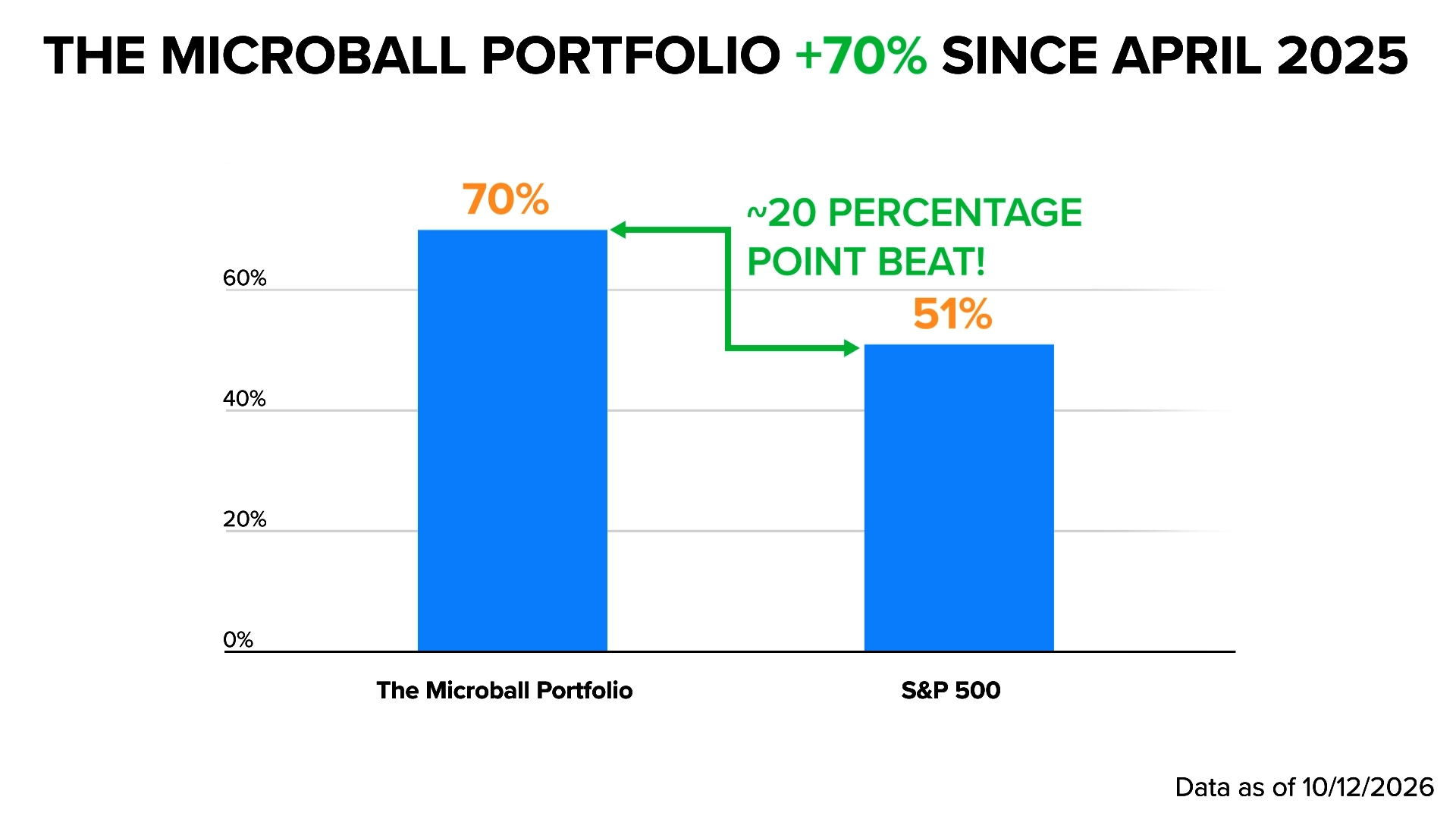
Chart refers to US market and dollars
US Quantum Leap: +52% since November 2025, more than 3X the market over that time.
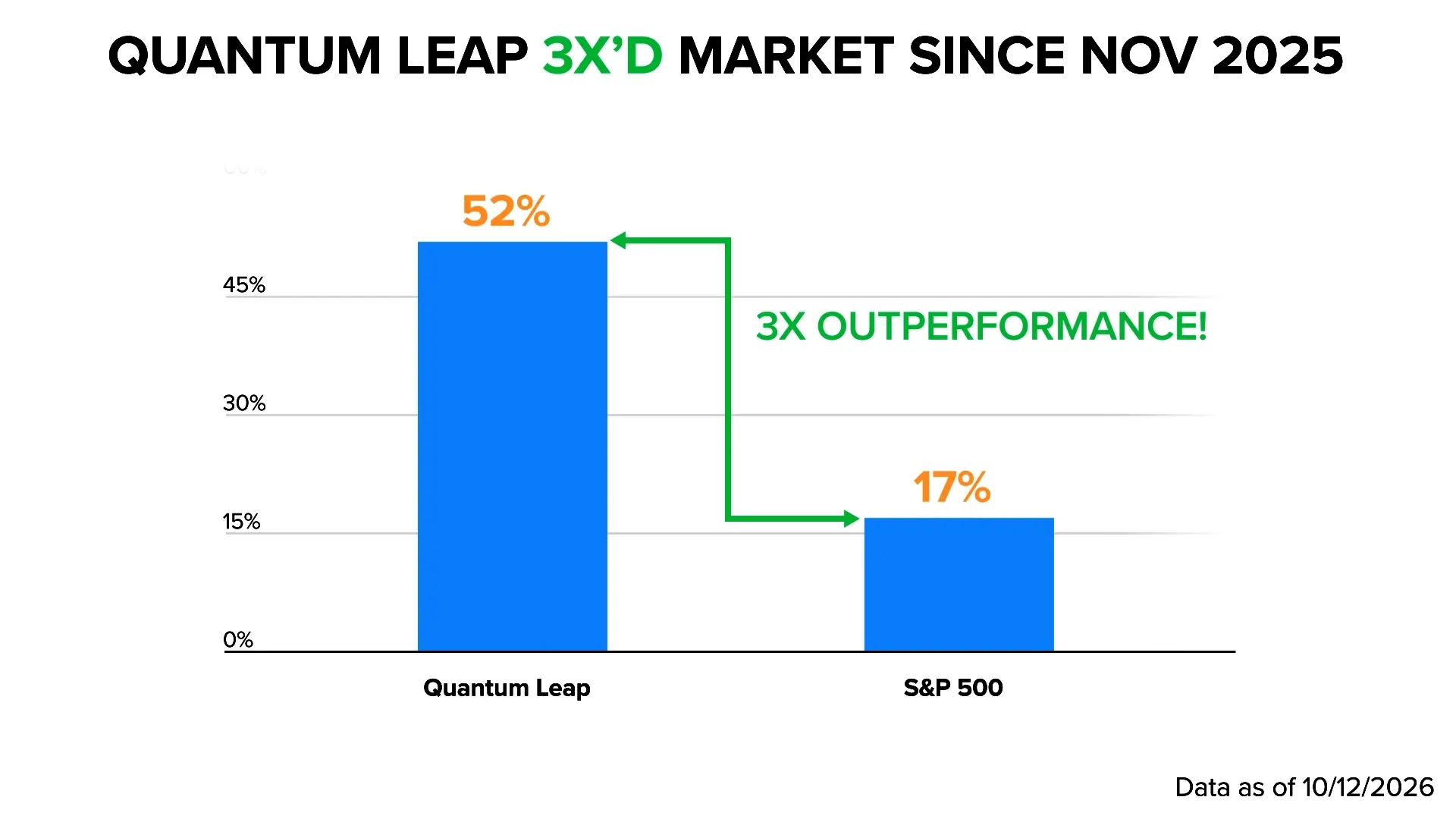
Chart refers to US market and dollars
US Data Center Superstars: +31% since January 2026, basically 2X the market.
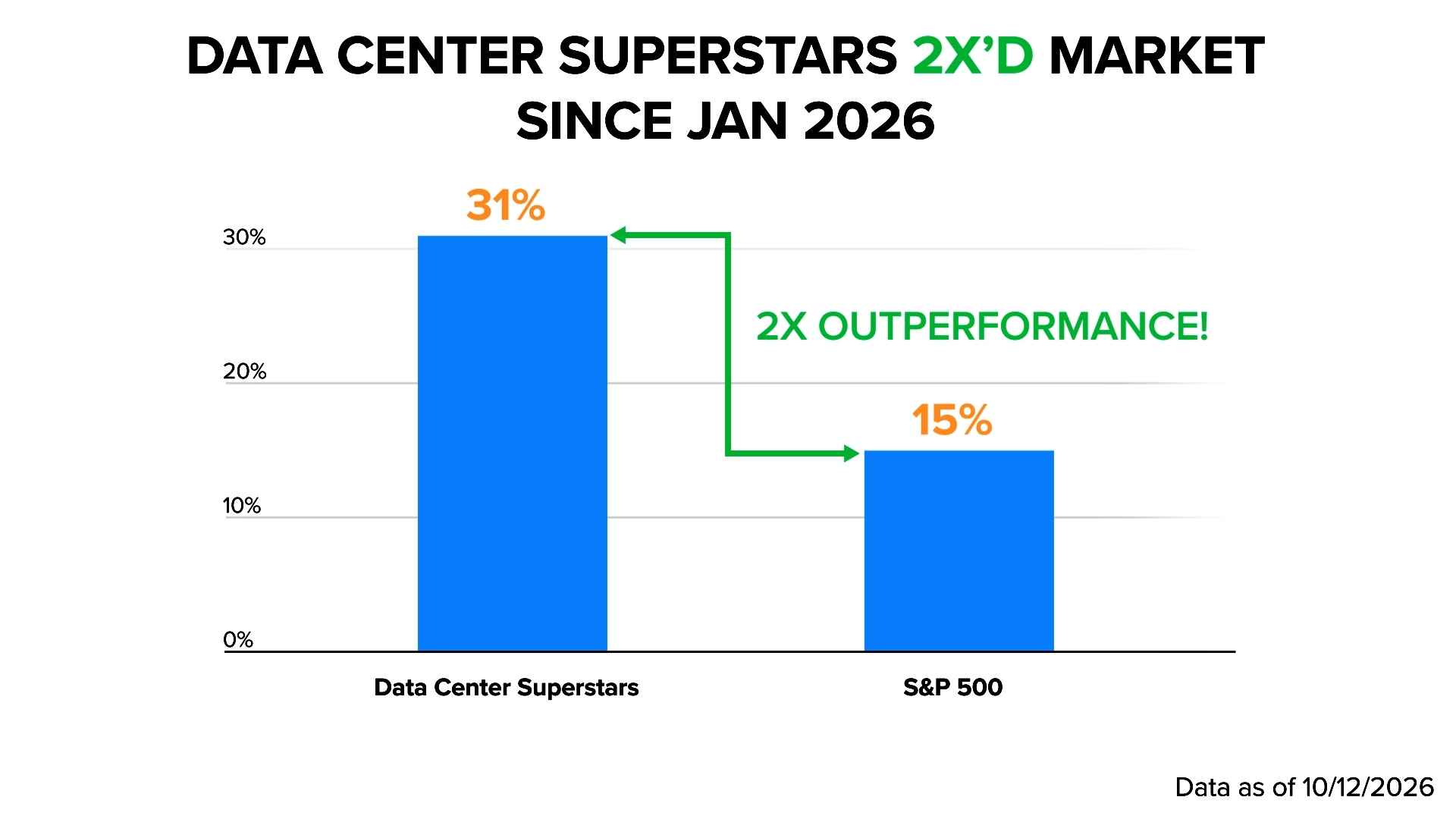
Chart refers to US market and dollars
US Space Race: +16% since February 2026, beating the market by 2-3 percentage points despite a recent pullback.
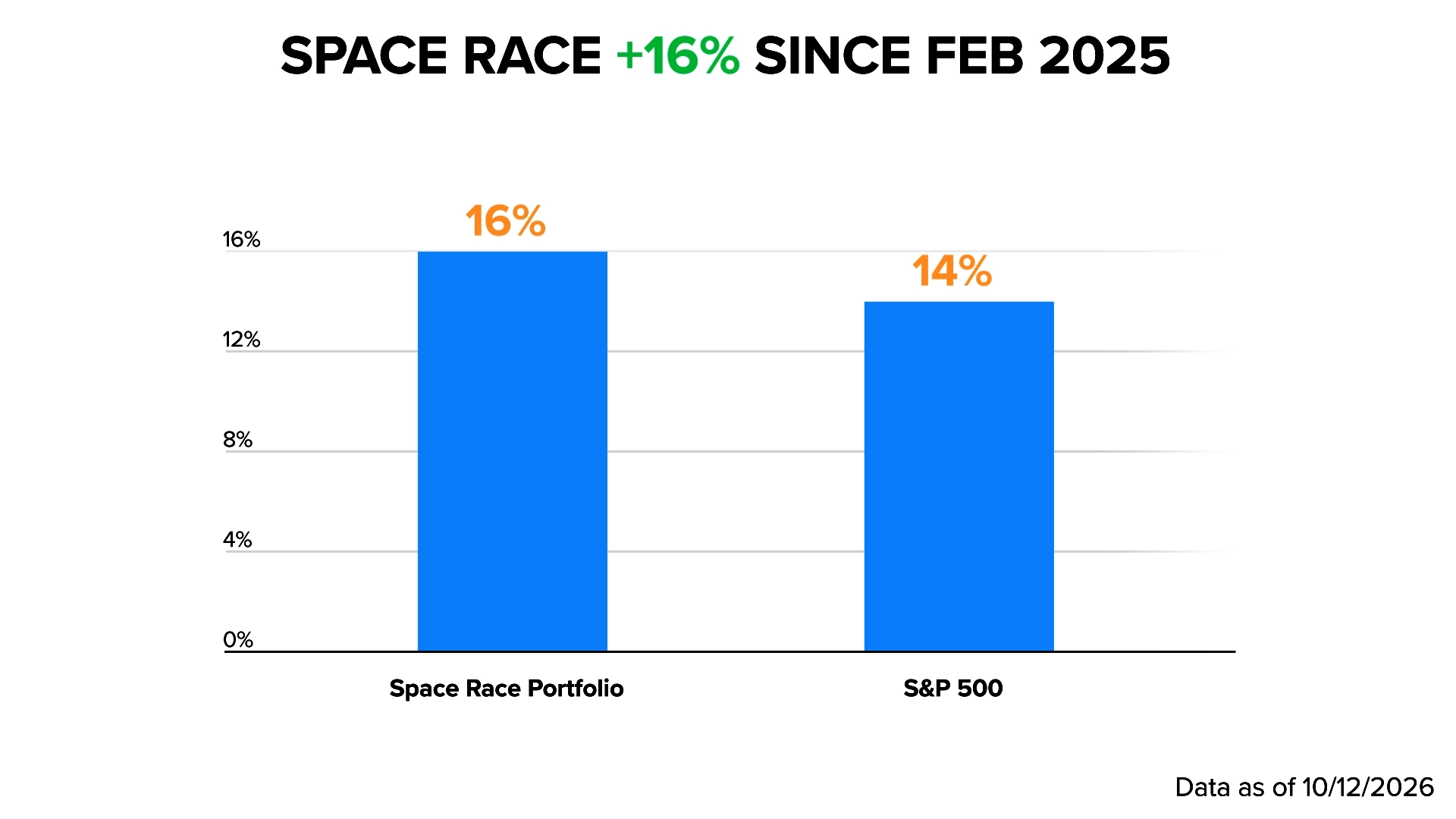
Chart refers to US market and dollars
US Health AI: +25% since May 2026, also more than 3X the market over the past half year.
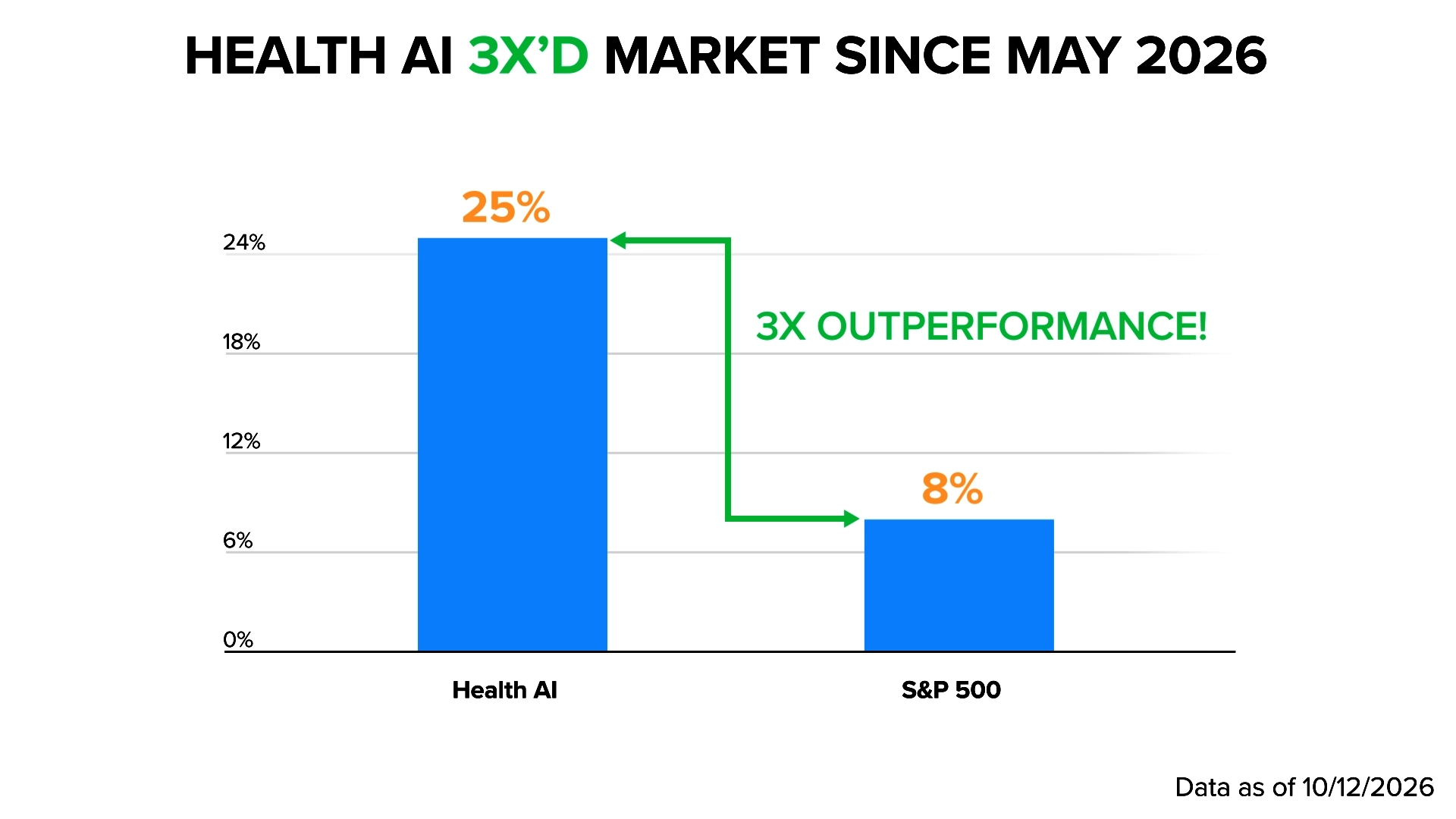
Chart refers to US market and dollars
And here’s the truly exciting part…
Tom recently stated, “These tools are picking up skills that no one has taught them. Finding patterns that none of us have seen.”
Basically, we think our AI scoring systems could soon be at the point where they can teach themselves how to improve.
“I don’t honestly know where we’ll be in a year, but I think we’re gonna be at least five times smarter with our systems than we are now.”
— Motley Fool CEO, Tom Gardner
Now, as we’ve said before, not all recommendations will be home runs and we’ve had plenty of losers as well.
Now, we’ve fully pivoted these proprietary systems to focus on the new AGI world…
Over the past two months since Jensen Huang announced his belief in the arrival of AGI, we’ve been hard at work behind the scenes.
In that time, we’ve used our proprietary AI systems to score upwards of 2,800 public stocks based on an “AGI Score” that shows our view of their readiness… or lack of… for the new AGI era.
After all, I’ve gone to great lengths to emphasize that Tom believes the winners from an AGI world will be totally different from those in a pre-AGI world.
“I don’t think the winners are just going to use this (AGI). I think they’re going to rebuild their organizations around it. And we can follow the companies that are doing just that in the public markets.”
— Motley Fool CEO, Tom Gardner
But it brings us to an extremely important question today…
What are the “7 Traits of an AGI Leader” Tom Gardner has identified?
Feel free to have a thorough read through all seven of these unique AGI traits, if you’d like.
(I’ll admit I was flat-out floored when I saw No. 6 — not something you’d have expected from The Motley Fool!)
Or if you just want to get to the part about how Tom’s planning to allocate that US$2.5 million slug of capital, you can go ahead and scroll down to the following section.
AGI Era Winner Trait No. 1
Revenue Per Employee
For a century, business has followed an iron law: If you want to sell more, you hire more. More salespeople, more engineers, more HR people, and ever-more managers to manage them. Growth and headcount marched in lockstep.
At long last, AGI seemingly breaks that law.
Tom believes the winners of the AGI era will deliver massively more output while their labor costs actually fall.
How? By having small teams of sharp humans direct vast teams of AI agents that research, write, code, analyze, and execute at machine speed with human-level capability and superhuman efficiency.
Combined, it creates a virtuous cycle for producing work at a scale no traditional company can match.
That’s why Tom is zeroing in on one simple number: revenue per employee.
When sales climb while payroll stays flat, the extra dollars don’t just disappear, they usually fall straight to the bottom line. Margins explode. Profits surge. And as Wall Street catches on, valuations follow.
In other words, this one number may be the earliest signal that a company is about to break away from the pack.
AGI Era Winner Trait No. 2
Workforce Efficiency
Ask most investors how they size up a stock, and you’ll hear the usual suspects: earnings… revenue growth… and hey, don’t forget the tried-and-true P/E ratio!
Workforce efficiency rarely makes the list. For now. But Tom thinks that’s about to change for good in the AGI era.
When two competitors chase the same customers, the one squeezing far more output from every hire can undercut on price, outspend on innovation, and pocket fatter profits. Simple enough.
But here’s the twist: AI itself will help us identify these companies.
See, traditionally comparing workforce efficiency across thousands of businesses was nearly impossible.
The data is scattered across filings, job postings, earnings calls, industry reports, etc. And human analysts had one heck of a time attempting to connect all those dots.
That’s hardly an issue for teams of AI agents. They can comb through output and labor costs company by company, then rank the rising leaders in each category before the gap ever shows up in the headlines.
AGI Era Winner Trait No. 3
Accelerating Product Deployment Rate
Here’s one I didn’t consider until Tom pointed it out to me.
Traditionally, fewer people meant fewer projects. And the projects you do tackle take longer, because everyone’s stretched thin. Cut your team in half, and you’d be lucky to ship half as much.
For most of business history, that math was unbreakable. Not anymore!
Tom believes a well-run company in the AGI era will get far more done with fewer people, BUT here’s the kicker: only if those people know how to put AI to work.
That doesn’t mean a few specialists tucked away in IT. It means everyone, in marketing, finance, legal, operations, even customer service.
Tom calls it “AGI-talent density.” Companies with plenty of it will launch more products, faster, with fewer mistakes than rivals still working the old way.
That’s a gap that compounds year after year. And Tom is betting on the companies on the right side of it.
AGI Era Winner Trait No. 4
Outcome-Based Pricing
Software companies that charge per user, per seat, per month will be under siege. You don’t have to flip the calendar back far to see what happened during the SaaSpocalypse earlier this year for just a small indication of how bleak this could get.
In the AGI era, customers will increasingly pay for one thing only: the outcome. “Did my project get done?” “Did my problem get solved?”
AI agent-powered firms can complete far more work, faster, better, and cheaper. That means they can promise results and still earn handsome profits.
That’s terrific news for the winners… and an unmitigated disaster for the losers.
Meanwhile, the spoils will go to the modern, fast-scaling, aligned, agentic companies built from the ground up for this new AGI world.
AGI Era Winner Trait No. 5
Hyper-Personalized Solutions
Think about how most products and services are built today. Companies design for the “average” customer, then hope it fits well enough. One-size-fits-most.
Naturally, businesses don’t choose this. It’s just that tailoring a solution to every single person has always been far too expensive. Until now.
When AI agents can learn a customer’s history, preferences, goals, and quirks, and then act on them instantly, personalization stops being a luxury and becomes the default.
Expect deeply individualized products and services to arrive fast, and for customers to flock to them. Tom plans to invest in the companies that deliver them.
AGI Era Winner Trait No. 6
Executive Team Voting Control
Here’s a trait that may surprise you, and I personally find it the most interesting on the entire list.
In the AGI era, the ability to move like lightning is paramount. So while in the past it may have been a positive to have independent boards or powerful outside shareholders keeping companies honest, going forward that’ll likely just slow good businesses down.
Consider who’s typically sitting in the boardroom. The average public-company chairpersons built careers long before ChatGPT even existed.
Many have little hands-on AI expertise, and even less real understanding of where AGI is headed. Or, frankly, what it is. That’s why Tom favors companies where executives fully bought into AGI hold voting control.
When the leaders who understand AGI also have the power to act, they can move VERY fast. They can reallocate capital, rebuild teams, and seize new markets while slower rivals are still scheduling the next committee meeting.
AGI Era Winner Trait No. 7
Scalable 24/7 Organizations
The traditional company runs on a clock. Doors open at 9. Lights go off at 5. Weekends are dead time. Projects stall overnight while everyone sleeps, then pick up again the next morning, if nothing else gets in the way.
AI agents don’t keep those hours.
They don’t clock out, take weekends, or go on vacation. They can keep researching, building, testing, and serving customers 24 hours a day, seven days a week, in every time zone on Earth.
Tom believes the companies that embrace this will grow at a pace that’s never been possible before. Small human teams, surrounded by tireless agents, will finish projects faster, with fewer errors and higher quality.
The race is already on.
Companies stuck in a 9-to-5, five-day-a-week rhythm are going to lose badly to organizations with a native 24/7, worldwide mindset.
Tom’s laser-focused on hunting for companies that possess those seven traits.
Perhaps even more important, he’s doing whatever he can to avoid the ones that DON’T display them. Or, worse still, are actively resisting them!
“We will see an amazing separation between the winners and losers in AGI.
The winners aren’t just going to use these tools. They’re going to rebuild everything that they do around these tools.”
— Motley Fool CEO, Tom Gardner
Which brings us to the question of the day…
With AGI either already here or seemingly fast-approaching, what is Tom doing to take advantage?
For starters, he’s cutting a check for a cool US$2,500,000, and he’s going shopping for his biggest winners for the AGI era.
Now if you’ve been around The Motley Fool for a while, you know that US$2.5M is the single largest public stock allocation we’ve ever committed to at one time.
It’s 5X larger than Tom’s US AI Reckoning solution that he made available to US Fools back in June…
And it’s a whopping 10X larger than Tom’s US AI “Third Wave” play from back in early 2025.
In no way is that meant to diminish those solutions whatsoever. Instead, it’s a reflection of just how excited by… how confident in… and, yes, how prepared for this AGI moment Tom is!
Behind the scenes at the Fool, he’s been quietly laying the groundwork for what comes next for more than two years now.
And what comes next is this…
Introducing… The AGI Portfolio
Tom Gardner’s US$2.5 million “all in” play to potentially claim a share of the global economic reset!
As I said earlier, Tom believes the entire global economy is about to be upended, putting quite literally hundreds of trillions of dollars up for grabs.
The winners will be the companies that reorganize their entire business around the concept of AGI. Or even build it from scratch.
The losers will bury their heads in the sand and convince themselves that the tried and true “business as usual” practices will be enough to sustain them going forward.
They aren’t. As Tom said earlier, “Business as usual doesn’t exist anymore.”
We’ll get to those losers shortly, which you’ll definitely want to hang around for because Tom’s identified quite a few of them.
But first, his AGI winners. 40 of them, in fact.
All of which have been vetted to within an inch of their lives not only by Tom and his analyst team, but our in-house AI experts as well.
Of course, our proprietary AI scoring systems that I’ve told you about played a big part as well.
Unearthing some stocks we never would have picked otherwise, and a few we’d never even heard of.
And instead of just dropping 40 stocks on you in a vacuum, Tom’s spread them across five distinct sleeves designed to take advantage of this AGI opportunity from five very different angles:
AGI Portfolio Theme 1 — Magnificent 7+: Think of this like the 15 or 16 largest tech companies in the world — pretty much all of which are involved in AI and AGI in some way, shape, or form, and we’re going to tell you precisely which ones we think are the best… which are worth some investment… and which ones will get no allocation at all.
Not only do they provide what we think is a nice bit of stability for The AGI Portfolio, but Tom believes this is particularly helpful for Fools who may have built up huge positions in the world’s megacap tech companies via our recommendations over the years and want to know which to still buy, sell, or hold.
AGI Portfolio Theme 2 — AGI Leaders Among Existing Motley Fool US Recommendations: Pretty simple. We went back through our current Motley Fool US recommendations and identified the ones that we believe will be the best in an AGI world.
Hopefully, a good many of the Motley Fool recommendations you own already fit into this bucket.
AGI Portfolio Theme 3 — New-to-Fool AGI Leaders: And this is the exact opposite. Stocks we’ve uncovered and are specifically bringing to the Fool for the very first time because of their appeal as investments in an AGI world.
Again, these are all BRAND-NEW Motley Fool recommendations that no US Fool will have ever seen before in any TMF service.
AGI Portfolio Theme 4 — AGI Full Insulation: Tom’s not stopping at stocks that are actively taking advantage of the AGI era — he’s also fortifying it even further by adding stocks he believes are entirely shielded against AGI.
These are stocks that Tom believes will win regardless of whether AGI is here yet, or how fast it gets here.
AGI Portfolio Theme 5 — Wildcards: Here’s the thing about AGI… as much preparation as we’ve done for it, it’s still evolving rapidly. Every single day in fact.
Which is why we’re leaving ourselves some wiggle room with our “Wildcards” sleeve, so we can adjust on the fly as necessary.
Over the next month or so…
We’ll be building out The AGI Portfolio to its full initial 40-stock allocation… With eight positions in each of the five sleeves!
Eight brand-new recommendations from the “New-to-Fool AGI Leaders” sleeve would probably be worth the cost to join The AGI Portfolio alone.
(I’ve seen some of the early names and have heard of ZERO of them before.)
Of course, Tom’s not simply going to tell you the name and ticker of the company and send you on your way.
Every single recommendation will come with precise allocation guidance in both percentage and absolute dollar terms, so you can follow along whether you’re investing US$2.5 million like Tom is… US$25,000… or anything in between.
Either way, mirroring The AGI Portfolio couldn’t be easier.
You’ll also get a comprehensive BUY recommendation write-up on all 40 stocks in the portfolio that includes not only why our team thinks the company is great, but why we believe they’re specifically well-positioned for an AGI world.
And remember, the proprietary AI-scoring systems that Tom has spent literally tens of millions of dollars building out have played a massive role in helping him unearth and ultimately winnow down these 40 AGI leaders.
Which is why aside from a select few international companies and any companies that just recently IPO’d, every single BUY report that you receive in The AGI Portfolio will also include an:
- AGI Score — The overarching “Superscore” that our team has spent years building out, which power rates the company on a scale of 1-99 across a slew of AI- and AGI-based criteria.
- AI Shield Score — How insulated the specific company’s business is from AI’s ever-creeping influence on society, on a scale of 1-99.
- AI Chokepoint Score — How central is the company to the continued proliferation of AI? If it ceased to exist tomorrow, would that be front-page news or go entirely unnoticed? Scale of 1-99.
Here’s an example of how that will look once you become a Charter Member of The AGI Portfolio.
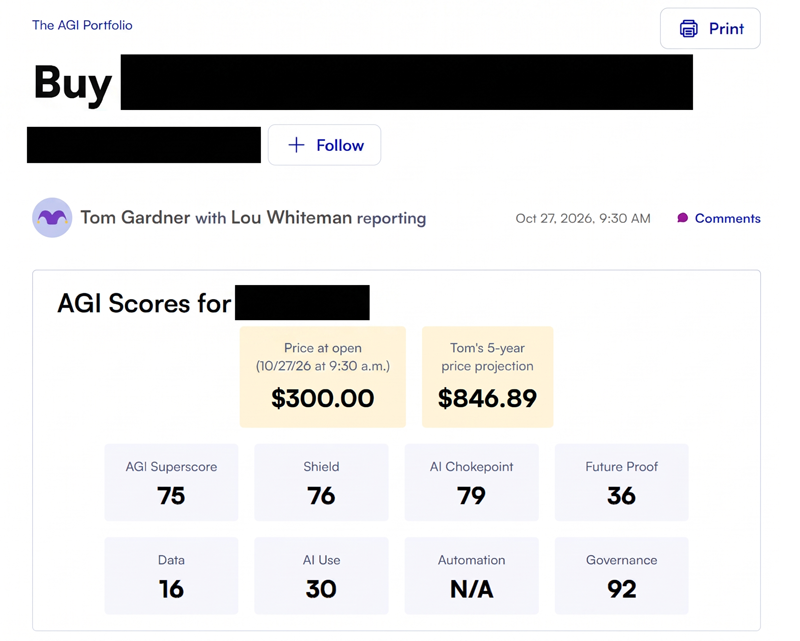
Chart refers to US market and dollars
Right now, as we speak, our members-only AGI Portfolio website already has recommendations from the Magnificent 7+ sleeve, as well as additional recommendations from each of the other four sleeves.
That’s real-money recommendations for The AGI Portfolio on Day 1, already waiting for new members like you!
Here’s just a quick sneak peek at three of those stocks:
- AGI Portfolio Recommendation No. 1 – “The Miraculous Cancer Identifier:” This company’s proprietary testing system can scan for multiple cancers at once using just a single tube of blood. A doctor orders the test, a sample is drawn, and this company’s accredited lab in North Carolina runs it – with machine learning reading the test. Then they earn money each time it delivers a result report.
Even better, this company has been recommended just twice across the entirety of The Motley Fool US, and in just one service. [“Wildcard” Sleeve] - AGI Portfolio Recommendation No. 2 – “The Physical Haven from AI:” When a family loses someone, they need a nearby chapel, a licensed funeral director, and often a plot of ground. This company provides all three through its funeral homes and cemeteries.
As grim as it may be, the opportunity here lies in what AI leaves alone, which is why it falls under our “Insulated” sleeve in the portfolio. The company charges per funeral contract and per burial plot, and families keep paying more for that ground. A burial plot bought before a death cost 17% more on average in Q2 2026 than a year earlier.
Even better, this company is brand-new to The Motley Fool US – it’s a first-time recommendation by us! [“Insulated” Sleeve] - AGI Portfolio Recommendation No. 3 – “The ID Verification Specialist:” This mere US$3.5 billion small-cap stock has NEVER been recommended before at The Motley Fool US. But Tom and team think they’re perfectly positioned for the AGI era.
Just consider, AI can make fake faces, voices, and papers cheap and easy to produce. But this company’s proprietary technology is able to confirm a person’s identity in advance of an interview or final hiring, saving a business time, money, and humiliation – a triple-benefit that’s hard to beat in an AGI-native world. [“New-to-TMF” Sleeve]
And that’s en route to building out a full 40-stock portfolio with eight stocks from each of the five sleeves over the course of the coming month, which again we’ll be backing with US$2.5M of Motley Fool US capital.
Which may have you wondering…
Are we just giving you access to a 40-stock AGI Portfolio and sending you to fend for yourself?
Of course not!
The stock picks themselves are just the beginning of everything you’ll unlock as a Charter Member of The AGI Portfolio…
For a technological phenomenon as important and as rapidly changing as the emergence of the AGI era, we’re pulling out all the stops on behalf of members.
Here’s what you can expect from our team going forward as a member of The AGI Portfolio:
- Active Portfolio Guidance: Ongoing buy/sell/hold recommendations as Tom sees fit.
- Monthly Portfolio Review Report: A monthly recap of everything you need to know about The AGI Portfolio and the stocks within, as well as an overview of the state of AGI today. Split roughly 50/50.
We’ll be there every step of the way as the AGI news comes flying in from all directions in the weeks, months, and even years to come.
The goal is that you never have to see news and guess how to react, because we’ve already made you aware of it well in advance.
Now, with that all said, let’s pause a second.
If you’re ready to get started ASAP and see those initial recommendations right away, simply click the button below to view your heavily discounted Charter Membership offer and get started now.
Lock in Charter Membership status to The AGI Portfolio now!
Or if you’d prefer to hear more about everything that comes with joining The AGI Portfolio in this jam-packed offer today, keep on reading — we’re in no rush!
It starts with something I alluded to earlier that may very well be even more important than picking the winners of the AGI era.
Identifying the losers!
Which is precisely what Tom’s seeking to do with the following special report…
— A Special Motley Fool Bonus Report —
“Warning Shots: The 46 Stocks MOST Threatened by AGI”
Tom didn’t just use his list of more than 2,800 active AGI Scores to find the biggest winners… he also went through it with a fine-toothed comb to identify the businesses his system believes are actively under threat from the AGI revolution.
And not just five… 10… or even 20 companies, either. No, a whopping 46 stocks that Tom believes are fundamentally in trouble. Here’s the scariest part…
When you see the list for yourself, I’ll bet you never would have dreamed that some of these stocks would have been remotely affected by AGI. I’m talking about companies like:
- A US$300 billion investment bank that ranks as one of the most venerable financial institutions in the history of America.
- The fifth largest food and beverage company in the world, that owns a wide portfolio of iconic American food and beverage brands from the world’s most famous condiments… to prepared meals… to snacks… and other grocery staples.
- Even one of the most well-known and beloved American sporting goods stores. Nobody is safe!
They seem arbitrary, right? But that’s just the power of the AGI scoring systems that Tom’s spent tens of millions building out.
They’re able to dive far beneath the surface to instantly identify the tiniest vulnerabilities that would take human researchers weeks… even months to uncover. If at all.
Simply put, Tom believes they deserve a very close look for investors who own them.
Before AGI begins taking its toll on them…
And AGI’s impact goes beyond just “warning shots,” too…
We’re already taking action.
— A Special Motley Fool Bonus Report —
“Sell Off: 48 US Hidden Gems Sells from Tom Gardner”
A $2,400 value|2-Year Offer Exclusive

Tom’s already making dramatic changes to many of the other Motley Fool solutions that make up his personal “US Hidden Gems” suite of services.
That includes 48 ACTIVE Motley Fool US recommendations Tom believes are either directly susceptible to AGI or less likely to be one of the big beneficiaries of AGI and artificial intelligence more broadly.
And while these SELL recommendations would usually be restricted exclusively to Motley Fool members of these services themselves, you know by now that “business as usual” is over.
Which is why Tom’s making all 48 of the sell recommendations he’s been planning to make across his US Hidden Gems suite of services available in one single report to any Fools who join The AGI Portfolio on a two-year membership offer.
And considering how popular some of the stocks you’ll find in “Sell Off” are, I wouldn’t be surprised if they’re in your portfolio as we speak.
- A software collaboration tool provider that’s been recommended a whopping 65 times across 24 separate Motley Fool US solutions.
- A cloud-hosted CRM platform that’s been recommended 46 times across 19 separate Motley Fool US solutions.
- A cloud-based AI platform that helps financial institutions automate evaluating consumer credit risk that’s been recommended 64 times across 27 separate Motley Fool US solutions.
This is a unique opportunity to get a glimpse behind the inner workings of Tom’s other US Hidden Gems solutions without having to actually be a member!
*Report available soon
— A Special Motley Fool Bonus Report —
“AGI Options Lab: 10 Strategies for Playing Both Sides of the AGI Future”
A $1,000 value|2-Year Offer Exclusive

This is a really neat report, and I’m not sure we’ve ever done anything like this. But it couldn’t be a more perfect fit for The AGI Portfolio specifically.
Dedicated Motley Fool options expert JP Bennett, along with Matt Frankel and Dan Caplinger, has helped us come up with 10 unique and exciting options plays to leverage AGI and specifically The AGI Portfolio in addition to the 40 stocks themselves.
JP, Matt and Dan have 10 total options trades spread across three distinct buckets:
- AGI Options Bucket 1 — “Stock Replacement:” Want to spend less money up front while still getting exposure to Tom’s AGI Portfolio stocks?
These THREE option plays allow you to approximate the benefits of purchasing shares in three different AGI Portfolio companies, while putting less money on the line. Upside may be capped. - AGI Options Bucket 2 — “Options Moonshots:” For the Fools who are truly “all in” on AGI, the team has FOUR out-of-the-money LEAPS plays to capitalize in an outsized way on AGI Portfolio stocks that we believe could win big.
Allowing us to potentially make disproportionately huge returns off of moderate stocks moves. - AGI Options Bucket 3 — “The Flip Side:” There will be countless AGI winners… but a slew of losers, too. JP, Matt, and Dan dug into Tom’s “Warning Shots” list of the 46 stocks most threatened by AGI to find where put options could let members of The AGI Portfolio potentially profit if the biggest potential losers from the AGI era stumble.
You’ll get comprehensive, easy-to-follow walkthroughs on all 10 options plays straight from the team, including:
- How You Participate
- Why We’re Using Options
- Temperament Needed
- The Business
- The Thesis
- How the Trade Works
If you’ve never traded options before, there’s no need to worry.
JP and team are masters of taking an otherwise complex topic and making it feel like a walk in the park!
*Report available soon
Speaking of never having been done before, here’s yet another example of us pushing the boundaries to meet the moment Tom says is “Gonna dwarf them all.”
AGI: Active Oversight
A $792 Value|2-Year Offer Exclusive
In the purest sense, AGI: Active Oversight is Tom Gardner going to the mat for Fools who truly want to go all-in alongside him with AGI.
Tom will be personally hosting a quarterly 90-minute LIVE webinar event alongside his handpicked team of AI experts for members who are seeking, in Tom’s words:
- A deeper analysis of the companies inside The AGI Portfolio.
- A much better and more nuanced understanding of the rate and impact of the technical change stemming from the proliferation of AGI.
- A look at the key AGI trends rolling across one industry after another.
- A Q&A about the most important stocks in your portfolio, including a commitment to answer ALL questions that are sent in — either LIVE or in writing.
AGI: Active Oversight is for members who want to follow this portfolio extremely carefully, understand this worldwide transformation in-depth, and see the exact trends we see.
Yes, I’m ready to join The AGI Portfolio at a deep Charter Member discount!
As you can see, we’ve pulled out all the stops to make The AGI Portfolio one of the most valuable solutions in Motley Fool history.
Which brings us to the all-important question at hand…
How much is Charter Member access to The AGI Portfolio going to cost?
Before we get to that, let’s briefly recap everything you’re getting access to in what for my money can only be described as the single most jam-packed investment solution in Motley Fool history.
Remember, it all starts with Tom’s top 40 AGI leaders inside The AGI Portfolio itself, backed by US$2.5 million worth of Motley Fool US capital — our largest one-time public stock allocation ever — and including full allocation guidance [a $3,999 value]…
Plus “Warning Shots: The 46 Stocks MOST Threatened by AGI,” which reveals the 46 companies Tom believes AGI could destroy entirely…
Now, we’ve set the 1-year Charter Member price to get access to the above at $2,199.
So already almost half-off the value of The AGI Portfolio itself. Not bad.
But here’s the thing…Tom has said he believes Artificial General Intelligence is going to dwarf every technological advancement he’s seen in his 30+ years since founding The Motley Fool — yes, including the entire birth of the internet itself — combined.
Simply put, he’s in this for the long haul… and as such, he wants Charter Members in The AGI Portfolio who are in it for the long haul with him.
Which is why — as the VP of Membership — he made me solemnly promise to give Fools who commit to a long-term outlook toward AGI the best membership terms we could possibly offer.
Message received, loud and clear.
So when you join us for two years of The AGI Portfolio, not only will I also kick in our “Sell Off: 48 US Hidden Gems Sells from Tom Gardner” report [a $2,400 value]…
The “AGI Options Lab: 10 Strategies for Playing Both Sides of the AGI Future” report [a $1,000 value]…
AND access to Tom’s in-depth, 90-minute quarterly AGI overviews events via AGI: Active Oversight [a $792 value]…
But I’ll make ALL of that available today for a special discounted 2-year Charter Membership price today of just $3,199, bringing your price down to just $1,599/year.
Not only is that a total savings of $8,991 off the overall value we’ve assigned to two years of The AGI Portfolio membership…
But it also saves you 50% OFF the price of that second year of membership when compared to taking the 1-year offer.
Special discounted 2-year Charter Membership price: $3,199 just $1,599/year
Here’s how it looks for the more visually inclined:
| What’s included | 1-year Charter Member | Best membership terms2-year Charter Member |
|---|---|---|
| Charter Member price | $2,199 | $3,199 just $1,599/year |
| The AGI Portfolio — Tom’s top 40 AGI leaders, backed by US$2.5M | ✓ | ✓ |
| “Warning Shots: The 46 Stocks MOST Threatened by AGI” | ✓ | ✓ |
| “Sell Off: 48 US Hidden Gems Sells from Tom Gardner” | ✕ | ✓ |
| “AGI Options Lab: 10 Strategies for Playing Both Sides of the AGI Future” | ✕ | ✓ |
| AGI: Active Oversight — quarterly 90-minute events | ✕ | ✓ |
| Your price today | $2,199 | $3,199 |
And while nobody would ever argue that $3,199 for two years of membership is cheap by any means, considering everything you get access to:
- The AGI Portfolio, including US$2.5M spread across Tom’s top 40 winners of the AGI era.
- “Warning Shots: The 46 Stocks MOST Threatened by AGI”
- “Sell Off: 48 US Hidden Gems Sells from Tom Gardner” [2-year exclusive]
- “AGI Options Lab: 10 Strategies for Playing Both Sides of the AGI Future” [2-year exclusive]
- Quarterly 90-minute “State of AGI”-style events with Tom himself via AGI: Active Oversight [2-year exclusive]
…I do believe it’s a fantastic value.
A fantastic value that, unfortunately, won’t last long…
You see, we’re only offering this special discount pricing to Fools who take prompt action in joining Tom as Charter Members of The AGI Portfolio.
That means that come Saturday, November 7th, at the stroke of midnight, this offer window will immediately expire — come back Sunday morning and you’ll see it’s gone for good.
And while that does introduce an element of urgency into all of this, you don’t need to feel rushed.
That’s because I’ve ensured that you’re 100% protected by our Ironclad 30-Day Satisfaction Guarantee. Here’s how it works…

You’re fully protected by…
Tom Gardner’s Ironclad 30-Day Satisfaction Guarantee
Here are the specifics on how it works. Simply:
- Join Tom inside The AGI Portfolio on a 2-year membership today…
- Immediately securing your 73% discount, before it expires Saturday, November 7th, at the stroke of midnight…
- While also locking in that second year of Charter Membership inside The AGI Portfolio at 50%-OFF the renewal price…
- Then go view Tom’s first AGI winners already awaiting you on our private, members-only website…
- Be there as we release another full round of 12 recommendations in mid-November… and our final round of 12 recommendations in late-November as we build out the initial US$2.5 million AGI Portfolio to 40 total stocks…
- Get Day 1 access to “Warning Shots: The 46 Stocks MOST Threatened by AGI,” already available…
- Check back soon when our “Sell Off: 48 US Hidden Gems Sells from Tom Gardner” report goes live [2-year exclusive]…
- Follow back up again soon when “AGI Options Lab: 10 Strategies for Playing Both Sides of the AGI Future” comes out [2-year exclusive]…
- And if by Day 30 of your Charter Membership to The AGI Portfolio you still aren’t convinced that joining was the single best investment decision you’ve made yet…?
I can promise our MS team is the single most friendly and single most helpful group of Fools at the company, and they’ll go to the mat on your behalf.
Either way, you’ll get a boatload of value just for giving The AGI Portfolio a try, including Tom’s top 40 AGI winners… 10 alternative ways to play the AGI emergence via options… as well as nearly 100 stocks Tom and team are concerned about.
With that all said, I will just issue one final word of warning…
Come midnight on Saturday, November 7th, your 73% discount will immediately expire.
At that time, the Charter Member price for The AGI Portfolio will come to an end. Come back Sunday morning and you’ll find today’s price will be gone, and it’s not coming back.
That discount is a reward for Fools who are as excited about this AGI opportunity as Tom is — and who have seen enough from the Fool through past generational shifts to feel confident taking advantage of this one.
Remember what the world’s brightest minds are saying about this opportunity…
Google DeepMind Chairman Demis Hassabis calls it “10 times the industrial revolution at 10 times the speed” and “probably something more like the advent of fire or electricity.”
Ark Invest CEO Cathie Wood previously boasted it could 10X global GDP growth per year.
And Goldman Sachs says overall token consumption will shoot up 24X as soon as 2030.
While Grandview Research predicts the AI market to shoot up 6.5X — not by 2050… or 2040… but by 2033!
No wonder Alphabet CEO Sundar Pichai simply calls it “the foundation for everything we do.”
And Tom Gardner himself says it’s about to put hundreds of trillions of dollars up for grabs, along with a final sign-off today:
“Whether Jensen Huang is right or wrong that AGI is here right now, we’re not gonna sit around and wait to find out.”
Can you really afford to risk missing out?
Just click below to begin your AGI journey alongside Tom now, and see the first stocks where he’s already beginning to allocate that US$2.5 million within seconds!
Lock in my 73% discount to become a Charter Member of The AGI Portfolio now — before it expires midnight Saturday!
To our shared AGI future together,

Jaimin Patel
VP of Membership
The Motley Fool