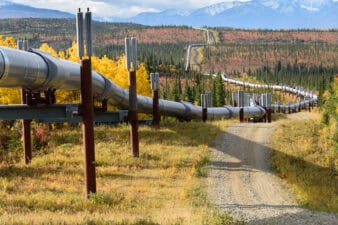
According to the Canadian Association of Petroleum Producers, or CAPP, Canadian oil production will more than double over the next two decades, fueled by steadily growing oil sands production and a rebound in conventional production.
But could the rise of alternative energy sources such as solar render expensive oil sands projects unprofitable within the next several years? Let’s take a closer look.
CAPP’s projections
CAPP forecasts total production to reach 6.7 million barrels per day in 2030, compared to roughly 3.2 million barrels per day last year. It expects oil sands output to account for a little over three-quarters of the expected 6.7 million barrels per day in 2030, or around 5.2 million barrels per day.
Conventional crude and condensate from western Canada will make up the remaining 1.4 million barrels per day, while eastern Canadian production is expected to account for the remaining 100,000 barrels per day, CAPP reckons.
Risks to CAPP’s forecast
As CAPP itself admits, its projections are dependent on a number of assumptions. In my view, any projections about oil sands output growth out to 2030 are bound to be highly uncertain due to the litany of factors that could cause them to deviate sharply from reality.
Already, Alberta’s oil sands producers are finding it hard to cope with three major challenges: ballooning operating costs, depressed prices for Western Canadian crude oil, and greater competition from shale producers in the U.S. for what limited outbound infrastructure exists in Alberta.
The combination of these factors has made certain oil sands projects particularly challenging, depending on location and the method of extraction. Not surprisingly, some operators have decided to abandon some of the more expensive projects.
For instance, Total SA recently abandoned its Voyageur Upgrader project, deciding to sell its 49% stake in the project to its joint-venture partner, Suncor Energy (TSX: SU) , for $500 million. Total defended the move to scrap Voyageur – a 200,000-barrels-a-day facility designed to “upgrade” bitumen into crude oil – by saying that it was “no longer justified from a strategic and economic” standpoint.
Faced with growing uncertainty, some operators are even scaling back investments and reducing cash flow guidance. Talisman Energy (TSX:TLM), Canada’s sixth-largest independent oil producer, cut its capital budget forecast for the year by 25%, while Cenovus Energy (TSX: CVE) in December lowered its cash flow forecast for the year by 16% to as low as C$3.1 billion. And Canadian Natural Resources (TSX: CNQ) said that it plans to reduce spending on thermal sands production.
The threat from alternative energy sources
Some analysts argue that if oil sands producers fail to surmount these hurdles, additional investment in Alberta could soon dry up, especially if the price of crude oil sees a sustained decline. Jeremy Grantham, co-founder and chief investment strategist at Boston-based investment firm GMO, is one of the more outspoken critics, arguing that growing competition from alternative energy sources threatens to send oil sands operators packing:
I believe anyone investing in tar sands is very likely to end up with stranded assets in the next decade or two. Solar is getting cheaper by the minute, whereas petroleum is getting more expensive. It is only a matter of time before their expenses cross.
While foreseeing the evolution of solar energy would require a crystal ball, Grantham’s point – that alternative sources of energy pose a major long-term threat to expensive, unconventional oil projects – is an important one.
Perhaps, then, there is a good reason why the share prices of oil sands producers – especially those with high exposure to particularly expensive projects – have remained depressed over the past few years. Investors attracted to some of these companies’ cheap valuations would be wise to heed Grantham’s words of wisdom.
Another alternative energy source with a bright future is none other than uranium. Click here now for instant access to our FREE report titled “Fuel Your Portfolio With This Energetic Commodity”. We think you’ll be surprised just how bright the future is for uranium, just how far these two Canadian names have fallen, AND how fast they could rebound. Click here to access this free report, and hop on for the nuclear ride of your life!
The Motley Fool’s purpose is to help the world invest, better. Click here now for your free subscription to Take Stock, The Motley Fool Canada’s free investing newsletter. Packed with stock ideas and investing advice, it is essential reading for anyone looking to build and grow their wealth in the years ahead.
Follow us on Twitter and Facebook for the latest in Foolish investing.
The original version of this post, authored by Arjun Sreekumar, appeared on Fool.com.
Fool contributor Arjun Sreekumar has no position in any stocks mentioned at this time. The Motley Fool recommends Total SA.