Canada has the world’s third largest oil reserves. However, 97% of those reserves are in the oil sands. With those oil sands being so important to North America’s energy future, it’s important for investors to have a firm grasp of that resource.

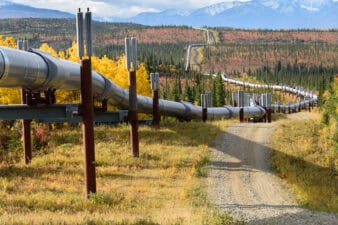
Photo credit: Suncor Energy https://www.suncor.com/en/newsroom/2482.aspx?id=2049
Canada has the world’s third largest oil reserves. However, 97% of those reserves are in the oil sands. With those oil sands being so important to North America’s energy future, it’s important for investors to have a firm grasp of this resource.
Digging deeper into the oil sands
The oil sands are actually a mixture of sand, water, clay and bitumen. While the Canadian oil sands are often called the “tar sands”, bitumen is actually interchangeable with asphalt. Like asphalt, bitumen is oil that is thick and sticky, making it too heavy to flow without being heated or diluted. At room temperature it’s a lot like cold molasses, while in cold temperatures it’s as hard as a hockey puck.
Because of these characteristics, refining this heavier oil from the oil sands requires additional investments at refineries. For example BP (NYSE:BP) spent $3.8 billion to upgrade its Whiting Refinery in Indiana so that it could process crude oil from Canada. In another example, Suncor (TSX: SU) (NYSE: SU) spent well over a billion dollars to upgrade its refining operations in order to process this heavier crude oil.
How much oil are we talking about?
As I mentioned at the beginning, Canada has the world’s third largest oil reserves thanks to the oil sands. At last count that was 168 billion barrels of oil. For some perspective, the U.S. only has oil reserves of 29 billion barrels.
While Canada already has a lot of proven oil reserves, some believe that there is even more oil in Canada. Estimates are as high as the sum total of all of the world’s known conventional reserves of 1.7 trillion barrels of oil. In fact, Former CEO of Shell (NYSE: RDS-A) Canada Clive Mather believes that Canada’s reserves could total more than 2 trillion barrels. Bottom line, Canada is sitting on a world class supply of oil, if not the world’s largest supply.
In addition to its sheer size, Canada’s reserves are unique for another reason. One of the problems energy companies face is that 81% of the world’s oil reserves are owned or controlled by national governments. That leaves precious little reserves accessible to the private sector for investment. However, 56% of those reserves are located in Canada. That’s one of the reasons why so many private oil companies have set up shop in the oil sands.
This is big for big oil
As an example of how important this is, consider the trouble U.S. based ConocoPhillips (NYSE: COP) has had operating in Venezuela, which holds even more proved reserves than Canada. After investing heavily to develop oil projects it had its oil investments expropriated in 2007. Just last week it was ruled that Venezuela did so illegally. For a major oil company like Conoco, there are few other places in the world it can invest in to develop the vast oil resources critical to growing its business. That’s one reason why Conoco has invested so heavily in Canada’s oil sands.
Conoco, along with partner Cenovus Energy (NYSE: CVE) (TSX: CVE) are investing in several major oil sands projects including Foster Creek, Christina Lake and Narrows Lake. In total, Conoco believes it has resource potential of 16 billion barrels of oil equivalent. That represents an outsized portion of its total resource base of 43 billion barrels of oil equivalent. With seven oil sands projects in development, Conoco has plans to grow its production by 16% annually through 2017.
What this boils down to is that the supply oil in the oil sands moves the needle for “big oil”. Another example is Shell, where oil sands production represented 4% of its total global production. For an idea of how large this resource is, Shell and its partners in the Athabasca Oil Sands Project plan to pursue regulatory approval to increase the current output of that one project to 770,000 barrels of oil per day, which is about the entire current daily output of the Bakken shale of North Dakota.
Final Foolish thoughts
There really is a stunning amount of oil in Canada’s oil sands. While that oil is challenging to extract, it’s well worth it for the world’s oil companies. Speaking of the challenges to extract the oil, next up in the series is a deeper look at how oil companies develop the oil sands.
Fuel Your Portfolio With a Different Commodity
Canadian energy is more than just the oil sands. Instead of oil, your portfolio could be best served by uranium – the key ingredient for nuclear power. And with the global nuclear market ramping up in places like China, it could be a big winner.
That’s why the Motley Fool has prepared a Special FREE Report that will clue you into the two best uranium companies in Canada. It’s called “Fuel Your Portfolio With This Energetic Commodity,” and you can receive a copy at no charge by clicking here!
The Motley Fool’s purpose is to help the world invest, better. Click here now for your free subscription to Take Stock, The Motley Fool Canada’s free investing newsletter. Packed with stock ideas and investing advice, it is essential reading for anyone looking to build and grow their wealth in the years ahead.
Follow us on Twitter and Facebook for the latest in Foolish investing.
Fool contributor Matt Dilallo owns shares of ConocoPhillips. The Motley Fool does not own shares of any of the companies mentioned at this time.