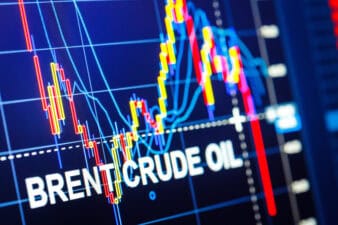
It’s about that time of year when oil and gas producers release both Q4 2014 and full year 2014 results. Given the fact that WTI prices plummeted over 40% in Q4 alone (preceded by a muted decline throughout Q3), full year and Q4 2014 results for most Canadian energy firms saw year-over-year declines.
This is not so for Crescent Point Energy Corp. (TSX:CPG)(NYSE:CPG). In fact, Crescent Point’s results bore little indication that it was even operating within an oil bear market. Cash flow from operations jumped 11% from Q3 2014 and production grew 9%, ending the year at a record 153,822 boe/d, in line with guidance.
There are a few reasons Crescent Point has been able to perform so well.
1) Crescent Point has a best-in-class hedging program
Crescent Point’s hedging program is a key component of its risk management strategy and its overall business strategy. Crescent Point uses a very conservative hedging program to ensure that it can adequately maintain its large $1.1 dividend (yielding almost 10%) in a variety of crude price environments.
Currently, Crescent Point maintains a 3.5 year hedging program, which ensures that Crescent Point is protected from price declines for 3.5 years in the future. Crescent Point has a large 56% of its 2015 oil production hedged at CAD$89 per barrel, 33% of its 2016 production hedged at $84 per barrel, and about 9% of its 2017 production is hedged.
Crescent Point also hedges its gas production, and 53% of its gas production is hedged for 2015 and 2016. Although hedges are a trade-off in the sense that the value of these hedges will decline if prices rise, resulting in losses (Crescent Point lost $111 million from its hedges in 2013), hedges also result in gains in weak price environments, which offsets a portion of any price related losses.
For example, in 2014 Crescent Point’s hedges gained $880 million, offsetting price weakness and creating a year-over-year gain in cash flow from operations.
2) Crescent point has a large high-quality asset base
High-quality assets result in high operating netbacks and low reserve declines (and therefore low sustaining capital expenses). Combined, these features result in strong cash flows that give Crescent Point the ability to be cash flow positive even as oil prices decline. Crescent Point currently spends only about 40% of its cash flow to maintain current production levels, which means they are well positioned to succeed in a weak price environment.
Not only is Crescent Point’s asset base high quality, but it also contains a large number of drilling locations. Currently, Crescent Point has an inventory of about 7,000 well locations ready to be drilled. This inventory alone will take Crescent Point six to eight years alone to drill, assuming no new wells are located. Crescent Point, however, has been growing its reserves, replacing its drilled wells by 189% in 2014.
This results in growing production and Crescent Point has been able to offset low oil prices by upping its production.
3) Crescent Point has financial flexibility
As mentioned earlier, Crescent Point only spends 40% of cash flows on sustaining capital, which gives it a decent amount of financial flexibility to respond to low oil prices without cutting production.
In addition, Crescent Point also has one of the strongest balance sheets in the business, with an expected debt-to-cash flow ratio of only 1.5 in 2015, and a current debt-to-capital ratio of only 20%. Because of this, Crescent Point was able to secure $1 billion on its current credit facility, increasing it to $3.6 billion. With only $1.27 billion used so far, Crescent Point has plenty of flexibility to grow and maintain its production, fund its dividend, or potentially make an acquisition even if prices fall.
With energy company market caps down, it is possible that Crescent Point could use the current weak market to buy, making it a high-quality purchase for cheap.