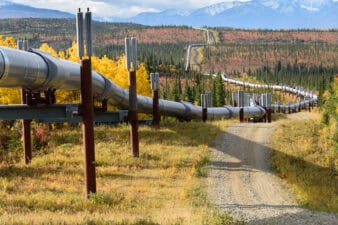
Recently, TransCanada Corporation (TSX: TRP)(NYSE: TRP) announced some extremely positive news for Canadian natural gas producers—the company proposed reducing tolls on its Canadian Mainline pipeline (a 14,000 km natural gas pipeline extending from Alberta to Quebec) by 46%. The reduction would be for the portion of the pipeline connecting Empress, Alberta, to the Dawn Hub in Ontario, which serves the massive Great Lakes demand market and includes Toronto.
Canadian natural gas has been suffering from the serious problem of having nowhere to go, and with no liquefied natural gas projects to export gas to the west and uneconomic pipeline tolls to take gas east, the proposal from TransCanada was a good turn of events. Without the proposal, Canadian natural gas would suffer from a severe lack of market access and be subject to depressed Albertan prices.
Unfortunately, the proposal fell flat. TransCanada needed at least 1.5 million gigajoules per day of volume from Canadian natural gas producers for the project to be economical, and the terms they offered simply weren’t good enough for natural gas producers to sign on, even though lower tolls were desperately needed.
The problem is that TransCanada was requiring shippers to sign decade-long contracts, which is far beyond industry norms. Many shippers were unwilling to commit for this time frame in case natural gas prices dropped again. Many in the industry are claiming that the lack of agreement is fatal for the Canadian natural gas industry; one industry expert stated in a recent Financial Post article that “drills would stop turning” in Alberta should an agreement not be reached.
What does all this mean for Canadian Natural Resources Limited (TSX: CNQ)(NYSE: CNQ)? Canadian Natural is now Canada’s largest natural gas producer and has extensive exposure to Alberta (producing 1.7 million cubic feet of natural gas per day). It is also Canada’s second-largest energy name by market cap and a core holding of many Canadians.
What the lack of agreement means for Canadian Natural Resources
Natural gas prices, like many commodity prices, are determined in part by location. Henry Hub prices (a key distribution hub in Louisiana) are the natural gas price that are most often quoted, but Albertan natural gas producers often sell their product based on AECO prices.
The main problem is that AECO prices often trade at a huge discount to Henry Hub prices. Last week, Henry Hub prices averaged US$2.76/mmBtu compared to US$2.01/mmBtu for AECO prices–a discount of US$0.75. Over the summer, this discount averaged over $1 for many months.
Why does this discount exist? Quite simply, it exists because there is too much Canadian natural gas in storage, and it has nowhere to go. The main reason for this is that production from the Marcellus and Utica regions in the eastern United States has grown dramatically, and this production (since it is much closer to the key Toronto market) has made Canadian production noncompetitive.
Canadian production is just simply too far away and too costly to transport. The end result is that Canadian production has been steadily losing market share, and the Canadian Mainline pipeline (which was built to transport seven bcf/d of gas) now only transports 1.5 bcf/d of gas.
The end result is that Canadian natural gas producers are facing lower and lower prices. Canadian gas was over a dollar cheaper than U.S. gas during the summer months compared to 30 cents before. TransCanada’s cheaper tolls would have allowed Canadian Natural Resources to sell its gas into the more premium Dawn market.
Canadian Natural Resources has many advantages
Unlike other natural gas producers, Canadian Natural has many advantages. Firstly, while Canadian Natural may be Canada’s largest natural gas producer, natural gas is only about 35% of its total production.
Secondly, Canadian Natural has highly economic and, in many cases, industry-leading natural gas production costs, which could allow it to compete to an extent in eastern Canada, even without a TransCanada deal. Canadian Natural has total operating costs for natural gas close to $1/mmBtu, which leads the industry.
While TransCanada’s lack of a deal may be a headwind for Canadian Natural over the long term, the company’s size, diversity, and low operating costs should help it manage the effects.