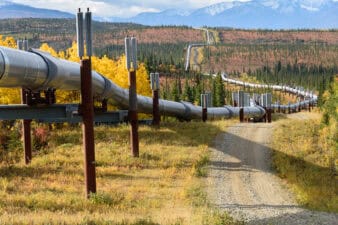
Five years can turn a modest dividend stock into an entirely different animal. The business can double in size, reduce debt, reach new customers, and send considerably more cash to shareholders. It can also make one unfortunate acquisition and spend several years pretending everything is “progressing as planned.” The difference usually begins with what management does today.

Source: Getty Images
Today’s yield isn’t the future
Dividend yield divides the annual payment by the current share price. It shows what an investor would collect at today’s payout, but says nothing about what the company may earn five years from now. A 4% yield that grows can eventually become more valuable than a 7% payout frozen in place and guarded by nervous accountants.
Investors should therefore examine free cash flow, debt, and the amount of money required to maintain production. The safest payment is one a company can fund after covering its essential spending. Monthly frequency may make budgeting easier, although it doesn’t magically improve payout coverage. Twelve cheques can remain shaky.
Reinvesting distributions from monthly dividend stocks can still accelerate compound growth. Each payment purchases additional shares, which produce additional dividends. That cycle becomes considerably more interesting when the underlying company is expanding at the same time.
A merged giant
Whitecap Resources (TSX: WCP) has already begun that transformation. The oil and natural-gas producer completed its combination with Veren in May 2025, creating a much larger company with conventional oil assets and enormous positions in Alberta’s Montney and Duvernay regions.
The conventional assets produce cash with relatively modest decline rates, while the Montney and Duvernay provide years of drilling opportunities. WCP stock can use cash from today’s wells to develop its larger growth portfolio, reduce debt, and maintain the monthly dividend. That makes the merged company much more than two producers sharing office supplies.
A winning combo
Second-quarter results offered an unusually strong progress report. WCP stock generated record free funds flow of $925 million after capital spending, while paying $221 million in dividends. It also reduced net debt to $2.5 billion, equal to just 0.5 times annualized funds flow, and raised its 2026 production guidance for the second time.
Lower debt gives management more freedom when commodity prices weaken and more options when they strengthen. WCP stock could repurchase shares, expand production, increase the dividend, or make another acquisition. Investors shouldn’t assume every option will be exercised at once, since management doesn’t have access to a money fountain.
Five years of new demand
The market around WCP stock may change as well. The Canada Energy Regulator expects liquefied natural gas exports to become a key driver of Canadian natural-gas production growth. Additional export capacity could give Western Canadian producers access to more buyers instead of leaving every molecule waiting near the same North American door.
WCP stock also produces condensate, which is used to dilute heavy oil before it moves through pipelines. More heavy-oil export capacity could therefore support another part of the portfolio. Over five years, the company could evolve from a newly combined producer into a lower-debt energy giant selling several products into expanding markets.
Considerations
There are points to consider, as always. WCP stock pays $0.06 per share monthly, or $0.73 annually. At writing, the shares yield approximately 4.4%. A $10,000 investment would buy 604 whole shares for $9,990.16 and produce about $440.68 annually.
| COMPANY | RECENT PRICE | NUMBER OF SHARES | ANNUAL DIVIDEND | ANNUAL TOTAL PAYOUT | FREQUENCY | TOTAL INVESTMENT |
|---|---|---|---|---|---|---|
| WCP | $16.54 | 604 | $0.7296 | $440.68 | Monthly | $9,990.16 |
What’s more, WCP stock now trades close to its 52-week high, so I wouldn’t chase it with both hands and a borrowed wheelbarrow. Oil and natural-gas prices can fall rapidly, while disappointing wells or integration problems could reduce free cash flow. The dividend isn’t guaranteed, regardless of its current coverage.
Bottom line
I’d build a position gradually among diversified Canadian dividend stocks. If WCP stock keeps improving drilling returns, lowering debt, and benefiting from new export demand, today’s 4.4% monthly payer could become a larger, stronger, and considerably more generous business by 2031.