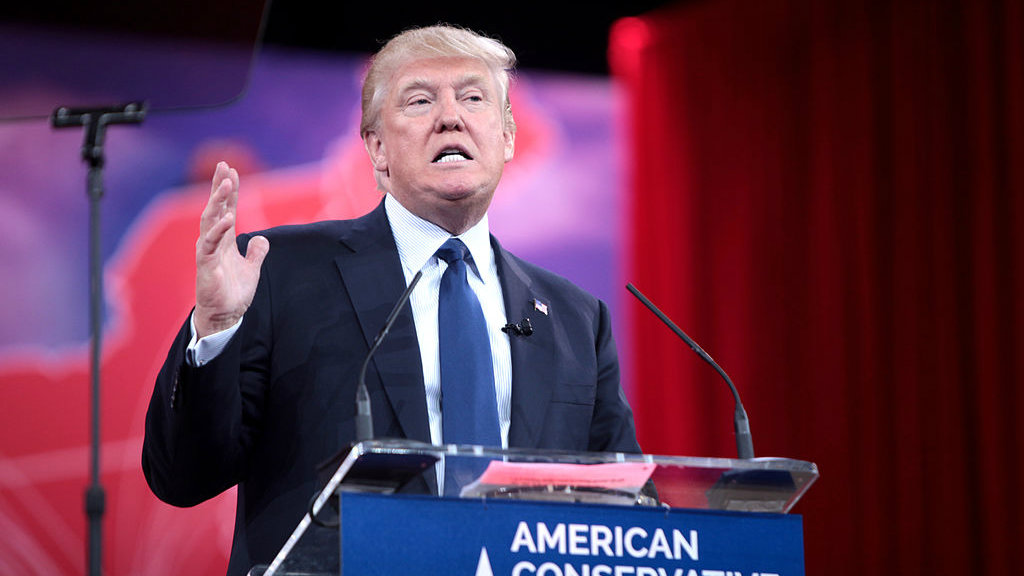
At a time when President Trump is threatening Canada with tariffs, trade wars, and the sort, you would think that sentiment surrounding Canadian stocks would be the lowest it’s been since the Great Recession.
This hasn’t been the case, though, with the S&P/TSX Composite Index blasting past all-time highs in June only to fall back down to Earth courtesy of Donald Trump and the escalating fears over a massive global trade war that could trigger the next recession.
With oil rallying past $70 and an explosive new legal cannabis market about to form, there are many reasons to believe that the Canadian economy will finally begin to pick up traction after lagging for quite some time. With Trump standing in the way, though, could a recession end up happening before the next meaningful economic expansion?
Let’s consider the worst-case scenario, where a full-on tit-for-tat trade war ends up escalating such that trade flows between Canada and the U.S. end up taking a nosedive.
In a previous piece, I’d noted that U.S. companies would have the advantage of corporate tax cuts that will partially offset any sales declines resulting from the deterioration of international trade. While U.S. firms, especially those more reliant on trade, will still take a hit to the chin, the damage will likely be profoundly less severe compared to a similar firm that’s not domiciled in the U.S. and is lacking the backdrop of lower corporate taxes.
Who will be the first to fold in the prisoner’s dilemma?
While a trade war is definitely a lose-lose situation for all parties involved, there are some nations that will stand to get hit harder if U.S. trade falls off a cliff.
National Bank of Canada (TSX:NA) economists recently analyzed the export-to-GDP ratios to determine which nations would be the hardest hit in the event of a severe reduction in international trade that accompanies a trade war.
It was determined that the U.S. is the least sensitive to a reduction in trade flows compared to many other nations that it deals with. Canada, while more sensitive to a reduction in trade flows than the U.S., is not as sensitive to the Eurozone, which is the most sensitive on the list compiled by economists and stands to take the biggest gut-punch from Trump in the event of a full-on trade war.
Furthermore, the economists also noted that they’re not certain as to whether or not “global trade volumes can bounce back quickly” and that a “deceleration in trade flows has historically been associated with slower world GDP growth.”
In other words, Trump essentially has a “recession button” on his desk, and given his tone, it sounds like he’s not afraid to push it, even if it means blowing up the U.S. economy.
Fortunately, Canada and the U.S. both stand to be affected about the same should trade levels plunge in a trade war versus the Eurozone, which will be between a rock and a hard place.
Moreover, the mutually beneficial relationships formed by the U.S. with its allies may take a permanent hit that may take decades to repair if, in fact, a trade war escalates such that a recession results. That in itself wouldn’t be worth it for Trump, even if he gets his “fair deal.” If you’ve played the video game called Civilization, then you’ll know that creating unnecessary tensions with your allies isn’t typically strategy you’ll want to adopt if you plan to win.
Bottom line
Canadian investors ought to acknowledge the possibility that Trump’s “recession button” may be pressed and if a tit-for-tat trade war escalates out of control, the price of admission in defensive dividend stocks like Hydro One Ltd. (TSX:H) will go up, as cyclical names crumble under the heat.
Stay hungry. Stay Foolish.