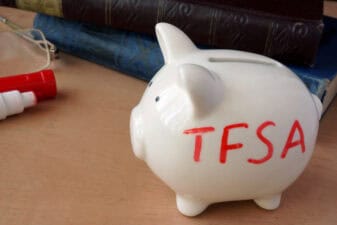
In 2020, eligible investors now have an additional $6,000 that they can contribute into their Tax-Free Saving Accounts (TFSAs). And if you’ve been eligible every year since its inception and haven’t contributed to a TFSA, your cumulative limit is $69,500.
While you’ll need a lot more than that to retire, that doesn’t mean you can’t grow that amount into something more significant: $1,000,000.
Growth is important, but so is safety
One way that investors can quickly accelerate the growth of their portfolios is by investing in growth stocks. Shopify Inc (TSX:SHOP)(NYSE:SHOP), for instance, has grown more than 270% in just two years and highlights just how significant returns can be in a relatively short amount of time when investing in tech.
The problem, however, is that there can be a lot of risk involved as well. For instance, Shopify shares fell multiple times as a result of short-seller reports, and although they would end up recovering, investors who sold during the sell-offs could have incurred significant losses.
Shopify’s impressive results over the years have also made the stock’s value balloon into a bit of a bubble. With a market cap of around $70 billion, it may be one of the TSX’s most overpriced stocks especially given the company’s lack of profitability.
There’s a risk today that Shopify shares could be headed for a correction, as its strong historical returns make it a prime candidate for a sell-off should a crash happen in the markets.
With a beta of 1.20, Shopify is a volatile stock that could be in trouble if the Canadian or U.S. economies struggle and investors opt for safer, more stable investments.
Why ETFs can offer an optimal path to long-term growth
Instead of investing in just one stock like Shopify or another growth stock, investors can take a more diversified approach, such as holding one or more Exchange-Traded Funds (ETFs) in their portfolios.
For example, holding the Vanguard S&P 500 Index ETF (TSX:VFV) can give investors a way to try to mimic the returns of the S&P 500. In five years, the Vanguard ETF has risen by more than 70%, averaging a compounded annual growth rate of over 11%.
That’s a very good rate of return, and even if you can average that through a combination of dividends and capital appreciation, this is how your portfolio could look over the next few decades:
| Year | Balance |
| 1 | $69,500 |
| 2 | $77,145 |
| 3 | $85,631 |
| 4 | $95,050 |
| 5 | $105,506 |
| 6 | $117,112 |
| 7 | $129,994 |
| 8 | $144,293 |
| 9 | $160,165 |
| 10 | $177,784 |
| 11 | $197,340 |
| 12 | $219,047 |
| 13 | $243,142 |
| 14 | $269,888 |
| 15 | $299,576 |
| 16 | $332,529 |
| 17 | $369,107 |
| 18 | $409,709 |
| 19 | $454,777 |
| 20 | $504,802 |
| 21 | $560,331 |
| 22 | $621,967 |
| 23 | $690,383 |
| 24 | $766,326 |
| 25 | $850,621 |
| 26 | $944,190 |
| 27 | $1,048,051 |
It would nearly three decades for a balance of $69,500 to grow to over $1,000,000 using this approach while targeting an average 11% return.
And while that may seem like a long time, investing in ETFs is also a safer, more diversified approach than putting all your eggs in one basket. Given that 11% can be a combination of dividends plus capital appreciation, it’s not an unrealistic return, as there are ETFs that have dividend yields of more than 4% per year, meaning that they would need to grow by just 7% on average to reach a combined return of 11%.
Bottom line
There are no guarantees when it comes to investing in a stock like Shopify or any other, which is why investing in ETFs can give your portfolio much more predictability when it comes to achieving long-term growth and you won’t have to worry about the performance of one individual stock in the process.