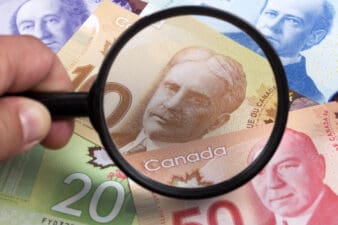
For now, eligible Canadians can get $2,000 per month of Canada Emergency Response Benefit (CERB) money. This is needed relief money, as COVID-19 has disrupted industries and driven many Canadians out of work.
The Canadian government expects to pay out a total of about $70 billion in CERB money by the end of the summer. That’s a big bill to pay to keep Canadians fed and the economy going.
CERB payments will stop at one point. Here’s how you can make your CRA CERB money and your savings last longer.
Invest with a focus on income
By focusing your investments on income, money will flow in regularly to help you pay the bills for utilities, groceries, and other necessities. If there’s any extra income, you can also get yourself a treat.
Many dividend stocks have sold off in light of the COVID-19 disruptions to the economy. The pullbacks are legitimate. However, many of these companies have the balance sheets to withstand economic downturns.
For example, it’s a good time to accumulate shares in Toronto-Dominion Bank (TSX:TD)(NYSE:TD) for long-term investment.
Surely, this year, its earnings will be meaningfully impacted by the recession in Canada and the United States. However, its earnings should still be enough to cover its dividend. Its payout ratio is estimated to be about 65% this year.
To be prudent, the bank might halt dividend increases in the near term. Nevertheless, the depressed stock has lifted its dividend yield to 5.3%, which makes it worthwhile for investing.
In a normal market, the best yield investors can get from TD stock is about 4%. So, investors can get extra income of close to 33% today!
It could take at least two years for TD’s earnings to normalize. To be safe, investors should have an investment horizon of at least three years. By that time, buyers now would have collected some nice income, and the stock should recover to about $80 per share.
Real estate is another source for big income
Real estate investment trusts (REITs) that have any retail exposure have come under pressure, including H&R REIT (TSX:HR.UN). The diversified REIT is now trading at levels last seen during the global financial crisis in 2008/2009.
Its office, residential, and industrial properties are holding up well during the pandemic with rent collections of 99%, 92%, and 90%, respectively, in May. In comparison, it collected 50% of rents from its retail portfolio. Overall, it collected 80% of its rents for that month.
H&R REIT cut its cash distribution by 50% in May. It believes that this move will provide the “additional financial flexibility to absorb any income interruption related to the pandemic in the near term, and allow for significant capital reinvestment into our properties to address tenant turnover without increasing the REIT’s financial leverage.” Therefore, another cash distribution cut is unlikely.
Now, when the economy is stressed, is the best time to invest in H&R REIT for long-term income generation. It currently yields close to 6.9%. Last time it cut its cash distribution in 2009, it steadily increased the payout when economic conditions improved. Thus, it could do it again this time. If so, buyers today will get even more income as things improve.
Right now, analysts think the stock can appreciate about 48% higher over the next 12 months. Over three years, it’s highly possible for the stock to get back to even more normalized levels of $19, which would represent 89% upside on top of the rich dividend income it provides.
Notably, the stock will report its Q2 results on August 12, which is not too far off into the future. So, by all means, feel free to wait for the report for more clarity on the COVID situation before deciding to invest in H&R REIT or not.