Welcome to a series where I break down and compare some of the most popular exchange-traded funds (ETFs) available to Canadian investors!
Canadian investors looking for a hands-off, “buy-the-haystack” approach to their portfolio’s bond allocation can opt for a broadly diversified aggregate domestic bond fund, which includes investment-grade government and corporate debt of all maturities.
Fund managers like Vanguard, iShares, and BMO Global Asset Management provide a set of low-cost, high-liquidity ETFs that offer exposure to a portfolio of these bonds.
The three tickers up for consideration today are Vanguard Canadian Aggregate Bond Index ETF (TSX:VAB), iShares Core Canadian Bond Index ETF (TSX:XBB), and BMO Aggregate Bond Index ETF (TSX:ZAG). Which one is the better option? Keep reading to find out.
VAB vs. XBB vs. ZAG: Fees
The fee charged by an ETF is expressed as the management expense ratio (MER). This is the percentage that is deducted from the ETF’s net asset value (NAV) over time, calculated on an annual basis. For example, an MER of 0.50% means that for every $10,000 invested, the ETF charges a fee of $50 annually.
VAB and ZAG both have an MER of 0.09% vs. 0.10% for XBB. All three are extremely cheap, costing around $9-10 in fees annually for a $10,000 portfolio. If we had to pick a winner, it would be either VAB or ZAG here.
VAB vs. XBB vs. ZAG: Size
The size of an ETF is very important. Funds with small assets under management (AUM) may have poor liquidity, low trading volume, high bid-ask spreads, and more risk of being delisted due to lack of interest.
VAB currently has AUM of $3.2 billion, XBB has $4.5 billion, and ZAG has $5.9 billion. All three are more than sufficient for long-term, buy-and-hold picks. If we had to pick a winner, it would be ZAG.
VAB vs. XBB vs. ZAG: Holdings
When selecting a bond ETF, investors should pay attention to three considerations. First, check the credit quality of the bonds. Ideally, we want bonds rated A, AA, and AAA (investment grade). We don’t want junk bonds, as our goal here is to reduce volatility, not increase it.
VAB, XBB, and ZAG each contain 36%, 37%, and 37% AAA-rated debt, with another 35% each allocated to AA, and the rest spread evenly along A and BBB. All three funds are evenly split between federal, provincial, and corporate bonds, offering a balanced mix of protection and yield.
Two, check the effective duration of the bond. This is a measure of how sensitive the bond is to interest rate movements. Bond prices move inverse to interest rates. For example, a bond with an effective duration of 2.46 years would lose approximately 2.46% if interest rates rose by 1%. VAB, XBB, and ZAG have average durations of 7.6, 7.4, and 7.5, respectively, making them virtually identical.
Finally, we look at the weighted average yield to maturity (YTM) of the bonds, which is the total return anticipated on a bond if held until maturity. This is influenced by the face price of the bonds as well as their coupon payments. VAB, XBB, and ZAG have YTMs of 3.4%, 4%, and 3.5%, respectively.
VAB vs. XBB vs. ZAG: Historical performance
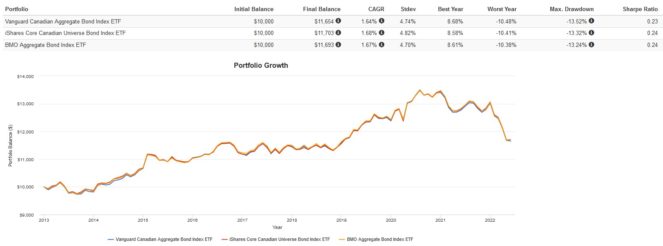
A cautionary statement before we dive in: past performance is no guarantee of future results, which can and will vary. The portfolio returns presented below are hypothetical and backtested. The returns do not reflect trading costs, transaction fees, or taxes, which can cause drag.
Here are the trailing returns from 2013 to present:
Here are the annual returns from 2013 to present:
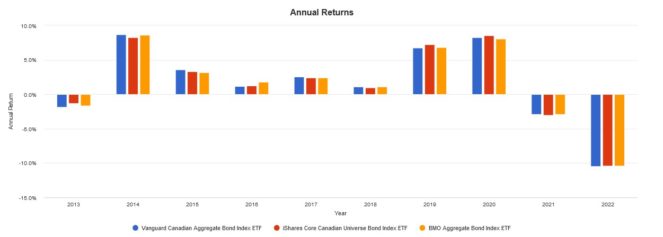
All three aggregate bond ETFs performed virtually identical, barring some minor tracking error in various years. I expect their performance to be nearly identical over time.
The Foolish takeaway
It’s a coin toss between VAB or ZAG for me, simply because either are just a hair cheaper (0.01%) than XBB. All three ETFs are highly liquid and popular and make great passive buy-and-hold picks for a long-term, balanced portfolio.