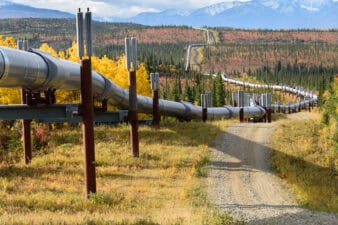
Canadian Natural Resources (TSX: CNQ) has long been Canada’s largest energy company, and one of the biggest crude oil producers in the world. After acquiring $6.5 billion worth of assets from Chevron this week, it is set to grow larger still. Through the recently closed transaction, CNQ will acquire 122,500 barrels per day of active production, as well as 1.44 billion barrels worth of reserves. As a result, the company will solidify its leadership position in Canada’s oil and gas industry.
The question is, will all these new assets pay off? Oil prices have been extremely volatile this year, setting dizzying highs as well as some shocking lows all in 12 short months. CNQ’s newly acquired assets add about $9 million per day in marginal revenue, which is about $2.7 billion in the run of a year assuming the company produces for 300 days in a typical year.
At CNQ’s current profit margin, that $2.7 billion in revenue should produce $551 million in extra profit. However, this all depends on where oil prices go in the years ahead. In this article, I will explore the fundamentals of the oil and gas market in 2024, as well as CNQ’s business fundamentals, and attempt to forecast where the company will be in five years’ time.

Source: Getty Images
Oil and gas industry facts
If oil prices hold their current level, then CNQ will likely be very profitable and will grow for several years to come. The company already does about $7.6 billion in annual earnings and $9.3 billion in annual free cash flow, and that’s not counting the impact of the newly acquired Chevron assets. Also, CNQ stock is modestly valued, trading at 12 times earnings and 7 times cash flow. So, with oil prices at their current level, CNQ is likely to be a good investment.
The question is whether oil prices can hold their current level. Demand for oil has been marginally increasing over the last few years, while OPEC cuts have held back the supply. These two combined factors led to relatively high oil prices over the last five years, especially when compared to the five before that.
However, many countries are incentivizing renewable energy in various ways. Others are re-starting nuclear projects, as nuclear energy is becoming more popular after several decades of being out of favour. It takes a long time to build a nuclear power plant, though. So it seems likely that oil prices will be relatively high for the next five years.
How high is high? I’m inclined to think that prices will likely fall somewhere in the $60 to $75 range for the next five years. That’s based on the fact that the current WTI crude price is $75, and OPEC plans to increase production next year, which should reduce prices somewhat. If my forecast plays out, then CNQ should increase in value over the next five years.
Canadian Natural Resources: Company fundamentals
Having established that oil industry fundamentals are likely to be kind to Canadian Natural Resources in the near future, we can now try to determine how that will impact the company’s performance going forward.
CNQ has a 21% net income margin and a 24% free cash flow margin. With oil prices in the $60 to $75 range, the company should be able to keep up this level of profitability going forward. Based on that, plus the $6.5 billion of newly acquired Chevron assets, I’d expect something like $8 billion in profit and $10 billion in free cash flow in the year ahead. If this scenario plays out, then CNQ stock is cheap today, trading at 10 times forward earnings and 8 times forward free cashflow. Overall, I think this company will be bigger in five years than it is today.