If you’re a passive-income investor, it pays to make your 2025 Tax-Free Savings Account (TFSA) contribution as early as possible. The sooner that money is in, the sooner you can put it to work in cash-flowing assets that pay you every month.
Personally, I prefer to hold tax-inefficient income assets in a TFSA. Canadian dividend stocks are great, but the dividend tax credit gets wasted inside a tax-free account. However, real estate investment trusts (REITs)—which are taxed as ordinary income—are a perfect fit for a TFSA.
Here’s why I like this approach better than owning a rental property and the exchange-traded fund (ETF) I’d use to collect a 7.85% annualized yield with a $7,000 TFSA contribution as of April 17.

Image source: Getty Images
Why I like REITs over rental property
As someone who recently closed on a house, I can confidently say there’s no way I’d want to go through that process again as a business activity. Buying a primary residence is stressful enough—doing it repeatedly for rental income feels more like a full-time job than an investment strategy.
First off, the logistics take time. You need to book showings with a realtor, walk through properties, go back and forth on offers, pay for inspections, arrange financing, deal with closing costs, and hire a lawyer. In contrast, a REIT trades like a stock. You can buy it in seconds on your phone through your brokerage app.
REITs are also far more diversified. You can buy REITs that own residential apartments, office towers, industrial warehouses, self-storage units, retirement homes, hospitals, or retail centers—or go with a REIT ETF that holds a bit of everything. With rental properties, you’re usually limited to single-family homes unless you’ve got serious capital for bigger developments. You simply don’t get the same diversification.
Then there’s leverage. Sure, real estate investors can juice returns by borrowing through a mortgage. But leverage cuts both ways. If property values drop, you could end up underwater. With REITs, you’re only risking the money you put in—no borrowing required unless you choose to.
Finally, REIT distributions are reliable and typically paid monthly. With a rental, one missed rent cheque means chasing down your tenant, navigating the tenancy board, and possibly dealing with repairs, maintenance, or even an eviction. That’s not passive income. That’s active property management.
The goal of passive income is to sit back, do nothing, and get paid for it. Being a landlord doesn’t check that box. Owning REITs does.
I like this monthly income REIT ETF
One of my favourite options for passive income inside a TFSA is Middlefield Real Estate Dividend ETF (TSX:MREL).
As of April 17, it’s paying a 7.85% annualized yield with consistent monthly payouts of $0.075 per share. It’s also as diversified as it gets when it comes to real estate exposure:
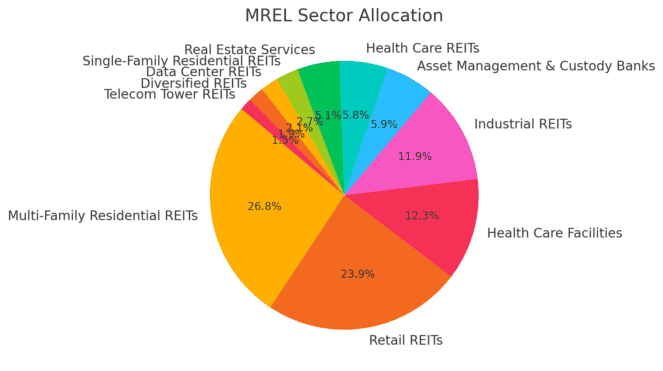
Unlike many Canadian REITs that stick to domestic holdings, MREL is 21.70% invested in U.S. REITs, giving you valuable geographical diversification on top of its broad sector mix.