If I could own a business expanding its top-line sales by 34% year over year while converting 18 cents of every incoming dollar straight into raw, unencumbered cash, I wouldn’t sell it. That’s precisely the cash-generation profile Shopify (TSX: SHOP) stock attained recently. While Bay Street endlessly debates the e-commerce giant’s high valuation multiples, Shopify’s underlying business has quietly transformed into an organic cash flow compounding machine. I’d confidently keep holding SHOP stock for its expanding free cash flow margins.
The e-commerce platform reported 34% growth in second-quarter revenue to US$3.6 billion in August, alongside a stunning 18% free cash flow margin. Canada’s top tech stock is proving that massive top-line growth and free cash flow efficiency can coexist seamlessly. Shopify is converting more of its revenue into cash. The market is loving it, and SHOP stock has soared to near all-time highs lately.

Source: Getty Images
Why stock investors should watch cash flow
Free cash flow is the ultimate lifeblood of any business. It’s the excess cash flow earned from operations, after deducting the capital expenditures necessary to sustain operations at current levels. This excess cash funds internal innovation, eliminates debt concerns, and shields shareholders from painful share dilution.
With management actively deploying this expanding cash pile into aggressive stock buybacks, retiring US$1.4 billion of stock in a single quarter, holding Shopify stock is more than just a bet on e-commerce growth; it’s a high-conviction long-term investment decision supported by ever-improving fundamentals, especially by free cash flow.
Shopify’s expanding free cash flow margin
Shopify’s sustained double-digit revenue growth is accompanied by expanding cash flow. Understanding why an 18% free cash flow margin is a game-changer requires looking at how far Shopify has come.
When a business can’t internally generate enough organic cash flow from operations, existing investors eventually pay the toll through high-cost debt issuances or equity dilution. Free cash flow is the discretionary cash left over after paying operational bills and essential capital expenditures (capex).
Back in 2022, Shopify’s attempt to build out its own physical logistics and fulfillment network drained corporate liquidity, driving free cash flow margins to a negative 3%. Management’s decisive pivot to divest its logistics arm in 2023 restored the company’s identity as a high-margin, asset-light software business. And annual free cash flow margins have expanded since, with management forecasting a “high-teens to low-twenties” free cash flow margin for 2026.
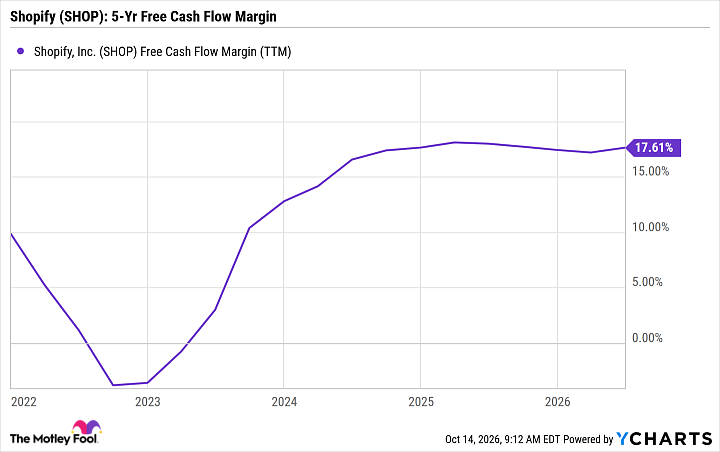
SHOP Free Cash Flow Margin (TTM) data by YCharts
The secret sauce behind Shopify stock’s sustained cash flow expansion is structural operating leverage. Overhead costs as a percentage of revenue dropped from 41% in mid-2023 to just 30% in mid-2026. Meanwhile, quarterly research and development (R&D) spending has stabilized in the US$300 million to US$350 million range, effectively shrinking R&D intensity from 23% of sales down to 10%.
Furthermore, while big-tech competitors spend tens of billions building capital-intensive artificial intelligence (AI) data centres, Shopify utilizes large language models (LLMs) from established expert developers to build its agents. It embeds artificial intelligence tools like Shopify Magic and Sidekick directly into merchant workflows without shouldering heavy hardware infrastructure costs, expanding its software gross margins while keeping capital expenditures minimal.
What to like best about Shopify’s free cash flow uses
What’s management doing with all this discretionary liquidity at Shopify? Rather than chasing potentially wasteful acquisitions – evidenced by a balance sheet goodwill line that has remained flat below US$500 million – Shopify is buying back its own stock.
The company repurchased US$491 million of common stock in the first quarter of 2026 and followed that with US$1.4 billion in the second quarter. Retiring shares while free cash flow grows exponentially increases free cash flow per share and enhances earnings per share, compounding real value for remaining long-term HOP stock investors.
Investor takeaway
Admittedly, a forward price-to-earnings multiple hovering above 90 means Shopify stock is by no means cheap on conventional accounting metrics. Value stock investors may hesitate at that multiple, but dominant growth stocks with widening moats rarely sell at a discount. Management points toward further free cash flow margin expansion for 2026, and Shopify’s impressive revenue growth is amplifying its cash-generation power. I’d hold this kind of growth stock for the long haul.