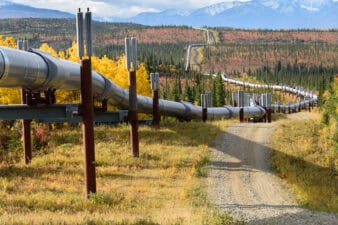
Canada is the sixth largest producer of oil and ranks third in the world for total proven reserves, mostly thanks to Alberta’s oil sands. This oil rich area of Canada now accounts for approximately 98% of Canada’s proven oil reserves.
Nearly all of the oil exported by Canada is targeted to our neighbor to the south, the United States. Though we are tight trading partners, sending oil primarily to the United States may not be the best long-term solution. According to the International Energy Agency, the U.S. will become the world’s largest oil producer before the year 2020 and demand for imported oil is expected to diminish.
Build it and oil will flow
Currently, there are two major proposals on the table that would greatly enhance Canada’s ability to export oil and potentially reduce its dependence on the U.S. Both projects are awaiting regulatory approval and still have political hurdles to overcome.
First is the politically hot Keystone XL Pipeline proposed by TransCanada Corporation (TSX: TRP). The $5.4 billion project proposes a 1,897 kilometer pipeline beginning in Hardisty, Alberta traveling south across the Canadian/U.S. border to Steele City, Nebraska. The pipeline will transport crude from Canada as well as providing producers in the prolific Bakken areas of Montana and North Dakota with additional takeaway capacity.
In addition, an extension of the existing Keystone pipeline, the Gulf Coast Project, is under construction and will extend from Cushing, Oklahoma south to Port Arthur, Louisiana and Houston, Texas. The Gulf Coast Project is roughly 70% complete and service is expected to begin to Port Arthur later this year and to Houston the middle of next year. These final legs of the project will give oil transported through the pipeline a means to be exported.
The Keystone XL pipeline would seem to be a win for both countries as it will allow the U.S. to increase its imports from a friendly nation, while reducing imports from more volatile countries such as Venezuela and those in the Middle East.
Despite its merits, TransCanada has struggled with the Obama administration to get approval for its cross-border project. However, in a recent speech, the President stated that the pipeline would only get approved if it is does not significantly exacerbate the problem of carbon pollution. Like all politicians, his words leave us guessing, but also leave his administration options.
In order to potentially send exports to the thirsty Asian markets, Enbridge Inc. (TSX: ENB) is proposing the Northern Gateway Project which is a 1,177 kilometer pipeline capable of carrying 525,000 barrels of oil per day from the Edmonton area west to Kitimat, British Columbia. The proposal includes a second pipeline that would transport condensate east from Kitimat back to the Edmonton area. The condensate is used to thin oil and other petroleum products for transport through pipelines. The condensate pipeline will run the same path as the oil pipeline and will carry approximately 193,000 barrels of condensate per day.
The Northern Gateway Project is still awaiting final regulatory approval which the company expects a decision in mid-2014. If the decision is made at that time, Enbridge will begin engineering the project details with construction expected to begin in 2016.
In the trenches of the oil sands
While the major proposals to move oil to the West Coast of Canada and the Gulf Coast of the United States are imperative to the success of Canadian oil producers, the pipeline companies providing takeaway services for individual projects will also play a large role. Two companies have reached agreements that will substantially increase their capacity as it relates to specific project areas.
Pembina Pipeline Corporation (TSX: PPL) recently agreed to enter negotiations to construct a new greenfield pipeline system for the transport of diluent and blended bitumen to be known as the Cornerstone Pipeline. Cornerstone will connect projects owned by KKD Oil Sands Partnership in northeast Alberta and the terminal infrastructure of Pembina in the Edmonton area as well as other interconnects.
And last year, Inter Pipeline Fund (TSX: IPL.UN) announced a $2.1 billion project to connect three major oil sands projects requiring the addition of 840 kilometers of new pipeline as well as additional infrastructure. The project will carry diluent and blended bitumen from the Christina Lake and Narrows Lake projects located near Fort McMurray, Alberta as well as the Fosters Creek project located on the Cold Lake Air Weapons Range. The projects are owned by FCCL Partnership which is a venture between Cenovus Energy (NYSE: CVE) and ConocoPhillips (NYSE: COP).
Final thoughts
It is imperative to producers in the Canadian oil sands to find additional outlets for those immense resources. With the U.S. on the verge of becoming energy independent due to recently discovered and recoverable reserves, exports to our neighbor stand to decline. Both the long haul operators and those that move product from the individual projects are willing to invest to ensure producers have access to additional markets. The bottom line however is that the fate of the oil sands industry currently lies in the hands of the U.S. and Canadian governments.
While Canada’s oil industry hangs in the balance, uranium stands to become the energy source of the 21st century. Click here now for instant access to our FREE report titled “Fuel Your Portfolio With This Energetic Commodity”. We think you’ll be surprised just how bright the future is for uranium, just how far these two Canadian names have fallen, AND how fast they could rebound. Click here to access this free report, and hop on for the nuclear ride of your life!
The Motley Fool’s purpose is to help the world invest, better. Click here now for your free subscription to Take Stock, The Motley Fool Canada’s free investing newsletter. Packed with stock ideas and investing advice, it is essential reading for anyone looking to build and grow their wealth in the years ahead.
Follow us on Twitter and Facebook for the latest in Foolish investing.
This post was created by Fool contributor Alex Gray.
Fool contributor Alex Gray has no position in any stocks mentioned at this time. The Motley Fool does not own any stocks mentioned at this time.