One of the great tasks faced by big box retailers is the challenge to manage its responsibility to investors and find innovative ways to serve its client base. For many years companies such as Loblaw (TSX:L) merely set up shop and opened its doors.
But as technology begins to sway the habits of consumers, retailers have been faced with the realities of adaptation. As more and more traditional retailers made the move online, there was still one sector that lagged behind its counterparts, the grocery sector. The race is now on to see who will become the prime player in the online grocery game, which in Canada is only a year old (when it comes to big box stores).
While Canadians are some of the most pro-online shoppers in the world, spending $19 billion a year, groceries have thus far only comprised 1% of total online spending. This number is set to jump as a new player is moving into online grocery shopping.
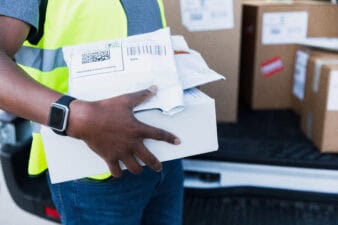
Loblaw has recently announced a pilot program that will allow shoppers to order groceries online and then pick up their orders at a Shoppers Drug Mart location. This is to be the first step to establishing a projected $300 million worth of synergies between the brands in the next three years.
The program will begin with two yet to be named locations, and if successful it could be rolled out to all 1,200 Shoppers Drug Mart locations. The decision to use Shoppers over Superstore stems from location. Shoppers stores generally have a smaller footprint, which has allowed the company to develop more in urban areas. Also many Shoppers locations have retail post offices in the stores, meaning that customers are already accustomed to retrieving orders from Shoppers.
A key consumer type that could be intrigued by this offering would be busy parents, who could order in advance and drastically reduce their shopping times. The core of this program is to increase convenience for customers, and to act as a buffer against U.S. competition.
The first company to delve into Canadian online grocery shopping was Walmart (NYSE: WMT), which offers a good portion of its in store inventory online. By infiltrating the Canadian grocery market with a two-pronged strategy, both in-store and online, Walmart has been able to take sizable amounts of market share from local retailers. The newest step taken by the American big box giant is to offer free shipping on online orders, with optional delivery to the door or to a post office. This means that when the new program by Loblaw is launched fully, it may already be out of date.
The other company making inroads into the Canadian online grocery market is Amazon (NASDAQ: AMZN), which launched its own grocery section last October. This is part of a massive expansion by Amazon in Canada that also includes automotive, toys, and musical instruments. Part of Amazon’s strategy for its grocery section is to act as “filler goods” to top up customers carts to $25 to qualify for free shipping.
Foolish bottom line
Loblaw is attempting to make online grocery shopping more prevalent in Canada, a country that has seen little investment in this area. One of Loblaw’s hopes is to bring the same level of success its UK counterparts have seen in the past few years. In the UK, online grocery shopping has seen a boom and has become the model for other countries to achieve.
This program from Loblaw is a cheap alternative to generate revenues, aside from the $12 billion spent to buy Shoppers Drug Mart. If launched properly this could give Loblaw an edge in urban markets and could support its bottom line as competition heats up.
As for the other U.S. retailer, Target (NYSE:TGT), it once again misses the mark completely by not having any online shopping capabilities.