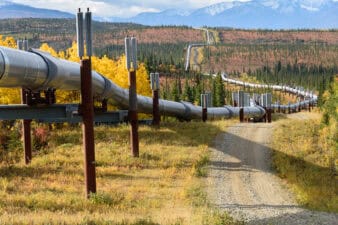
Energy infrastructure companies with massive pipeline networks charge a fee for transporting oil or gas across their network, not unlike how a toll road imposes a fee for each car. As you can probably imagine, that creates an incredible opportunity for investing a growing business with a recurring revenue stream.
Enbridge Inc. (TSX: ENB)(NYSE: ENB) and Inter Pipeline Ltd. (TSX:IPL) are often mentioned as some of the best long-term investment options for those looking at the very lucrative world of pipeline investments in the energy sector.
But which of these two represents the better investment option?
The case for Enbridge
Calgary-based Enbridge Inc. also happens to be one of the largest energy distributors on the plant, with thousands of kilometres of pipeline traversing North America and a backlog of multi-billion dollar projects ready to expand that network.
Despite the incredible opportunity that the company poses, year-to-date, Enbridge has dropped over 6%. Earlier this year, that drop was by a far wider margin, nearly 20%.
The drop in Enbridge’s stock price can be attributed to the company’s acquisition of Spectra Energy, which left Enbridge heavily indebted and forced credit agencies to lower the company’s ratings earlier this year.
The opportunity for investors comes in the form of looking past the short-term fallout of the Spectra acquisition. Over the long-term, Enbridge’s results are both healthy and growing. In the most recent quarter, the company posted a 17% improvement to net income over the same quarter last year, and restructuring efforts and asset sales announced earlier this year will also bring costs and the company’s debt down.
In terms of a dividend, Enbridge offers a very handsome 5.71% yield, and the stock currently trades at $47 with a P/E of 31.63.
The case for Inter Pipeline
While Inter Pipeline may be smaller than Enbridge, the company is a great investment option. Inter Pipeline recently provided an update on the second fiscal of 2018 earlier this month, which was, in a word, impressive.
Inter Pipeline throughput volume for the quarter was 1.37 million barrels per day, resulting in a net income of $136 million. Funds from operations came in 26% better than the same quarter last year, at $261.5 million, or $0.68 per share.
In terms of growth prospects, the company is actively working on the $3.5 billion Heartland Petrochemical Complex, and in the most recent quarter, Inter Pipeline received approval for an $82 million expansion of the Central Alberta Pipeline system.
One of the most impressive aspects of Inter Pipeline remains its dividend. The incredible 6.80% yield that the company offers may initially sound as unsustainable to many, but as of the most recent quarter, the payout ratio was a very sustainable 62%.
Inter Pipeline currently trades for just under $25 at the time of writing with a P/E of 16.68.
Which is the better investment?
Both Enbridge and Inter Pipeline make great investments, as both offer a great dividend and have stellar growth prospects. As a result, the decision of which of the two to select will ultimately fall to the long-term objectives of each individual investor.
Inter Pipeline’s higher dividend may appeal more to investors with a shorter time frame as well as those seeking income above all, whereas Enbridge’s recent stock drop may appeal to value-minded investors not only looking for income, but long-term growth that will come as the stock recovers and rises again.