Real estate investment trusts (REITs) are often treated as bond proxies for their fixed-income like distributions. Investors like bonds for the periodic interest payments and the “guarantee” to get back the par value at maturity. They could earn price appreciation on top of interest income.
Many Canadian REITs offer decent monthly cash distributions. In fact, some even have a track record of increasing their cash distributions over time. So, when bond yields dropped to low levels, some investors turned to REITs for greater investment income.
Bonds
Like REITs, bonds aren’t created equal. Government bonds are lower risk than corporate bonds. Typically, short-term bonds are lower risk than long-term bonds, but they also usually have lower projected yields and returns.
Bonds also have different credit ratings. Generally, ones with A-grade credit ratings have a low probability of defaults. Default risk means the government or company halts interest payments or can’t pay back the par value at maturity.
On Monday, Lorne Steinberg, president at Lorne Steinberg Wealth Management stated on BNN that if investors seek high-yield bonds with yields in the 8% range, it’s important to diversify with an exchange-traded fund (ETF) that has bonds from at least 50 companies because of occasional defaults.
Bonds and REITs are both sensitive to interest rate changes
Like bonds, REITs are also sensitive to interest rate changes. By taking an educated guess on where interest rates may be headed, investors can bank on exceptional price appreciation from timing their bond or REIT purchases. At least, you could aim to avoid paying a high price for low income.
When interest rates are low, the cost of capital reduces for REITs, which potentially increase their investment returns. When interest rates fall, bond prices increase (as do REIT stock valuations). And when interest rates rise, bond prices fall (as do REIT stock valuations).
The Bank of Canada increased the policy interest rate through 2022 from 0.25% to 4.25%, dragging down the Canadian REIT industry, using iShares S&P/TSX Capped REIT Index ETF (TSX:XRE) as a proxy, by 21%.
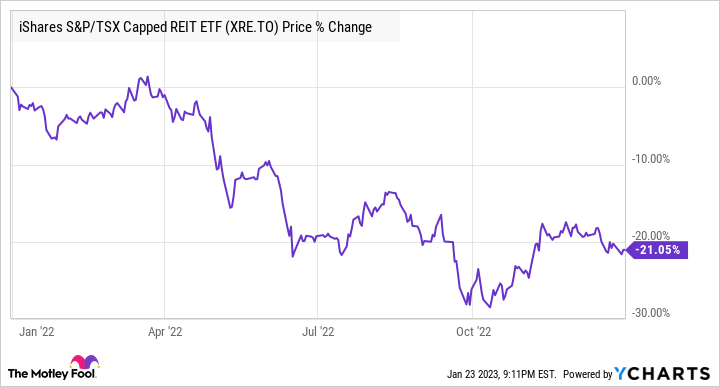
XRE data by >YCharts
Investors should be ready to bear systematic risk or market risk when investing in REITs.
Be ready for systematic risk
When investors buy REITs, they should be ready to ride through market volatility. Even if a REIT is doing well versus its peers, the stock could still be falling if interest rates rise quickly or the economy isn’t doing well. Therefore, it would be super helpful for investors to be aware of where we’re at in the economic cycle, and on top of changes to the monetary and fiscal policies.
Here’s an example. During the recent period of low interest rates, before rates started rising in 2022, stock valuations, including for REITs were pumped up to high levels. Some were even in bubble territory!
Other than low interest rates, the stock rally that occurred post-pandemic through March 2022 was also attributable to an increase in money supply from over $200 billions of dollars pumped into the economy as the COVID-19 pandemic aid, such as the Canada Emergency Response Benefit, wage subsidies, and rent subsidies. At the time, the Canadian government determined it was essential to provide financial assistance to certain industries and workers that were directly impacted by the pandemic.
The Foolish investor takeaway
REITs are similar with bonds in some ways, such as providing investment income, price appreciation prospects, and being sensitive to interest rate changes. However, REITs shouldn’t be treated as bond proxies.
REITs act more like stocks than bonds. So, investors must beware of potential bubbles or downturns in the market and aim not to overpay for REITs, which can be a complicated endeavour. Additionally, REIT’s investment income could be more favourably taxed than interest income, which are taxed at your marginal tax rate.
Quality REITs may be characterized by growing cash distributions over time, which suggests the REIT may be able to increase their rental income.
For the higher risk that investors take in REIT investments, they could potentially get higher returns over an economic cycle given that they aim to buy REITs that have quality management and assets when the stocks are undervalued.