It’s so tempting for investors to chase the next flashy get-rich-quick theme and gamble on speculative “growthy” stocks, hoping to catch lightning in a bottle. Such assets may deliver life-changing returns, but their market-churning volatility usually leaves many investors’ accounts bleeding. However, real generational wealth can still be built in the background, quietly, without taking on too much capital risk, by owning essential assets that generate boatloads of cash year after year.
You don’t necessarily have to settle for the safety of a slow-growing utility, though. There is a TSX-listed infrastructure giant that offers the rock-solid stability of a utility combined with a hidden growth engine tied directly to the world’s biggest investment trends. I’m referring to Brookfield Infrastructure Partners (TSX: BIP.UN), and it could be one of the best core holdings for your retirement portfolio.

Source: Getty Images
Brookfield Infrastructure Partners stock: A global empire built on “boring” essentials
Brookfield Infrastructure Partners is a global powerhouse that owns the mission-critical assets you use every day without a second thought. Its portfolio is diversified across four essential segments: Utilities, Transport, Midstream, and Data.
The infrastructure powerhouse owns everything from natural gas pipelines and electricity transmission lines to railways, ports, and toll roads. It owns energy storage facilities and the data centres and cell towers that power our digital lives. Assets are spread across North America, South America, Australia, and other countries. This global footprint is incredibly defensive.
A massive 85% of Brookfield’s cash flow is either regulated or tied to long-term contracts and protected from, or indexed to, inflation. The US$37 billion billion infrastructure portfolio has been a financial fortress for BIP.UN units investors for years.
BIP’s “quietly rich” two-engine growth strategy
Brookfield Infrastructure Partners builds investors’ wealth using two powerful engines, and this is where its story gets exciting.
The first is the “quiet” income stream. This infrastructure powerhouse is a dividend-growth machine. It has a 17-year history of consistently increasing its dividend payout, actively targeting 5–9% annual growth for that distribution. The current payout yields 5% annually. Given management’s dividend commitment to shareholders, this reliable passive income stream could grow faster than inflation, and it has been a significant source of returns for investors over the past 20 years.
But income is only half the story. Capital gains on this infrastructure play could make investors satisfactorily rich.
Just looking at Brookfield’s historical track record, a hypothetical $10,000 investment in BIP.UN a decade ago, with dividends reinvested, could have grown to nearly $155,000 today. Even if you just pocketed the dividends, the capital gains alone could have turned that $10,000 into more than $73,000.
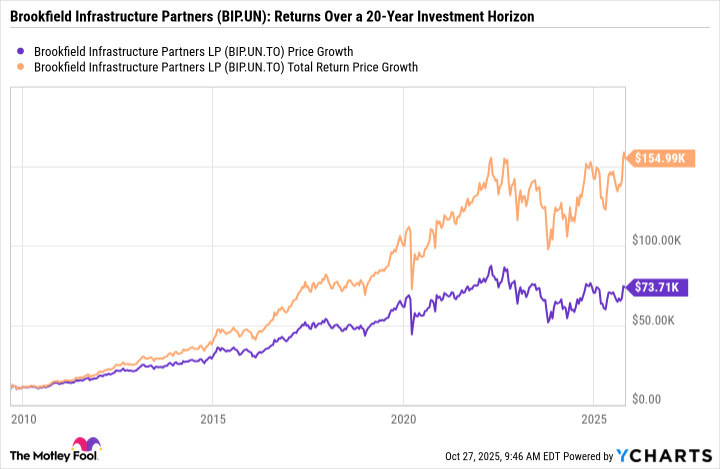
But how could the “boring” infrastructure company grow investors’ capital over the next decade?
The “secret” AI engine hiding in plain sight
BIP is arguably the best Canadian infrastructure stock to buy right now to profit from the artificial intelligence (AI) revolution. While management focuses on three unstoppable megatrends: Decarbonization, Deglobalization, and Digitalization, the last one is a goldmine.
The fast-emerging AI-powered global economy requires a massive build-out of physical assets, and Brookfield is building this infrastructure backbone. Its data segment already includes over 140 data centres, 308,000 telecom towers, and even two semiconductor manufacturing foundries. In fact, Brookfield’s partnership with Intel to build a US$30 billion semiconductor facility in Arizona is on the mark. Intel’s Arizona fabs will mass-produce the company’s latest and most advanced silicon for 2026, starting this quarter. Such deals are core growth drivers.
Brookfield fuels its growth with a brilliant strategy called “capital recycling”. It’s selling mature, slow-growing assets for good profits to reinvest that cash into high-growth areas. The infrastructure powerhouse’s asset recycling is gaining momentum with many takers in 2025, bringing in billions in fresh liquidity to plow into new acquisitions like the Hotwire fiber-to-the-home network in the U.S.
Investor takeaway
While no equity investment is risk-free, and Brookfield Infrastructure Partners essentially uses a significant amount of debt to execute its strategy, leverage is mostly a concern during high-interest rate regimes. Rates are coming down, and Brookfield maintains a strong BBB+ investment-grade credit rating, and most of its debt is locked in at fixed rates.
Brookfield Infrastructure Partners is a “get-rich-reliably” infrastructure powerhouse that offers a combination of secure, growing dividends and a powerful, hidden growth story that may successfully ride on AI infrastructure this decade. It might just be the best Canadian infrastructure stock to buy and hold for the next decade.