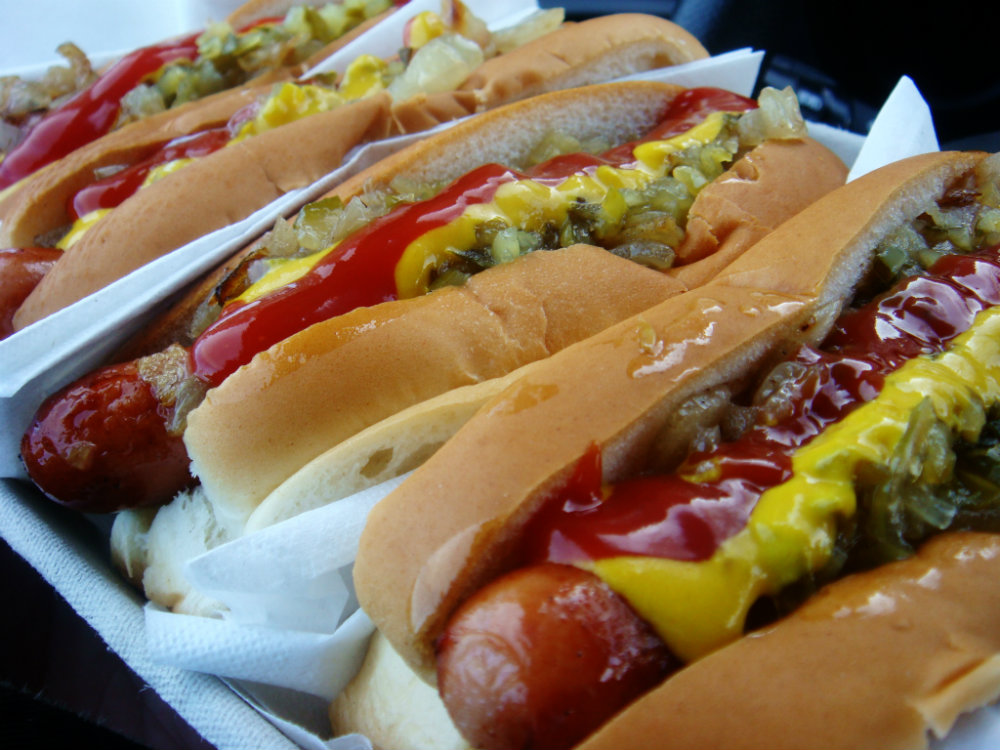
Every now and again, I could sure go for a nice hot dog.
I usually indulge my craving every time I head into Costco to do a little shopping. I delude myself into thinking that pushing a cart up and down a few aisles is hard work, so I reward myself with a $1.50 hot dog at the store’s food counter. They even throw in a free soda. It’s a great deal.
I’m not the only one who likes my meat tube shaped. According to research, Americans eat an estimated 20 billion hot dogs a year with consumption really spiking during summer’s barbecue season. And yet none of the 10 largest U.S.-based fast-food chains offer a hot dog on their nationwide menu.
This is changing with Restaurant Brands International Inc. (TSX:QSR)(NYSE:QSR) flagship banner Burger King announcing its plans to offer hot dogs in all U.S. stores starting February 23.
Hot dogs are a good idea for a number of different reasons. They’re cheap, which allows the company to push the item on its value menu. A hot dog value meal–with a small fries and drink–will be offered at an introductory price of just $4.49. The chain already has the equipment necessary to grill the meat, and hot dogs are becoming a trendy item, served at many boutique quick-service restaurants.
Hot dogs are a nice way for the company to differentiate from its two largest competitors in the hamburger space. There are only so many different kinds of burgers it can make, and every chain has a vast variety of chicken products. Adding hot dogs will also make the chain more attractive to parents looking for something quick and cheap that picky kids will eat.
Will this move alone be enough to boost the parent company’s share price?
Already good results
Over the last three months, Restaurant Brands shares have not performed terribly well, falling more than 13% on the Toronto Stock Exchange. Like many other Canadian stocks, it’s currently trading at a 52-week low.
Investor sentiment is mostly to blame for that, since underlying results are solid. In the company’s latest completed quarter, Burger King same-store sales grew 6.2%, an excellent showing. This compares to a 2.4% increase in the same quarter the year prior. Tim Hortons stores weren’t far behind, increasing same-store sales 5.3% versus 3.8% a year earlier.
Earnings were negative over the last 12 months, mostly due to one-time write-offs. Analysts predict the company will earn $1.76 per share for 2016, putting shares at a forward price-to-earnings multiple of 24.
The company gets more reasonably valued if we look at free cash flow. Over the last 12 months the company posted a free cash flow of US$730 million, while the stock has a current market cap of US$6.9 billion. That’s a price-to-free cash flow ratio of just 9.5, which is quite cheap.
There are still concerns, one of which is the company’s massive debt load. It owes more than US$12 billion, which is partially offset by US$975 million in cash. Out of the US$19 billion it has in assets on the balance sheet, more than US$14 billion are classified as either goodwill or intangibles. When 3G Capital acquired Tim Hortons in 2014, it really levered up the balance sheet to do so. Paying back that debt has to be a concern for any investor.
But at the same time, the world’s smartest investor obviously isn’t too concerned. Warren Buffett helped finance the deal, buying US$3 billion in preferred shares in exchange for a 9% annual dividend. Buffett continues to hold his preferred shares, so he must be pretty comfortable with the level of debt.
Restaurant Brands trades at a decent valuation, has the world’s greatest investor on its side, and now has the potential to really goose sales by introducing a unique item to Burger King’s menu. If hot dogs do take off, I doubt shares of this fast-food powerhouse will be trading at 52-week lows for long.