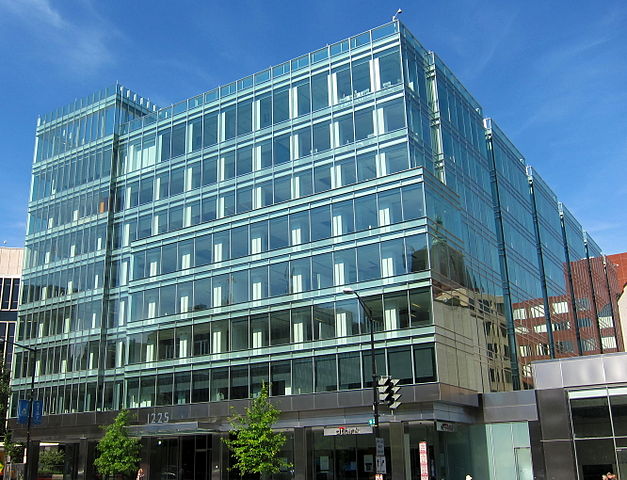
Photo: AgnosticPreachersKid. Licence: https://creativecommons.org/licenses/by-sa/3.0/
Friday is not shaping up to be a good day for Boardwalk REIT (TSX:BEI.UN). Shares have cratered, falling close to 6% or $2.89 each to $46.
The reason for the fall is Boardwalk’s abysmal fourth-quarter earnings. Funds from operations fell to $0.58 per unit for the quarter versus $0.86 per share in the same quarter last year. Total revenue fell 8.3% quarter over quarter, with net operating income down 20.4%. In other words, revenue was down while expenses were up. That’s not a good combination.
Full-year results were a little better. Total revenue was down 7.8% with net operating income falling 14.1%. Tough economic times in Alberta hit the company’s bottom line, plus the wildfires affecting Fort McMurray didn’t help.
Boardwalk just turned bearish on 2017 too. It slashed its guidance for the year, reducing expected funds from operations from a range of $2.70-2.90 per unit to a range of $2.30-2.65 per unit. Boardwalk posted funds from operations of $2.84 per unit in 2016, even after the terrible fourth quarter.
In short, investors knew things were bad in Alberta, where Boardwalk gets approximately 60% of its earnings. They just didn’t think things were that bad.
As a value investor, I’m naturally curious as to whether or not Boardwalk is a buying opportunity today. Let’s take a closer look.
Valuation
Let’s assume that Boardwalk can deliver funds from operations at the mid-range of its 2017 guidance, which would put us at $2.48 per share. Shares currently trade hands at $46. That gives us a price-to-funds-from-operations ratio of 18.5, which is hardly cheap.
If we use Boardwalk’s trailing funds from operations of $2.84 per share, we have a price-to-funds-from-operations ratio of 16.2. That’s better, but shares are hardly a screaming buy at today’s levels. Besides, it could be several years until Boardwalk can replicate 2016’s earnings. Alberta’s economy does seem to be getting better, but it’s certainly not great.
Boardwalk is much cheaper on a price-to-book-value perspective. The company has a net asset value of $60.94 per share, plus $1.95 per share in cash, giving each share a fair value of $62.89 each. Thus, shares trade at just 73% of book value. That’s a little closer to what we’re looking for.
But many analysts think Boardwalk should be writing down the value of some of its Alberta-based properties. It did do that in 2016, decreasing its book value from $65.77 at the beginning of the year to $62.89 at the end of the year. While that’s a good start, many are saying the true value of its portfolio is much less.
Taking care of shareholders
It looks as though Boardwalk is the kind of turnaround story that will require time. In the meantime, management is making sure shareholders get rewarded for their patience.
The company’s dividend was hiked in 2016, increasing from $0.17 to $0.1875 per share on a monthly basis. That’s good enough for a 4.9% yield with a payout ratio of between 85% and 98% of 2017’s projected funds from operations. That’s a little high, but it should be manageable.
Management has also been taking advantage of the temporally depressed share price to buy back units. Boardwalk spent $32.6 million in 2016 buying back 666,000 shares. That’s in addition to the $37.1 million in paid in 2015 to buy back 740,800 shares.
Finally, Boardwalk’s senior management are still big believers in the company, and they continue to hold on to their shares. Management owns about a quarter of the company.
The bottom line
Even after a big decline, Boardwalk shares aren’t really cheap at today’s prices. But the company is doing smart things during this downturn, including buying back shares, building new units, and giving investors a dividend increase.
Boardwalk could be one of these companies that never gets truly cheap. If you believe that, then today could be a very good entry point. And if not, then there could be a better opportunity to buy in down the road.