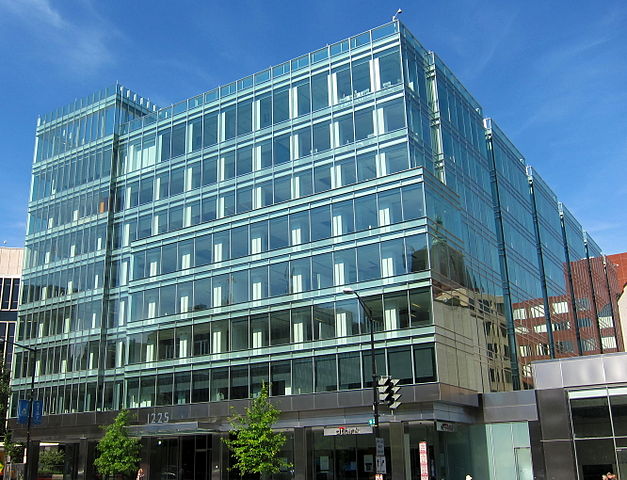
Photo: AgnosticPreachersKid. Licence: https://creativecommons.org/licenses/by-sa/3.0/
Commercial real estate is the crown jewel of property investing with large tenants that rent lots of square footage. More so, these are tenants that have strong balance sheets and tend to sign multi-year deals, resulting in reduced turnover. But not all commercial real estate is treated equally. I believe you want to focus your efforts on properties in more densely populated areas.
That’s why, I’m particularly excited about the prospects for Allied Properties Real Estate Investment (TSX:AP.UN), an owner, manager, and developer of urban office environments. And unlike other commercial REITs that grew by investing in western Canada when oil prices were high, Allied Properties has the bulk of its square footage in Toronto and Montreal — regions that have far more tailwinds behind them.
All told, Allied Properties operates in nine markets: Toronto with 4.58 million square feet; Montreal with 4.24 million square feet; Calgary with 1.01 million square feet; Kitchener with 538,000 square feet; Winnipeg with 342,000 square feet, Edmonton with 293,000 square feet; Vancouver with 284,000 square feet; Quebec City with 223,000 square feet; and Ottawa with 221,000 square feet.
Not only does it have geographic diversification, but its tenants are also quite diverse. Its 10 largest tenants account for only 18% of its business with its largest tenant, Equinix, only accounting for 2.8% of its rental revenue with a weighted average remaining lease term of 8.1 years. All told, its leasing is broken up into 29.3% in business and professional services, 28.3% in telecommunications and information technology, 13.1% in media and entertainment, 11.9% in retail (head office and storefront), 8.2% in parking, 4.6% in financial services, 2.6% in government, and 2% in education and institutions.
What’s important is that Allied Properties continues to grow, albeit at a slow and steady pace. At the end of Q1 2016, it owned 150 properties. At the end of Q1 2017, that grew to 156 properties. But it’s not just the number of buildings the company owns, but also how occupied they are. Across its entire network, its occupancy rate is 92.6%. This means that 7.4% of its total available square footage is currently unleased. Its major markets of Toronto, Montreal, and Calgary have an occupancy rate of 95.9%, 92%, and 84.3%, respectively. As long as Toronto and Montreal stay strong, the company will be fine.
All in all, the company continues to experience incredible growth. When it went public in February 2003, it had $120 million worth of assets and a market capitalization of $62 million. At the end of Q1 2017, it had assets worth $5.3 billion and a market capitalization of $3.1 billion. Clearly, this REIT knows how to grow.
But how are the financials?
In Q1 2017, Allied Properties had net income of $0.94 per share, up from $0.48 in Q1 2016. Its funds from operation were actually down by a penny to $0.53 per share with adjusted funds from operation (AFFO) staying relatively flat. Despite that one-penny drop, Allied Properties still brings in enough cash to pay out a $0.38 per quarter dividend with an AFFO payout ratio of 95.1%. Although I’d like to see this drop a little, with occupancy rate increasing, I expect revenue to follow.
All in all, the company believes that it has more growth ahead of it thanks to a strong Toronto real estate market resulting in increasing rents. Further, it predicts even more occupancy gains in Montreal, Edmonton, and Vancouver, though it doesn’t see much strength in its Calgary units. Nevertheless, Allied Properties is a great opportunity to gain diverse commercial real estate focused on major urban markets.