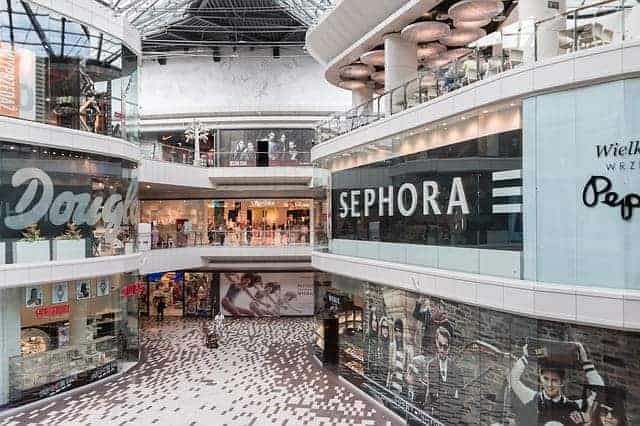
The apocalypse for traditional brick-and-mortar retailers continues. In less than a year, the volume of bankruptcies in an industry that is undergoing significant transformation has almost doubled from what it was a year ago. There are signs that the worst is yet to come for brick-and-mortar retailers because the industry’s revolutionary transformation far from over.
Legendary investor Warren Buffett has weighed in, stating at Berkshire Hathaway Inc.’s annual meeting earlier this year, “The department store is online now…”
Now what?
E-commerce behemoth Amazon.com, Inc. (NASDAQ: AMZN) has substantially disrupted the industry in such a significant manner to spark this apocalypse. In fewer than three decades, it has gone from being an industry start-up that survived the dot-com crash to a company with a market cap in excess of US$460 billion.
This relentless juggernaut appears to be far from reaching the pinnacle of its growth.
Not only has it proven exceptionally nimble for a company of its size, which can be attributed to it being among the leading companies globally for expenditure on research and development, it continues to refine its value proposition and product offerings while widening its operational scope. This coupled with the views of industry bodies and analysts that the e-commerce boom is far from over means that Amazon can only continue to grow and that there is further pain ahead for traditional retailers. Even after a decade of failures, Amazon seems ready to crack the groceries and fresh food market thanks to the Whole Foods Inc. acquisition.
Because e-commerce sales are estimated to make up a mere 8.5% of total retail sales worldwide, there is plenty of room for e-commerce companies to grow. That growth will proceed at an unprecedented rate because of rapidly evolving technology and an amplified uptake of technology as well as innovation among millennials, which are becoming the main consumer market.
E-commerce is still in its infancy, meaning that the revolutionary transformation of retail has only just begun. According to the U.S. National Retail Federation, e-commerce sales as a proportion of total retail sales are expanding at roughly triple the rate of overall retail sales growth.
According to the Federation, “Younger, newer and more engaged digital shoppers adopt digital technologies more quickly, and will hasten the expansion of digital grocery shopping further…”
That considered with the relentless digitization of society means that it is only a matter of time before e-commerce becomes the preferred means of transacting, further supporting Buffett’s statement.
So what?
Brick-and-mortar retailers are unattractive investments. Their decline is weighing heavily on the fortunes of real estate investment trusts (REITs) focused on retail properties. I have previously written about how to profit from e-commerce’s exponential growth by investing in Canada’s Amazon, Shopify Inc. (TSX: SHOP)(NYSE:SHOP). Another opportunity is to invest in industrial REITs that are focused on warehouses and logistics centres.
You see, logistics infrastructure, including warehouses, needs to grow at a rapid rate to support the anticipated growth in e-commerce sales. Analysts estimate that e-commerce retailers need roughly three times the warehouse space of brick-and-mortar retailers, and if e-commerce retail sales double, 600 million new feet of warehouse demand will be created.
One REIT positioned to benefit from this trend is Pure Industrial Real Estate Trust (TSX:AAR.UN), which has 165 income-producing industrial properties across the U.S. and Canada. E-commerce represents 30% of its portfolio, while 44% is based on transportation and logistics. It finished the second quarter 2017 with an impressive 97.5% occupancy rate and a stunning 37% year-over-year increase in adjusted funds from operations. Such a solid performance, along with growing demand for warehousing and logistics, supports the sustainability of its juicy 5% yield.