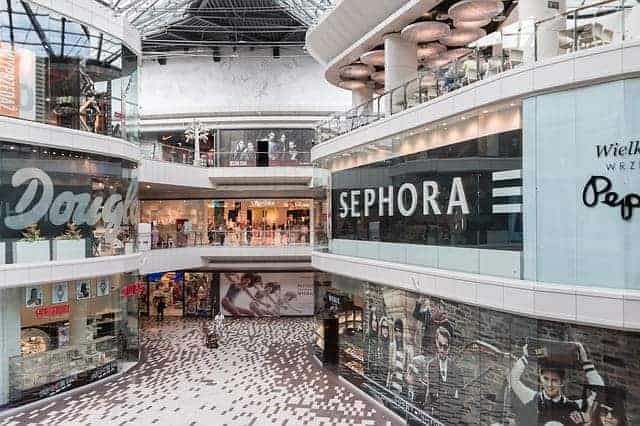
There are claims that the death of the shopping mall as we know it could be underway. The massive transformational shift occurring in the retail industry triggered by the rise of e-commerce and online retail behemoth Amazon.com, Inc. (NADAQ:AMZN) has challenged the very viability of traditional brick-and-mortar retailers, especially the department store.
The latest victim is Sears Canada Inc., which filed for bankruptcy in June this year, and, despite efforts to resurrect, the beaten-down department store chain will commence liquidation in October. That is bad news for many retail real estate investment trusts (REITs), because major department store chains like Sears have long been important anchor tenants that virtually ensure a shopping mall’s survival.
Now what?
This phenomenon is creating considerable anxiety over the future of the shopping mall and retail REITs. Many shopping malls were already struggling to fill the space left after Target Corporation bailed out of Canada and closed its 133 stores. The department store retailer made the decision after realizing that it would fail to turn a profit in an already saturated department store market, where it lacked any competitive edge.
There is the also the recent failure of Toys “R” Us; its Canadian operations filed for bankruptcy protection in mid-September. The retailer has 82 stores nationally, and it is unclear if it will emerge as a going concern.
Sears Canada’s liquidation is a massive blow for its U.S. parent Sears Holding Corp. (NASDAQ:SHLD) and is an even bigger blow for many Canadian shopping malls. It means the end of plans to resurrect the one-time retail giant and the closure of its remaining 150 stores.
You see, these large department store chains act as anchor tenants for shopping malls, and their failure can spark a cascading effect that eventually leads to the failure of a mall. Many smaller tenants have co-tenancy clauses that permit them to break their lease if an anchor tenant leaves.
This phenomenon isn’t restricted to large department store chains; smaller retail chains are also failing in droves, while others are rationalizing their operations and shutting stores across Canada.
While the full impact for many retail REITs has yet to be felt, it will be felt in coming months as retailers shutter more brick-and-mortar locations.
So what?
These events are weighing heavily on REITs with considerable exposure to brick-and-mortar retail. Among the most vulnerable is micro-cap Partners REIT (TSX:PAR.UN). Sears ranks as its fourth-largest tenant by leased area, and Partners only has a market cap of $141 million, yet, at the end of the second quarter, it had long-term debt of $181 million.
Even Canada’s largest diversified REIT RioCan Real Estate Investment Trust (TSX:REI.UN) has suffered because of the decline of the department store, and to some degree, it remains vulnerable. Its top 10 tenants by revenue are retailers including Lowes and Walmart Canada, which are feeling the pressure that Amazon is exerting on brick-and-mortar retail.
Nonetheless, RioCan has reduced the potential impact by selling its 49 U.S. retail properties for US$1.9 billion because of concerns over the long-term impact of the transformation of retail and the demise of the department store. Because of the heavy concentration of shopping malls in the U.S. per head of the population, it is the most vulnerable market. While this has allowed RioCan to bolster its balance sheet and refocus its portfolio away from retail properties, thereby reducing risk, it remains vulnerable because the worst of the carnage in Canada is far from over.
E-commerce has not penetrated Canada to the same extent as the U.S., and online retail has not had the same uptake among consumers, meaning there is further carnage ahead, because online retail sales are poised to expand at a rapid rate.