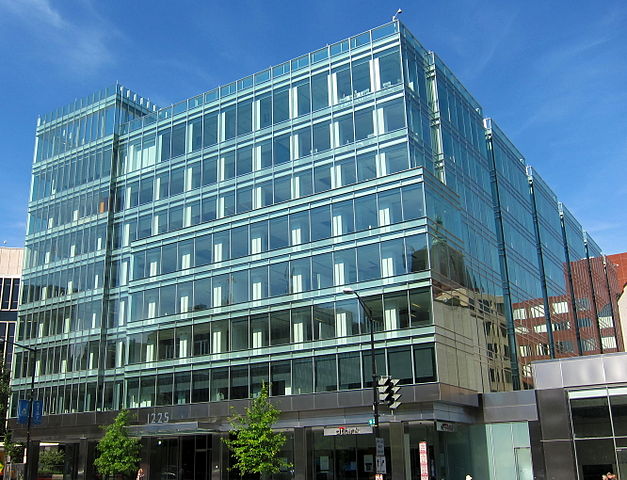
Photo: AgnosticPreachersKid. Licence: https://creativecommons.org/licenses/by-sa/3.0/
The Globe and Mail reported October 26 that Brookfield Property Partners LP (TSX: BPY.UN)(NYSE:BPY) had put its 50% ownership interest in the Bay Adelaide Centre in downtown Toronto up for sale. That follows its decision in March to sell its 51% interest in 245 Park Ave., a 50-year-old, 45-storey, 1.8-million-square-foot office building it owns in New York City in partnership with the New York State Teachers’ Retirement System.
Brookfield is expected to rake in as much as $1.7 million from the sale of both office buildings, which suggests the worm might be starting to turn when it comes to commercial real estate.
Vacancies are low
According to commercial real estate advisory CBRE, office vacancies in Toronto and Vancouver are the lowest in both Canada and the U.S. at 4% and 5%, respectively.
Why would BPY be selling if things were going so swimmingly in the office space?
The entire Brookfield ecosystem, whether it’s Brookfield Asset Management Inc. (TSX:BAM.A)(NYSE: BAM) or BPY itself, allocates capital in those places where it can get the best bang for its buck regarding annual and cumulative returns on its investment capital.
Brookfield feels it can put the money to better use elsewhere.
“On its core holdings side [Bay Adelaide, 245 Park Ave.], the expectation is 10% to 12% in total returns,” wrote Fool contributor Jacob Donnelly in May. “On the opportunistic side, the expectations are 20%.”
Brookfield continues to grow the opportunistic side of its business. In April, it raised $9 billion for its second global opportunistic fund, of which $2.3 billion, or 26%, came from BPY itself. Areas of high-growth real estate investment include self-storage, student housing, and manufactured housing.
“Our Opportunistic segment holds interests in certain real estate properties with weak financial conditions, poor operating results, substantial financial needs, negative net worth or special competitive problems, or that are over-leveraged,” stated BPY’s 2016 annual report. “Our ownership of underperforming real estate properties involves significant risks and potential additional liabilities.”
There are more significant risks in this area of its portfolio, but there are also greater rewards. It’s not necessarily that BPY doesn’t like owning commercial office space anymore; it’s just that it sees other areas where its capital can earn better returns.
The entire Brookfield group companies all operate this way — it recycles capital.
Valuations getting richer
The recycling of assets that began in 2016 has continued throughout most of this year. These assets will reap benefits for shareholders in the next three to five years as they appreciate in value.
However, as I mentioned in my headline, this recycling of assets also sends out a potential “sell” signal for investors holding office REITs. That’s because buyers of office properties are paying more today than they spent 12 months ago, 24 months ago, and so on.
Office real estate is not cheap.
“Over the course of the year, we successfully raised approximately $3 billion of net equity from core office and retail asset sales at attractive valuations,” stated BPY’s annual report. “The majority of these transactions — which include properties in New York, London, Sydney, Las Vegas, Washington, DC and Vancouver — were executed at cap rates between 3% and 5%.”
That means you as a new owner of office real estate are getting annual rents that generate as little as 3% on your investment. At some point, the bubble has to burst. Brookfield is just a little bit ahead of the curve.
Bottom line on BPY
Brookfield Property Partners was spun off by Brookfield Asset Management in 2013. Since then, as Fool.ca contributor Tyler Kirkpatrick stated in May, it’s delivered an annualized total return of 10.8% — almost 60% better than the TSX.
With all the opportunistic investing BPY has going on, you might want to sell your units in your office REIT and recycle them into BPY or BAM.A, which owns 62% of Brookfield Property Partners.
Either way, you’ll be glad you did.