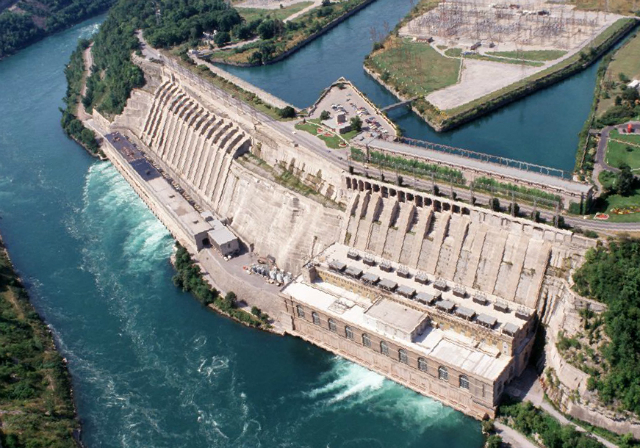
Photo: Ontario Power Generation - Adam Beck Complex. Rotated. Resized. Cropped. Licence: https://creativecommons.org/licenses/by-sa/2.0 Source: https://commons.wikimedia.org/w/index.php?curid=2564777
It has been a tough start to 2018 for Canadian investors. The S&P/TSX Composite Index has fallen by almost 4% since the start of the year, weighed down by energy majors and the big banks. This emphasizes that stock picking forms an important part of portfolio construction, particularly if an investor is seeking to beat the market. One stock that is poised to soar and will surely outperform the index over the long term is Brookfield Renewable Partners L.P. (TSX: BEP.UN)(NYSE: BEP).
Now what?
Brookfield Renewable owns and operates a portfolio of renewable energy assets across North and South America as well as Europe. It has also established an operational presence in the rapidly growing clean energy markets of India and China.
The partnership has a long history of outperforming the S&P/TSX Composite. Over the last 10 years, it has returned 130%, including distributions, for investors compared to the index gaining a mere 21%.
Brookfield Renewable is well positioned to unlock considerable value for investors because of improving operational conditions and recent acquisitions. Up until recently, challenging environmental conditions were affecting hydrology and water levels, which saw Brookfield Renewable battling to meet electricity output targets because of its reliance on hydroelectricity generation.
That is all changing, however, because improved hydrology in North and South America gave its 2017 power generation a solid lift. Actual electricity produced for the year was 21% higher than 2016 and 630 gigawatt hours more than the long-term average. This gave earnings a solid boost to see EBITDA soar by 21% year over year and funds flow from operations (FFO) shot up by an impressive 31%.
Such a strong improvement in Brookfield Renewable’s performance allowed it to hike its quarterly distribution by 5%, which was the eighth straight annual dividend increase and gives it a very tasty yield of over 6%.
There is every sign that the partnership will continue to unlock value for investors and deliver strong results.
You see, Brookfield Renewable remains focused on expanding its operations through acquisitions. The last significant deal that it completed was along with its institutional partners buying Colombian hydroelectric utility Isagen SA for US$2 billion in early 2016.
During the fourth quarter, as part of a consortium led by Brookfield Renewable, it completed the US$656 million acquisition of 51% of TerraForm Power Inc. (NASDAQ:TERP) and 100% of Terraform Global. The partnership’s contribution to the deal was US$203 million, which gave it a 16% interest in TerraForm Power and added 3,600 megawatts of contracted solar and wind power to its portfolio. This has further diversified its assets and reduced its reliance on hydroelectricity, therefore reducing the future impact of poor hydrology on its operations.
It will also lift Brookfield Renewable’s earnings, allowing to meet its targeted long-term return of 12-15% and further hike its distribution.
Importantly, even after completing the deal, the partnership finished 2017 with US$1.5 billion in liquidity, leaving it well positioned to continue making accretive and opportunistic asset purchases when they present themselves.
So what?
After completing the TerraForm deal in late 2017 and stronger operational performance, Brookfield Renewable is poised to soar. With its juicy yield of more than 6%, Brookfield Renewable should deliver outsized returns to investors, thereby beating the market. It also possesses considerable defensive characteristics, which makes it a great hedge against market uncertainty.