In recent weeks, talk of a stock market bubble has become more and more common. With central banks pushing low interest rates and buying up assets, some people have wondered whether the recent rally is sustainable. In May, the Federal Reserve began buying bond ETFs in a bid to keep the capital markets afloat. Rumours circulated that they’d even begin buying stocks.
All of the above would suggest that the U.S. markets are being propped up artificially — adding to concerns about a bubble. But what about Canadian markets? The Bank of Canada, like the Fed, responded to COVID-19 by slashing interest rates and buying up bonds. The bank even intervened to rescue debt-addled provinces that couldn’t borrow otherwise.
Still, Canadian stocks haven’t rallied as hard as their American counterparts. They’re up from their March lows but down for the year. By contrast, the NASDAQ is up 23% for the year. That doesn’t mean that the most recent TSX rally isn’t a bubble. If the true value of the TSX Composite is less than its market value, the recent gains could still be considered unsustainable. Before exploring that, let’s look at how the TSX has performed over the last 10 years.
Dismal 10-year returns
As you can see in the Koyfin chart below, the TSX Index rose from 12,234 to 16,431 over the past 10 years. That’s a percentage point change of about 35%.
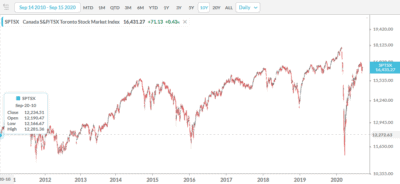
According to Koyfin, that gives the index a 10-year CAGR of just 3.03% — not exactly awe inspiring. Taken over a 10-year time frame, the TSX certainly doesn’t look like it’s in a bubble. However, a long-term trend of sluggish returns doesn’t rule out the possibility. According to Nasdaq.com, a bubble is “a market phenomenon characterized by surges in asset prices to levels significantly above the fundamental value of that asset.”
By this definition, the TSX’s more recent moves could be described as a bubble. Starting near the end of Q1, TSX stocks began a pronounced rally, rising 46% from March 23 to the present. However, reported earnings for Q1 and Q2 actually showed mostly misses and year-over-year declines. Assuming that Q1 and Q2 represent a long-term reality, then the gains from March 23 onward fit NASDAQ’s definition of a bubble. Of course, most investors don’t believe the damage in those quarters will persist long term. Hence the rally, which was basically a bet on the future recovery.
A relatively pricey TSX index
According to National Bank of Canada, the TSX has a forward P/E ratio of 18.1. Compared to U.S. indexes, that’s low. However, it’s high compared to historical norms, which put the TSX P/E at about 15.4. What this says is, if analyst earnings estimates are met, then the TSX is pricey at today’s levels. That would corroborate the idea that the past few months’ gains have been a bubble.
Foolish takeaway
The big takeaway of all the above is that you’d be wise to tread carefully if you choose to buy the TSX today. ETFs like the iShares S&P/TSX Capped Composite Index Fund (TSX:XIC) are coming out of a several months-long rally during which earnings actually declined and future EPS estimates remained muted. You can’t really say whether you were in the bubble until after the fact. But it’s possible that the TSX is in one now.
Normally, index funds like XIC are considered “safe” investments because of their built-in diversification and low fees. At today’s prices, however, they may be overvalued. Whether you choose to invest in XIC or any other investment, it’s wise to play it safe in today’s market.