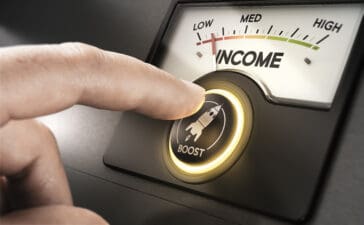
Canadians were more than just a little worried when the Canada Revenue Agency (CRA) announced back in August that the Canada Emergency Response Benefit (CERB) would be coming to an end. It meant that those receiving $2,000 a month from the program would now have to find another method of income. That is, until the Canada Recovery Benefit (CRB).
The CRB update provided Canadians with another way to receive cash, though with stricter guidelines. In fact, CRB isn’t the only benefit available to Canadians. So, the CRA wanted everyone to know, just because CERB is over doesn’t mean you can’t receive income. In fact, you could receive up to a year’s worth of income from these new benefits.
The CRB update
While there are four different benefits available, many Canadians have begun referring to the change simply as the CRB update instead of CERB. The benefits focus on Employment Insurance (EI), the Canada Recovery Caregiving Benefit (CRCB), the Canada Recovery Sickness Benefit (CRSB), and, of course, CRB.
I’ll briefly go over these benefits in case you’re unaware.
EI has changed where employees only need 120 hours of work to be able to apply for EI. This is down 300 hours from the 420 hours you need prior to the change. Employees would receive a minimum of $500 per week from the new guidelines.
Then, CRCB is aimed at those who have to stop work to take care of a dependent. A dependent in this case is both a child under 12 or an elderly or sick individual who needs care. If the facilities, schools, or day care are closed because of the pandemic, caregivers can apply for the benefit. You can receive $500 per week for a total of 26 weeks from this benefit for a total of $13,000 before taxes.
The CRSB is simply for if you either contract COVID-19, or need to self-isolate after coming into contact with someone with COVID-19. In this case, you will receive $500 per week for a maximum of two weeks while you recover.
Then there is, of course, the CRB. This is if you are eligible to work but are self-employed and so cannot get EI, or you’re not employed because of COVID-19 and not eligible for EI. It also applies if your income was reduced by at least 50% due to COVID-19. The benefit, paid in two-week periods, provides $500 per week as well for a maximum of 26 weeks.
Monthly income
So, as you can see, you can still receive that $2,000 per month. In fact, if you were to apply for each benefit if you aren’t eligible for EI, that’s 54 weeks of benefits you can claim. That’s a total of $27,000 in just over a year! But there’s an obvious problem.
The CRB update means you are either out of a job without EI, are looking after a dependent, or are sick yourself. All of these scenarios are certainly not ideal. So, perhaps there is another way to bring in $27,000 in a year’s time.
I would simply look at an industry doing well and that pays high dividends. In this case, I would recommend a company like WPT Industrial REIT (TSX:WIR.U). WPT Industrial currently has a number of advantages. It’s a real estate investment trust (REIT), which means it must pay out 90% of taxable income to shareholders, and this would be as dividends. The company has remained steady with its dividends, currently at 5.75% as of writing.
The other advantage is it’s part of the e-commerce boom. The company has 102 light industrial properties where e-commerce giants store and ship products. As e-commerce grows, so too will WPT Industrial. It also means it’s unlikely to see the slump other REITs will have with a housing crash.
Bottom line
If you want to bring in $27,000 per year, it will take a massive investment. At current prices, if you focus just on dividend income you would need to invest $461,842 in WPT Industrial shares. However, this company is set to grow by leaps and bounds for long-term holders. Returns could double in the next year. So, if you invest in 1,000 shares today for $13,000, you could bring in $760 in dividends this year, and see your shares double to $26,000 for a grand total of $26,760 in just a year! Better still? Those returns and dividends will come back every year you own them.