Canada Goose Holdings (TSX: GOOS)(NYSE: GOOS) stock soared by 20% on Friday to go over $60 after the luxury parka maker reported its second-quarter results. The growth stock is up by more than 60% year to date.
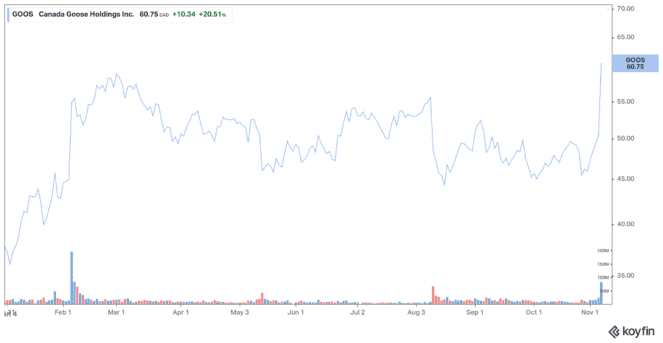
The market was visibly happy that the company raised its guidance for fiscal 2022. Canada Goose now expects total revenue for fiscal 2022 to exceed the outlook originally forecast on May 13, 2021.
Canada Goose also beat analysts’ expectations on Friday, reporting higher-than-expected revenues for its second quarter. Analysts expected the company to post a quarterly loss. However, Canada Goose posted a profit, although lower than a year ago. This positive surprise also contributed to boosting the retailer stock price.
The winter clothing maker envisions a strong holiday season this year as the company takes advantage of growing demand for its luxury parkas in China and remains immune to a global supply chain crunch in the sector.
Let’s look at Canada Goose’s quarterly results in more detail.
Revenue and earnings
Canada Goose saw its revenues increase in the second quarter, thanks to a surge in online sales and a strong demand for its luxury parkas as economies reopen. Let’s have a deeper look at the retailer’s quarterly numbers.
In the second quarter of 2022, Canada Goose posted total revenue of $232.9 million — an increase of 19.6% from $194.8 million in the second quarter of 2021. Excluding $28.8 million of temporary PPE sales in the comparative quarter, total revenue increased by 40.3%. Global e-commerce revenue rose 33.8%, driven by growth in all major existing markets.
Direct-to-consumer (DTC) sales and wholesale revenue also increased in the quarter ended September 26. DTC revenue rose 80.1% to $83.2 million, driven by higher sales from existing retail stores, e-commerce growth, and retail expansion. Sales in China were strong, as DTC revenue in Mainland China increased by 85.9%.
Wholesale revenues rose 24.8% to $147.9 million thanks to an earlier timing of shipping orders compared to fiscal 2021. Other revenue was $1.8 million, down from $30.1 million. The decline is attributable to sales of PPE in the comparative quarter, which were temporarily manufactured in support of COVID-19 response efforts.
Meanwhile, net income amounted to $9.0 million, or $0.08 per diluted share, for Q2 2022, down from $10.4 million, or $0.09 per diluted share, in the second quarter of 2021.
Non-IRFS adjusted net income came in at $0.12 per share in the quarter, up from $0.10 per share in the same period a year ago.
Analysts on average expected revenue of $206.1 million and an adjusted loss of $0.09 per share for the quarter, according to forecasts collected by financial data firm Refinitiv.
Canada Goose raised its outlook for the full year
Canada Goose’s president and CEO Dani Reiss said, “Our second-quarter results demonstrate our momentum. Across all channels, we are seeing strong leading indicators of peak season demand. With accelerating DTC trends, growing lifestyle relevance and unique supply chain flexibility, we believe we have the right foundation in place for an outstanding fiscal 2022.”
The company raised its fiscal 2022 outlook based on year-to-date performance and current trends. It now expects total revenue of $1.125 billion to $1.175 billion, compared to exceeding $1,000 billion. Non-IFRS adjusted net income per diluted share is expected to be in the $1.17 to $1.33 range.
Unlike some luxury competitors, Canada Goose produces its main items in Canada, cushioning the impact of rising shipping costs.