By retirement, you’ll be maximizing your income. Your income sources could include your Tax-Free Savings Account (TFSA), Registered Retirement Savings Plan/Registered Retirement Income Fund (RRSP/RRIF), Old Age Security (OAS), and Canada Pension Plan (CPP) payments.
The other end of the equation is budgeting to spend within your means. Remember that your retirement fund could still continue to grow during retirement, though your investments would probably be much more conservative post-retirement.
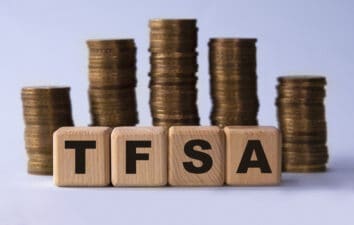
Your TFSA helps you retire
What you earn in your TFSA is tax-free, because your TFSA contributions were originally taxed. Therefore, your TFSA income and returns do not increase your taxable income, even when you withdraw from your TFSA.
What’s wonderful is that even during retirement, your TFSA room continues to grow every year so that you can persistently invest in your TFSA for tax-free income. For example, you might hold big Canadian bank, utility, and telecom stocks like Royal Bank of Canada, Fortis, and BCE in your TFSA for solid dividend income. Notably, it’s not necessarily the best time to buy them now, as they are all fully valued. They do provide safe yields of 3.4%, 3.6%, and 5.3%, respectively, though.
This year, your TFSA limit is once again $6,000. Unused room from previous years also accumulate. If you have investments in your taxable accounts, you can transfer them in kind into your TFSA for tax-free returns. Just note that the investments would be considered sold in your taxable accounts. So, make sure the investments are in the green when you make the transfer.
How your RRSP/RRIF works in retirement
The idea is to contribute to your RRSP in your working years to reduce taxes and compound the investments tax-deferred so that you can withdraw income during retirement ideally at a lower tax bracket.
According to MD Financial Management, “You can convert your RRSP to a RRIF as early as age 55. However, once you convert to a RRIF, you must make minimum annual withdrawals.” Withdrawals are taxable income, which can result in a clawback in your OAS and other benefits.
Sun Life explains, “By the end of the year you turn 71, you’re required by law to close down your RRSP.” Often the RRSP is turned into an RRIF that has minimum annual withdrawals that start with 5.28% of the RRIF at age 71. Withdrawal rates rise each year until age 95 when they peak at 20% annually.
How much monthly income are you getting from OAS payments?
The maximum monthly OAS payment from January to March 2022 is $642.25. If your taxable income exceeds $81,761 in 2022, you’ll start experiencing OAS clawbacks. Having an income of over $133,141 this year will result in no OAS payment at all.
What CPP payment can you expect?
All your years of CPP contributions start paying off when you begin receiving CPP payments. The Ontario Securities Commission notes that “You can start receiving CPP as early as age 60 (at a reduced rate) and as late as age 70 (at an increased rate).” The average CPP payment was $702.77 per month in October 2021. The maximum CPP payment in 2022 is $1,253.59 a month.
By estimating the income you’re getting in retirement, you can better plan your retirement life. Talk to a qualified financial planner to work out what your retirement might look like. Ideally, do so early on before you actually need to retire.