I’m a big proponent of passive investing. Countless studies have demonstrated the inability of most stock pickers to beat the market consistently, especially when benchmarked against the long-term performance of a simple index fund.
Indexes like the S&P 500 and the S&P/TSX 60 are regarded as barometres of U.S. and Canadian stock market performance, respectively. The aggregate performance of their underlying stocks is considered to reflect the average market return over long periods of time.
For Canadian investors, implementing a passive buy-and-hold strategy with either of these indexes is a great idea. You can do so using exchange-traded funds (ETFs) that track each index. The question is, which one should you buy? Each index has its own pros and cons, and today we’ll be exploring those.
The S&P 500
The S&P 500 is a market cap-weighted stock market index that tracks the 500 large-cap stocks listed on U.S. exchanges, such as Microsoft, Apple, Alphabet, JPMorgan, and Amazon. It spans the technology, healthcare, financials, communications, consumer staples, consumer discretionary, industrial, and energy sectors.
To track the S&P 500, you can buy Vanguard S&P 500 Index ETF (NYSE:VOO). This ETF is extremely cheap, with a management expense ratio (MER) of just 0.03%. The fund has high assets under management and good daily trading volume, making it a popular choice for retail investors.
However, VOO is denominated in USD, so you’ll need to convert CAD over. This will cost you a currency conversion fee, unless you’re using Norbert’s Gambit. As well, U.S.-listed ETFs incur a 15% foreign withholding tax on the dividend yield unless held in an RRSP, so you’ll need to account for that.
The S&P/TSX 60
The S&P/TSX 60 is a market cap-weighted index of the 60 largest stocks trading on the Toronto Stock Exchange (TSX). Its top holdings consist of blue-chip stocks such as Royal Bank of Canada, Shopify, Enbridge, and Canadian National Railway. Compared to the S&P 500, the S&P/TSX 60 is more heavily weighted towards the financial and energy sectors.
To track the S&P/TSX 60, you can buy iShares S&P/TSX 60 Index ETF (TSX:XIU). This ETF is the oldest one in Canada, with assets under management of more than $11 billion and high liquidity. XIU is more expensive than VOO, with a MER of 0.20%. This is still considered inexpensive for an ETF though.
XIU also pays a respectable dividend, thanks to its many underlying Dividend Aristocrat stocks in the energy, banking, telecom, and utilities sectors. Currently, the 12-month trailing yield stands at 2.41% and is paid quarterly. Reinvesting this dividend can significantly boost your returns.
Which is better?
A word of caution: the backtest results provide below are hypothetical in nature, do not reflect actual investment results, and are not guarantees of future results. Hypothetical returns do not reflect trading costs, transaction fees, or actual taxes due on investment returns.
That being said, from 2000 to present, with all dividends reinvested, VOO and XIU were neck and neck, with similar returns, volatility, drawdowns, and Sharpe ratio.
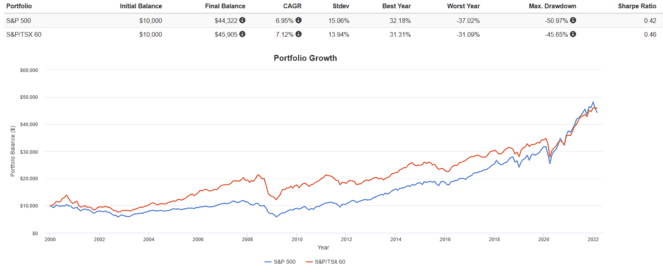
The answer here is to buy both. The U.S. and Canadian markets take turns outperforming. New investors might only remember the bull run the S&P 500 had during the last decade. Older investors will remember the “lost decade,” where the S&P/TSX 60 beat the S&P 500 handily. Buying both VOO and XIU will mitigate that risk.
Good investors avoid putting their eggs in a single (geographical) basket. The recent spell of U.S. outperformance might mean it’s a good time to buy the Canadian index while its still low in comparison. Over time, the difference will narrow, and you’ll minimize your chance of being stuck with years of poor results.