Welcome to a series where I break down and compare some of the most popular exchange-traded funds (ETFs) available to Canadian investors!
An allocation to gold can provide a tangible diversification benefit for portfolios due to its lower correlation with both stocks and bonds. Gold also offers a hedge against geopolitical unrest and currency devaluation. Thankfully, major fund managers provide a set of low-cost, high-liquidity ETFs that offer exposure to gold bullion.
The two tickers up for consideration today are Sprott Physical Gold Trust (TSX:PHYS) and iShares Gold Bullion ETF (TSX:CGL). Which one is the better option? Keep reading to find out.
PHYS vs. CGL: Fees
The fee charged by an ETF is expressed as the management expense ratio (MER). This is the percentage that is deducted from the ETF’s net asset value (NAV) over time and is calculated on an annual basis. For example, an MER of 0.50% means that for every $10,000 invested, the ETF charges a fee of $50 annually.
PHYS has a MER of 0.42% compared to CGL at 0.55%. For a $10,000 portfolio, the difference works out to around $13 per year, which can quickly add up over time, especially as your account grows bigger. The win goes to PHYS here.
PHYS vs. CGL: Size
The size of an ETF is very important. Funds with small assets under management (AUM) may have poor liquidity, low trading volume, high bid-ask spreads, and more risk of being delisted due to lack of interest.
PHYS has attracted AUM of $5.84 billion, whereas CGL has AUM of $786 million. Although both are sufficient for a buy-and-hold investor, PHYS is currently the more popular ETF among Canadian investors.
PHYS vs. CGL: Holdings
Both ETFs hold deposits of gold bullion stored in secure vaults. PHYS currently holds a total of 3,128,190 ounces of gold, while CGL holds 329,066. Both deposits are held by a secure custodian, with a trustee and auditor appointed to ensure transparency and accuracy. This makes bullion-backed gold ETFs like PHYS and CGL cost-effective ways of gaining exposure to gold.
It is worth noting that PHYS is structured as a close-ended trust. This means that the share price of PHYS can trade at a discount or premium relative to its net asset value (NAV) at times. Be careful of this when you’re buying to avoid paying a premium.
CGL is also currency hedged. The fund uses futures derivatives to minimize the impacts of fluctuations between the CAD-USD pair on is performance. This means reduced volatility, but also some tracking error due to the cost of hedging.
PHYS vs. CGL: Historical performance
A cautionary statement before we dive in: past performance is no guarantee of future results, which can and will vary. The portfolio returns presented below are hypothetical and backtested. The returns do not reflect trading costs, transaction fees, or taxes, which can cause drag.
Here are the trailing returns from 2018 to present:
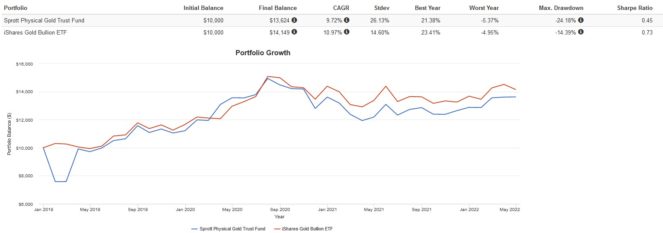
Here are the annual returns from 2018 to present:

CGL outperformed with a higher return and lower volatility. This is to be expected. Because PHYS is not currency hedged, it faced additional risks from changes in the CAD-USD pair during this time, which affected its returns. However, the annual returns are very similar. Over time, I expect both to perform more or less identically.
The Foolish takeaway
My pick here is PHYS, simply for the lower MER and higher AUM. My only concern is the close-ended trust structure. In this case, pay attention to the relative discount/premium to NAV to avoid overpaying for shares.