A common question I hear from new Canadian investors is, “How can I invest with just $1,000?” With inflation driving the cost of living up, it’s no wonder why most Canadians find it difficult to believe that $1,000 is enough to start investing with.
The $1,000 is a red herring. Canadian investors should focus instead on their time horizon — that is, the amount of time they have until retirement. This is the single most valuable asset that most investors, especially the young ones, possess. Time is literally money!
An investor with a long time horizon (say, 40 years until retirement) can turn even modest sums into a multi-million-dollar retirement nest egg. Don’t believe me? Let’s work through a historical example below using low-cost, index exchange-traded funds, or ETFs.
How to invest with $1,000
What do you invest it in with just $1,000? Of course, you could try and pick individual stocks (and my fellow Foolish writers have some fantastic suggestions). Still, trying to buy enough stocks with just $1,000 and remain diversified is very difficult. The solution here is an index ETF.
Index ETFs track a basket of stocks according to pre-set rules. A popular option here are broad-market index ETFs, which track well-known stock market indexes like the S&P 500. Broad-market index ETFs provide the highest degree of diversification and tend to have the lowest costs.
A favourite broad-market index ETF of mine is Vanguard U.S. Total Market ETF (TSX:VUN). This ETF tracks the CRSP US Total Market Index, which holds over 4,000 stocks. It’s a great way to invest passively for the long term, as you’re betting on the entire U.S. economy instead of a few select companies.
The results
Let’s assume that the year is 1982 and you’re 20 years old. You only have $1,000 to invest but can afford to contribute $200 per month. This works out to $2,400 a year in contributions, far below the annual Tax-Free Savings Account (TFSA) threshold of $6,500 in 2022.
You invest it all in the total U.S. stock market using the cheapest broad-market index ETF you can find on the market. You never panic sell, holding through numerous stock market crashes and bear markets, and always contribute your monthly amounts on time.
The result? 40 years later in 2022, your humble $1,000 initial contribution and $200 monthly deposits would have grown to over $1.8 million. If you invested more initially or increased your monthly contributions, the final amount would have been even greater.
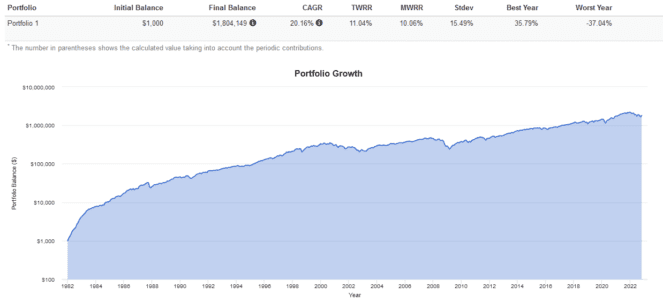
The key to success here is staying diversified, practicing good investment behaviours (not panic selling, timing the market, etc.), keeping fees low, and maintaining a long-term perspective. With this mentality, beginner investors with modest portfolios can find great success.