The way investment math works, time overpowers the amount. The longer you stay invested, the higher the returns you can get. Once you have your financial goal, you can work out various permutations and combinations around how much to invest and for how long. These factors are in your control, and you can change them depending on the potential return on investments, which you can’t control. Here, we will work out some combinations to earn $1,000/month in passive income.
The best source to earn passive income
One of the best sources of passive income is dividend stocks. Within dividend stocks, you have REITs that pay monthly distributions and bank, energy, utility, and telecom stocks that mostly pay quarterly dividends. Among the dividend kings that have sustained their payouts for decades, the highest yield is 6%.
Some stocks offer a 3–5% yield, and some offer an 8–10% yield. But the problem with high-yield stocks is they are not sustainable over the long term. Many companies slash the payouts in a weak economy. Assuming your passive income portfolio can earn an average dividend yield of 6%, we will prepare an investment plan.
How much money should you invest to earn $1,000 in monthly passive income?
The amount you need to invest = Amount you want to earn annually/rate of return x 100.
| Dividend Yield | Investment needed |
| 4% | $300,000 |
| 6% | $200,000 |
| 8% | $150,000 |
Unless you are retiring, a $200,000 investment seems unachievable. You would instead put that money into buying a house, removing mortgage payments from your monthly expense. It is not wise to invest such a huge amount in one go in a volatile stock market.
If you spend time in the market, investing a small amount every month for 13 years can build you a $210,000 portfolio for an investment of $147,000. Here’s how.
Start by investing $500/month and then increase your TFSA contribution by 10% annually ($550/month next year and $605/month the year after). Also, reinvest your dividend income to buy more stocks with a 6% yield.
| Year | Investment | 6% Dividend Yield | Total Amount |
| 2023 | $6,000 | $6,000 | |
| 2024 | $6,600 | $396.0 | $12,996 |
| 2025 | $7,260 | $779.8 | $21,035.76 |
| 2026 | $7,986 | $1,262.1 | $30,283.91 |
| 2027 | $8,785 | $1,817.0 | $40,885.54 |
| 2028 | $9,663 | $2,453.1 | $53,001.73 |
| 2029 | $10,629 | $3,180.1 | $66,811.20 |
| 2030 | $11,692 | $4,008.7 | $82,512.18 |
| 2031 | $12,862 | $4,950.7 | $100,324.44 |
| 2032 | $14,148 | $6,019.5 | $120,491.59 |
| 2033 | $15,562 | $7,229.5 | $143,283.54 |
| 2034 | $17,119 | $8,597.0 | $168,999.26 |
| 2035 | $18,831 | $10,140.0 | $197,969.78 |
| 2036 | $11,878.2 | $209,847.97 | |
| 2037 | $12,590.9 |
After 13 years, your invested amount could be around $147,000, your portfolio around $210,000, and your passive income around $1,000/month.
How to earn $1,000 every month?
Now that the basic investment plan is in place, your target is to lock in more than a 6% dividend yield. Ensure you divide your $6,000 in at least three dividend stocks from different sectors to reduce risk.
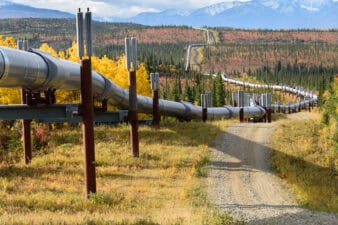
Now is a good time to buy TC Energy (TSX: TRP) stock while it trades closer to its 52-week low of $50 and lock-in a 6.6% dividend yield. You can invest $500 or $2,000 right now as the pipeline stock could see upward momentum from here.
The stock has nosedived 15% since November 2022 as investors reacted to an oil leak at the Keystone pipeline and the rising cost of the Coastal GasLink pipeline. The company took a hit on its 2022 profit for these projects and is now on track to return to normal profits.
The management expects to keep growing its dividend by 3–5% annually as new pipeline projects start earning toll money.
You can consider investing in Bank of Nova Scotia and True North Commercial REIT as well. They offer a yield of 6.1% and 10.92%, respectively. While the bank stock can grow its dividend in the long term, the REIT might cut its distribution further if the property bubble bursts.