Part of being a thoughtful investor is revisiting past investment theses in light of new developments and adjusting accordingly. Only meme-stock bagholders blindly buy and hold individual companies regardless of what’s happening in the market.
With that in mind, I’m rethinking my stance on the iShares U.S. Aerospace & Defense Index ETF (TSX:XAD). Back on May 16, I recommended XAD, and it has performed well since, appreciating 22.3% as of December 12.
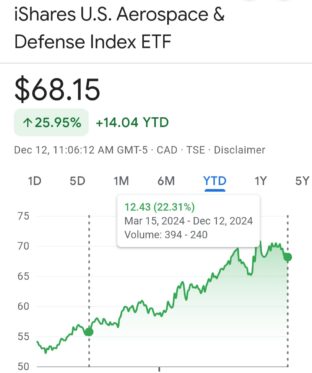
However, I’m no longer bullish on XAD – or, by extension, the major U.S. defence contractors it holds. Here’s why this sector isn’t a “buy” for me anymore.

Source: Getty Images
They’re objectively overvalued
As of December 11, the stocks in XAD are trading at an average price-to-earnings (P/E) ratio of 31.7. That’s significantly higher than the 24.4 P/E of the S&P 500 industrial sector and even the broader S&P 500, which trades at a 24.8 P/E.
By taking the inverse of these P/E ratios, we calculate the earnings yield – a simple “first look” metric that shows how much return you’re getting per dollar invested.
The earnings yield for XAD is just 3.2%, compared to 4.1% for the S&P 500 industrial sector and 4% for the entire S&P 500. Meanwhile, the 10-year Treasury yield, as of December 12, sits at 4.3%.
This comparison matters because it highlights a fundamental issue: the return on defence stocks, based on their earnings, isn’t even competitive with what you can earn from risk-free Treasurys. They offer no margin of safety from a valuation perspective.
Simply put, the earnings yield doesn’t justify buying unless you’re confident that defence stocks will grow their earnings significantly faster than the broader market – a bet I’m no longer comfortable making.
I’m not saying these stocks won’t rise further – momentum could carry them higher – but for value-conscious investors, XAD no longer looks like a good deal.
The political situation in the US is too uncertain
Defence stocks thrive on geopolitical volatility, but this can be a double-edged sword. The Ukraine-Russia war, the Israel-Palestine conflict, and ongoing Middle Eastern tensions have all contributed to highs for XAD.
However, the domestic political climate in the U.S. presents an increasingly fraught situation for defence contractors. A glaring example is President-elect Donald Trump’s recent conversation with Lockheed Martin (NYSE:LMT) CEO Jim Taiclet about potentially cancelling the $1 trillion F-35 contract.
Even if this doesn’t come to fruition, the mere mention introduces significant volatility as investors price in the possibility of losing such a massive deal. For defence contractors, the backlog is everything – losing a cornerstone program like the F-35 would be devastating.
Adding fuel to the fire is Elon Musk’s appointment to lead the newly created Department of Government Efficiency (DOGE), tasked with scrutinizing bloated federal programs.
This likely spells trouble for companies providing IT and support services to Department of Defense operations – key areas of the defence sector represented in XAD. These are tangible headwinds that could upend the stability defence stocks have enjoyed in recent years.
My recommendation?
For me, XAD and defence stocks in general are a “hold.” This means if you already own them, it’s worth sticking it out for the long term. Structurally, the defence industry is well-positioned to perform over the coming decades, supported by sustained global military spending and technological innovation.
However, if you don’t already own defence stocks, now might not be the best time to jump in. Elevated valuations and political uncertainties make the risk-reward tradeoff less appealing in the near term. Waiting for a better entry point with a more favourable margin of safety could be the smarter move.