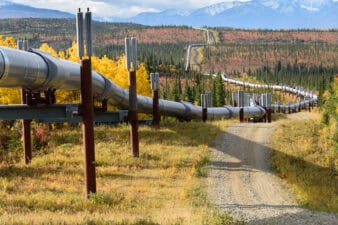
Canadian investors planning to buy top energy stocks in 2025 could consider Canadian Natural Resources (TSX: CNQ), TC Energy (TSX: TRP), and Brookfield Renewable Partners (TSX: BEP.UN). These Canadian stocks are supported by solid businesses that generate steady and growing cash flows. Moreover, these fundamentally strong companies consistently pay and increase their dividend payments. Let’s take a closer look.

Image source: Getty Images
Canadian Natural Resources
Canadian Natural Resources is one of the leading oil and gas producers. It benefits from its diversified portfolio, which supports its financials and lowers risk across commodity cycles. Thanks to its long-life, low-decline assets, it maintains stable production that drives earnings. Its ability to generate stellar earnings and cash flows supports its dividend payments and helps it deliver above-average returns.
The energy giant has raised its dividend at a compound annual growth rate (CAGR) of 21% for the last 25 years. Moreover, it offers a compelling yield of about 4.4%. Besides higher dividend payments, Canadian Natural Resources stock has grown at a CAGR of over 24.5% in the last five years, delivering overall capital gains of about 200%. Its solid dividend payments and ability to provide stellar returns make it an attractive investment in the Canadian energy space.
The company’s strong balance sheet, focus on strategic acquisitions, and opportunities from low-capital, high-growth projects will likely accelerate its growth in the coming years. Further, its operating efficiency and low reserve replacement costs will contribute to solid earnings and cash flow, supporting higher payouts and share prices.
TC Energy
TC Energy is another compelling bet in the energy space. This energy infrastructure company has a highly contracted and regulated asset base that generates consistent earnings and strong cash flow, supporting higher dividend payments and its stock price.
It’s worth noting that TC Energy has been consistently increasing its dividends, thanks to its growing cash flows. For instance, it has raised its dividend at a CAGR of 7% since 2000. Further, the company projects an annual dividend hike of about 3-5% over the long term. It also offers an attractive yield of 5.7%.
The energy giant’s secured capital projects and high asset utilization rate will continue to expand its earnings and drive higher cash flows. Further, its focus on productivity savings and debt reduction will enable TC Energy to boost its shareholder value and capitalize on growth opportunities.
Brookfield Renewable Partners
Brookfield Renewable Partners is a top investment option to capitalize on increased investments in the green energy sector. It is one of the world’s largest owners and operators of clean energy assets. Brookfield’s long-term contracts and highly diversified renewable assets generate steady cash flow, providing stability and higher dividend payments. Moreover, Brookfield’s strategic acquisitions bode well for future growth.
The company is poised to benefit from its large operating fleet and expansive development pipeline of renewable power generating facilities. Further, as renewable energy adoption expands, the company’s investments in innovative solutions like battery energy storage will likely accelerate its growth.
With its substantial installed capacity and a significant development pipeline, Brookfield is well-positioned to deliver consistent fund flows, enabling it to enhance shareholder value through increased dividend distributions. Brookfield aims to grow its dividend by 5% to 9% annually. It also offers a high yield of over 6%, making it a compelling bet for income investors.