Is Algonquin a Good Dividend Stock to Buy?

If you’re a dividend investor, consider avoiding AQN and picking this utility income ETF instead.

| More on:
ETF is short for exchange traded fund, a popular investment choice for Canadians

Source: Getty Images

Key Points

  • Algonquin remains weighed down by debt, cash flow issues, and shareholder dilution, making it a poor dividend pick.
  • HUTS offers diversified exposure to Canada’s top utilities, pipelines, and telecoms, with no Algonquin in the mix.
  • Modest 1.25x leverage boosts both performance and yield, making it a stronger option for monthly income investors.

Here’s the bottom line up front: no, Algonquin Power & Utilities Corp. (TSX:AQN) is not a good dividend stock to buy if your goal is making money from your investments.

The company is still struggling with negative leveraged free cash flow, a dangerously high debt-to-equity ratio, and an unsustainable payout when measured against distributable cash flow. On top of that, management has repeatedly diluted shareholders, treating them as a lifeline rather than partners.

If your reason for looking at AQN is to secure high dividend yields from utilities, there are better choices. One exchange-traded fund (ETF) that holds a basket of leading utilities and pays an attractive monthly yield is the Hamilton Enhanced Utilities ETF (TSX:HUTS). Here’s why I like it.

How HUTS works

HUTS tracks the Solactive Canadian Utility Services High Dividend Index, but this index takes a broader, more forward-looking view of “utilities” than traditional benchmarks.

Instead of limiting itself to regulated power and gas companies, it also includes pipelines – technically classified under energy – and telecom companies, which fall under communications.
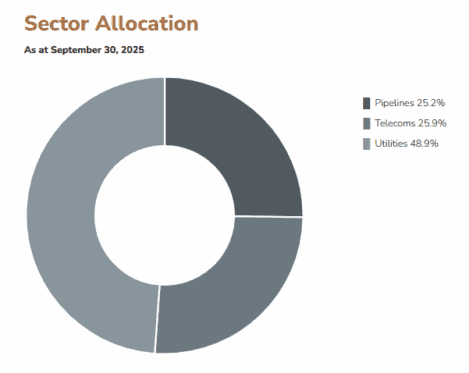
That matters because pipelines behave much like utilities, with regulated, tollbooth-style cash flows. Telecom companies also fit the profile, offering essential services with recurring revenues and strong dividend histories.

By blending utilities, pipelines, and telecoms, the index captures a wider set of essential service providers, creating a more diversified and resilient portfolio than the traditional S&P/TSX Capped Utilities Index, which is narrower and more exposed to power and gas.

HUTS leveraged explained

HUTS employs modest leverage of 1.25 times. For every $100 invested, the fund borrows another $25 at institutional rates. That leverage allows you to own more of the underlying stocks without managing margin yourself, and unlike borrowing directly, it can be held inside registered accounts like a TFSA or RRSP.

The effect is magnified exposure – both on the upside and downside – but also higher yield. Right now, HUTS pays a 6.3% distribution yield with monthly payouts.
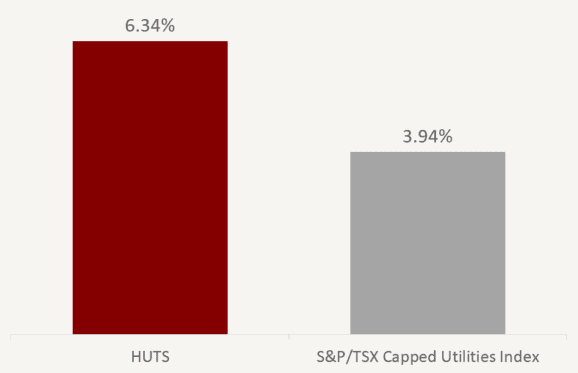
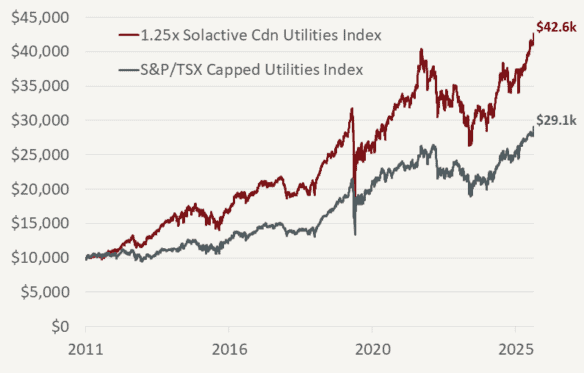
Moreover, the Solactive Index it tracks has historically outperformed the better-known S&P/TSX Capped Utilities Index in both yield and raw performance after factoring in the 1.25 times leverage.
The Foolish takeaway

Don’t pin your dividend income on a single, heavily indebted, and poorly managed utility. An ETF like HUTS spreads risk across the sector and uses modest leverage to boost income, giving you monthly yield without the baggage of companies like Algonquin.


Fool contributor Tony Dong has no position in any of the stocks mentioned. The Motley Fool has no position in any of the stocks mentioned. The Motley Fool has a disclosure policy.

More on Energy Stocks

Hourglass and stock price chart
Energy Stocks

Two High-Yield Dividend Stocks You Can Buy and Hold for a Decade

These companies have increased their dividends annually for decades.

Read more »

Oil industry worker works in oilfield
Energy Stocks

Canadian Investors: Should You Buy Canadian Natural Resources Stock While Under $45?

Is the Venezuela scare a threat or an opportunity? Here is why Canadian Natural Resources (TSX:CNQ) stock looks like a…

Read more »

A worker overlooks an oil refinery plant.
Energy Stocks

Canadian Energy Stocks Took a Big Hit to Start 2026: Should Investors Worry?

iShares S&P/TSX Capped Energy Index ETF (TSX:XEG) and Canadian crude have taken a hit to start the year, but it…

Read more »

A person builds a rock tower on a beach.
Energy Stocks

2 Rock-Solid Canadian Dividend Stocks for Steady Passive Income

These high-quality dividend stocks are capable of maintaining current payouts while increasing distributions across market cycles.

Read more »

diversification and asset allocation are crucial investing concepts
Energy Stocks

The Canadian Energy Stock I’m Buying Now: It’s a Steal

Find out how geopolitical tensions are shaping Canadian oil stocks and commodity prices amidst the crisis in Venezuela.

Read more »

canadian energy oil
Energy Stocks

Energy Loves a New Year: 2 TSX Dividend Stocks That Could Shine in January 2026

Cenovus and Whitecap can make January feel like “payday season,” but they only stay comforting if oil-driven cash flow keeps…

Read more »

how to save money
Energy Stocks

Cenovus Energy: Should You Buy the Pullback?

Cenovus is down more than 10% in recent weeks. Is the stock now oversold?

Read more »

oil pump jack under night sky
Energy Stocks

Suncor Energy: Should You Buy the Dip?

Suncor Energy (TSX:SU) saw its share price drop on concerns that Canadian oil sands producers are at risk of losing…

Read more »