If you want to generate passive income from your stock investments, you may want to choose consistency over excitement. Dividend investors want cash flow they can rely on, even when stock prices move up and down. That usually points toward companies with long-lived assets and predictable revenue streams.
Enbridge (TSX:ENB) stock fits that description well as it has a long dividend history and operates as an energy infrastructure business that remains critical across North America. Still, recent earnings numbers and short-term price weakness have sparked fresh debate among investors. In this article, I’ll break down what is happening with Enbridge stock and whether its dividend still makes it a buy for passive income-focused portfolios.

Source: Getty Images
A closer look at Enbridge’s business and recent stock performance
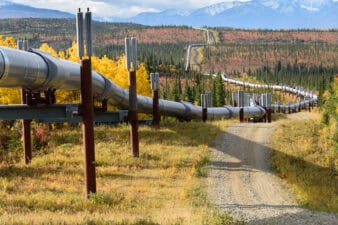
Before judging the dividend, let’s quickly review what is supporting it today. To put it simply, Enbridge operates a vast network of oil and natural gas pipelines, regulated gas utilities, and renewable power assets across Canada and the United States. Most of its assets are backed by long-term contracts and regulated frameworks, which help smooth out its cash flow even when commodity prices remain volatile.
At the time of writing, ENB stock was trading at $65.46 per share, giving it a market cap of roughly $142.8 billion. The stock has slipped around 6.7% quarter-to-date, which explains the recent caution among investors. Even so, ENB stock remains up about 9.4% over the past year and more than 50% over the last five years, highlighting its longer-term stability.
At the current market price, Enbridge’s annualized dividend yield stands near 5.9%, paid every quarter, which continues to appeal to passive income seekers. Interestingly, the company has been raising dividends for 31 consecutive years.
Earnings trends and cash flow tell the real story
In the third quarter of 2025, Enbridge’s adjusted earnings fell on a YoY (year-over-year) basis to $0.46 per share, mainly due to higher financing costs and increased depreciation tied to recent investments. Similarly, its revenue for the quarter came in at about $14.6 billion, slightly lower than a year ago, reflecting softer contributions from some of its liquids pipeline assets.
However, the dividend is supported more by cash flow than by revenue and earnings. On the brighter side, the company’s adjusted EBITDA (earnings before interest, taxes, depreciation, and amortization) for the quarter rose 1.6% YoY to $4.3 billion with the help of strong utilization across its pipeline network and contributions from gas transmission and utility assets.
As a result, Enbridge’s distributable cash flow remained stable on a YoY basis at $2.6 billion. That steady cash generation allowed it to comfortably cover its dividend while keeping leverage in check, with a debt-to-EBITDA ratio of 4.8 times.
Growth projects add visibility beyond today
Beyond a stock’s current financial growth trend, dividend investors should also focus on what comes next. During the third quarter, Enbridge sanctioned roughly $3 billion in new projects, including pipeline expansions, gas storage growth, and the Pelican CO2 Hub. Earlier in December, the company also approved Mainline Optimization Phase 1, which will add 150 thousand barrels per day of capacity to its Mainline system and increase deliveries to key U.S. refining markets by 2027.
In total, Enbridge now has about $35 billion in secured growth projects expected to enter service through 2030. The company has reaffirmed its 2025 guidance and continues to target about 5% annual growth in adjusted EBITDA, earnings per share, and distributable cash flow per share after 2026. That combination of visible growth, stable cash flow, and disciplined capital allocation helps explain why Enbridge stock remains appealing for long-term investors focused on dependable passive income, even after the recent period of volatility.