According to a detailed report from Blueprint Financial, the average Tax-Free Savings Account (TFSA) balance for Canadians aged 55 to 59 is around $33,200.
The number is well below what financial experts recommend for this age group, as many savers approach the final stretch before retirement. The TFSA balance for those aged 50–54 is around $26,400, while it rises to $39,750 in the 60–64 age group.
The relatively modest balances stem from inconsistent contributions and low-interest savings products. Several Canadians use the TFSA as a “savings account” rather than an “investment account,” which has led to less-than-impressive returns. Basically, Canadians have yet to fully leverage the TFSA’s tax-free growth potential for retirement income.
At 55, a well-funded TFSA becomes increasingly valuable. Unlike Registered Retirement Savings Plan (RRSP) withdrawals, TFSA distributions don’t trigger taxes or affect government benefit eligibility for Canada Pension Plan, Old Age Security, or Guaranteed Income Supplement.
Notably, the TFSA balance for women in the 55–59 age group is higher than that of men. This pattern is seen across most age groups, even as women earn 36% less on average. The gap suggests that differing savings habits may outweigh income differences in long-term wealth building.
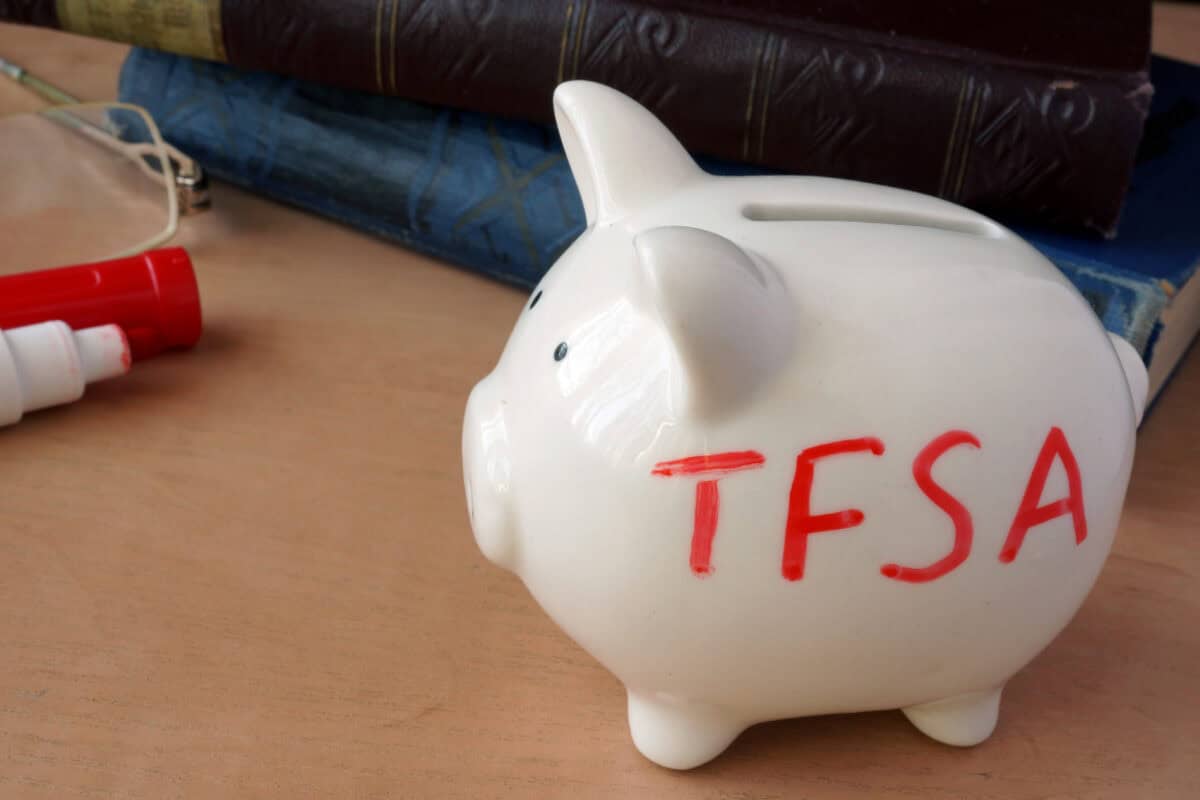
Canadians should prioritize maximizing TFSA contributions each year to benefit from tax-free returns for life. Here’s how you can also use the TFSA to create a steady stream of passive income.
Source: Getty Images
Own blue-chip TSX dividend stocks in the TFSA
TFSA investors should consider owning a portfolio of blue-chip dividend stocks to begin a recurring passive income stream in 2026. One such Canadian stock is Brookfield Infrastructure Partners (TSX: BIP.UN), which offers you a dividend yield of 5.1%. In the last 10 years, BIP stock has returned close to 300% to shareholders, after adjusting for dividend reinvestments.
Brookfield owns and operates a portfolio of cash-generating assets across sectors such as utilities, transportation, data centers, and midstream.
Brookfield Infrastructure Partners delivered strong financial results over the past five years despite facing headwinds, and the company now believes it stands at an inflection point that could drive substantially higher growth rates ahead.
The partnership generated 13% annual growth in absolute funds from operations and 10% growth in cash flow per unit over the last five years, while reducing its payout ratio from 78% to 67%.
These numbers outpaced Canadian midstream and utility peers, which averaged around 5% cash flow growth during the same period, though they fell short of BIP’s long-term average of 14% annual growth.
Rising interest rates in recent years weighed on results, with the federal funds rate jumping 500 basis points and the 10-year Treasury climbing 400 basis points. Adjusting for these headwinds, BIP’s funds from operations per unit would have grown 12% annually instead of 10%.
Interest rates are now stable or declining, and BIP recently issued a 5-year bond at 3.7%, compared with over 200 basis points higher just two years ago.
BIP deployed US$2.1 billion into new investments in 2025, including US$700 million in organic growth projects and US$1.4 billion across four new acquisitions targeting returns of 12% to 15%. It recycled US$2.8 billion through eight asset sales, generating a 20% internal rate of return and a four-times multiple on capital.
Management highlighted artificial intelligence infrastructure as a major growth opportunity, with plans to allocate US$500 million annually to AI-related projects.
The company is pursuing seven AI factories across five countries, with total capital deployment potentially reaching US$200 billion over time.
Looking ahead, BIP expects to return to annual growth rates approaching 14%, enabling dividend increases at the higher end of its 5% to 9% target range without raising the payout ratio.