The Bank of Canada gave investors a useful hint recently: don’t expect a straight line from here. The central bank held its key interest rate at 2.25%, while pointing to higher oil prices, trade uncertainty, and softer parts of the Canadian economy. Inflation rose to 2.4% in March and could move close to 3% in April, but the bank still expects it to drift back toward 2% in 2027.
That creates a tricky setup. Rates may not plunge quickly, yet the economy still needs support. In that kind of market, investors may want stocks with real earnings, solid dividends, and businesses that can keep going even when consumers feel squeezed.
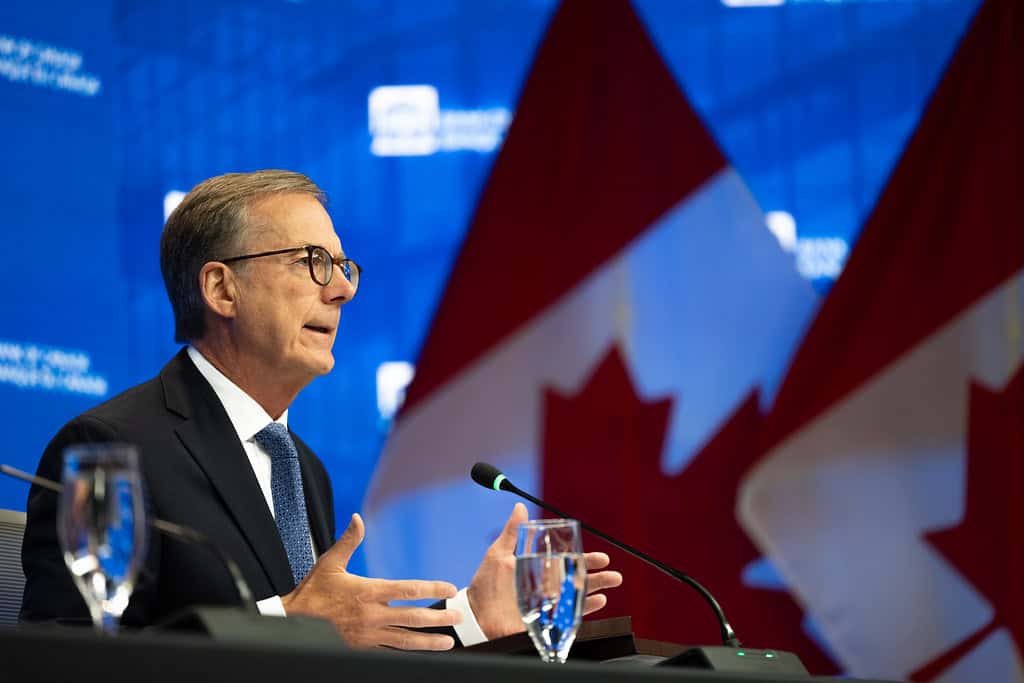
Governor Tiff Macklem; Source: Bank of Canada
TD
Toronto-Dominion Bank (TSX: TD) is relevant now as banks tend to wake up when interest-rate uncertainty begins to ease. TD stock is one of Canada’s largest banks, with major operations in personal banking, commercial banking, wealth, insurance, and U.S. banking. It went through a difficult stretch over the last year because of its U.S. anti-money-laundering issues, but that’s also why TD stock still has a comeback angle. The bank has spent heavily on controls, governance, and remediation. That work remains a risk, but it also gives TD stock a clear path to rebuild investor confidence.
The latest earnings showed why investors have not given up on it. In the first quarter of 2026, TD reported adjusted net income of $4.2 billion, up 16% year over year. Adjusted earnings per share (EPS) hit $2.44. Its Canadian personal and commercial banking division delivered record net income of $2 billion, up 12%. TD stock also ended the quarter with a strong CET1 capital ratio of 14.5%, giving it plenty of cushion.
Valuation helps the case. TD stock recently traded around 11.7 times trailing earnings with a forward dividend yield near 3%. That’s not dirt cheap, but it looks reasonable for a bank with strong Canadian operations and room to recover in the U.S. TD stock fits today’s Bank of Canada backdrop as it can benefit from steady loan demand, improving sentiment, and lower funding pressure if rates eventually drift down. The risk is clear: U.S. remediation could take longer and cost more. Still, patient investors could get paid to wait.
BEI
Boardwalk REIT (TSX: BEI.UN) also looks timely after the Bank of Canada’s update. If rates stay steady or eventually fall, real estate investment trusts (REIT) can catch a better mood. Boardwalk owns and operates rental apartment communities across Canada, with a major focus on affordable housing. That gives it a practical edge. People may delay buying homes when mortgage costs stay high, but they still need places to live.
The latest numbers were strong. For the fourth quarter of 2025, Boardwalk reported funds from operations (FFO) of $1.20 per unit, up 11.1% from the year before. Net operating income (NOI) rose 9.5% to $108.5 million. Same-property NOI climbed 7.3%, and the operating margin improved to 65.8%. Occupancy also stayed high, with management pointing to 97.5% occupancy to start 2026. That tells investors demand remains firm, even in a more competitive leasing market.
Boardwalk’s valuation and income also make it interesting. The REIT recently traded near 18 times earnings, with a monthly distribution yielding about 2.5%. It also increased its distribution by 11.1% for 2026. That’s not a huge yield, but it comes with growth potential. The main risk is that rent growth could slow if affordability pressure rises or if competition increases in key markets. Higher borrowing costs can also weigh on REITs. Even so, Boardwalk fits a softer-rate outlook because lower rates could support property values, financing costs, and investor demand for income stocks.
Bottom line
The Bank of Canada did not give investors an all-clear signal. It gave them something more useful: a reminder to stay selective. TD stock offers a recovery story backed by strong earnings and capital. Boardwalk offers steady rental demand and monthly income. And together, $7,000 in each could bring in ample income.
| COMPANY | RECENT PRICE | NUMBER OF SHARES | ANNUAL DIVIDEND | ANNUAL TOTAL PAYOUT | FREQUENCY | TOTAL INVESTMENT |
|---|---|---|---|---|---|---|
| TD | $144.74 | 48 | $4.32 | $207.36 | Quarterly | $6,947.52 |
| BEI.UN | $67.84 | 103 | $1.67 | $172.01 | Monthly | $6,987.52 |
Neither stock is risk-free, but both look built for a market where rates stay uncertain and quality matters more than hype.