The global artificial intelligence (AI) spending boom has sent stock markets into a frenzy, but lasting gains may accrue to sustainably profitable and cash flow positive growth stocks. Canadian investors scanning the Toronto Stock Exchange may face challenges separating speculative growth stocks from those with durable earnings and cash flow. That brings us to a fascinating tale of two top Canadian AI stocks with widely diverging fortunes: supply-chain software pioneer Kinaxis (TSX:KXS) stock and electronics manufacturing powerhouse Celestica (TSX:CLS).
While one is quietly building an AI-powered earnings machine while its shares languish, the other is riding a generational AI hardware super-cycle to record heights.

Source: Getty Images
Kinaxis stock: High margin growth collides with software headwinds
Kinaxis has spent the last five years quietly transforming its artificial-intelligence powered supply chain software platform into a more profitable cash flow generator.
As its cloud-based supply-chain software platform continues to gain loyal customers, the enterprise software provider has seen its quarterly revenue run rate increase by 170% over five years. Operating margins expanded from a thin 0.8% in 2021 to 17.8% over the past 12 months. Even more striking, cash flow per share has surged 551%, and earnings per share have ballooned 11,740%, all powered by its AI-powered software business.
Correspondingly, Kinaxis stock’s valuation multiple has compressed from an astronomical historical P/E of 370 in 2022 to a trailing P/E of 40.7 and a forward P/E of 33 today.
Why, then, is Kinaxis stock down 10% over the past five years while other AI stocks surge? The answer lies in its business model.
As a software vendor rather than an AI hardware supplier, Kinaxis sits outside the immediate capital expenditure wave sweeping chipmakers and hardware assemblers. Furthermore, investors fear that generative AI autonomous agents could eventually dilute revenue per corporate seat, potentially forcing software providers to lower subscription rates to retain clients.
Frustrated by slowing top-line growth acceleration, shareholders pushed for new leadership, leading to the departure of its longtime CEO in late 2024 to drive growth forward.
But Kinaxis has grown its earnings and cash flow at faster rates compared to a rallying Celestica over the past five years.
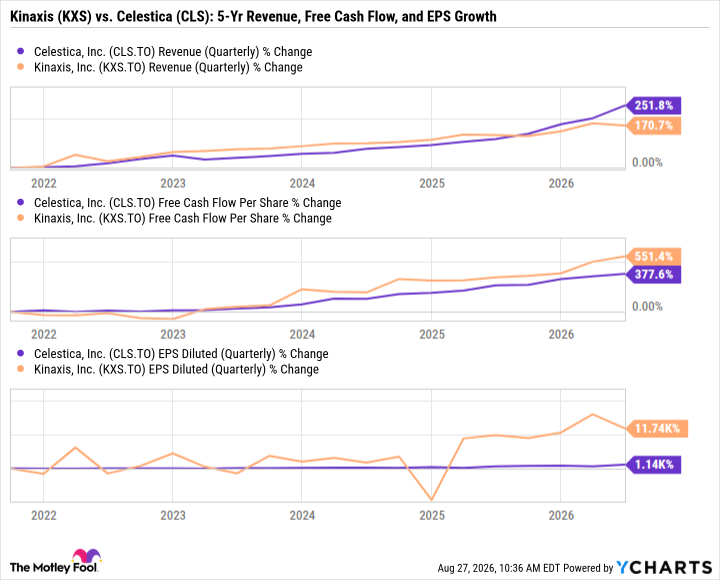
CLS Revenue (Quarterly) data by YCharts
Is KXS driving growth forward?
Kinaxis is driving revenue and earnings growth forward. The company has introduced AI agents, and its extending the scope of its offerings beyond planning and decision making to help customers coordinate and operationalize those decisions, using AI. It has already signed up 10% of its existing customer base on a paid or trial subscription to its Maestro AI agents going into the third quarter of 2026. Second quarter software-as-a-service (SaaS) revenue surged 20% year-over year, EPS increased 15%, and cash flow from operations surged 36% year-over-year.
To augment shareholder returns, Kinaxis has been using its excess cash flow to repurchase its common stock since November 2025.
Celestica stock: Riding the AI hardware super-cycle
Celestica stock has been one of the biggest winners during the global AI hardware super-cycle. It’s manufacturing customized hardware and high-speed connectivity solutions for data-centre builders who are bidding component prices to record levels. Celestica’s top line and earnings have exploded.
Total revenue tripled from $7.8 billion 2021 to $21.5 billion over the past 12 months, while diluted earnings per share surged from $1.15 to $13.29 during the same period. Operating margins expanded, and CLS stock’s Return on Equity (ROE) skyrocketed from 7.1% to 45%.
This structural operational shift has dampened legacy cyclicality in rewarding long-term shareholders with a 3,714% five-year return and turning a $1,000 investment into $38,140.
Which Canadian AI stock is the better buy?
Kinaxis stock has surged by 20% this month, perhaps it is gaining new momentum. But Celestica stock’s lower valuation makes it appealing still.
Despite Celestica stock’s historic rally, its forward P/E ratio of 22.8 remains noticeably lower than Kinaxis’s multiple of 33.3. A forward price-earnings-to-growth (PEG) ratio of 0.5 makes Celestica stock appear undervalued relative to its earnings growth outlook, while Kinaxis’s comparable PEG of 2.3 implies the stock could be overvalued.
Although Kinaxis stock has grown its earnings at a faster multi-year clip while generating consistent cash flow, market sentiment heavily favours hardware enablers today. Celestica is directly plugged into the unprecedented AI data centre spending wave, while Kinaxis is a good watch as it courts enterprises that may be tempted to try internally modified AI agents to enjoy some “AI savings”.