Investors looking for exposure to gold have a few options. They can buy ETFs, some of which are backed by actual gold and others of which are backed by gold future contracts. They can invest in gold mining companies, ranging in size from small and speculative to mega cap producers with operations around the world.
Investors can even invest in the physical metal itself. There are no shortage of options. But what method is right? Let’s look at a few of the pros and cons of each.
ETFs
There are many different gold ETFs on the TSX, tracking the performance of gold mining companies and the price of the yellow metal. Let’s focus in on bullion ETFs.
One thing many gold investors look for when buying an ETF that tracks the price of gold is whether the fund owns an equivalent amount of the metal. While owning gold future contracts in lieu of gold can help bring down the fund’s costs, gold investors tend to get a little nervous if the fund doesn’t hold gold. Gold bugs can be a little paranoid sometimes.
The largest gold ETF in Canada is the iShares Gold Bullion ETF (TSX: CGL). It has a market cap of more than $355 million, is Canadian dollar-hedged (meaning investors won’t get hurt on the Canadian dollar to U.S. dollar exchange rate, making it, essentially, a play on gold in Canadian dollars) and only has a management expense ratio of 0.5% a year. It also physically holds more than 219,000 ounces of gold, meaning investors could, in theory, exchange their units for bullion.
If investors are looking for a gold ETF that isn’t Canadian dollar-hedged, the iShares Gold Trust ETF (TSX:IGT) will do the trick. It’s a cross-listed fund from the United States, but holds enough physical gold to cover all its assets. It’s not nearly as liquid as the Gold Bullion ETF though, so keep that in mind.
Gold miners
Essentially, gold miners are a play on the price of gold with a dash of operational risk thrown in. If a miner has astute management and keeps costs down, it can outperform the price of bullion. If it spends too much on acquisitions and lets costs balloon out of control, investors will punish the stock. Barrick Gold (TSX: ABX)(NYSE: ABX) investors can tell you all about a miner taking a hit for making ill-timed moves.
One gold company with excellent fundamentals going forward is Goldcorp (TSX:G)(NYSE:GG). Goldcorp has kept costs down, maintained its dividend during this rough patch, and launched a takeover bid for Osisko. Because Goldcorp was prudent during gold’s boom times, it has the financial ability to acquire when prices are down. Goldcorp could easily outperform gold going forward.
Physical metal
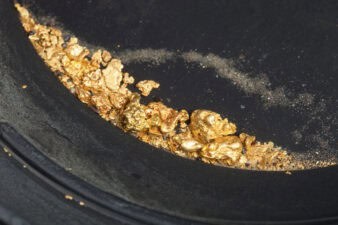
Many investors choose to forego exchange traded gold products all together, and choose to buy physical gold. This could come in many forms, including jewelry, coins, or small gold bars. Security is a concern when storing physical gold, as it’s essentially another form of cash. Most investors will either use their bank’s safety deposit box or an in-home safe to store their physical gold.
Foolish bottom line
Investors looking for a play on gold bullion are well served by the iShares Gold Bullion ETF. It has a reasonable management expense ratio, owns enough physical gold to cover the value of the fund, and can easily be bought from a brokerage account. There’s no worry about storing actual gold, and the fund will only go bankrupt if there’s a major economic collapse. In that case, investors will have a lot more to worry about.
Gold companies offer the potential to juice up returns, while taking a little extra risk. There are many to choose from. But gold miners aren’t a true proxy for the price of gold, since they add an operational component to the mix. Ultimately it’s up to investors to decide whether they want a pure gold play, or a gold play with the chance of upside.