There are two types of leverage in Baytex Energy Corp.’s (TSX: BTE)(NYSE: BTE) business that are causing the stock price to fall heavily when the oil price recedes or fails to take off, as has been anticipated for 2017. The share price has shed significant value and falls further with each marginal drop in oil prices.
The company is heavily leveraged to the price of oil due to excessive financial and operating leverage in a depressed energy oil price environment.
Let’s have a look at how each type of leverage is destroying shareholders’ confidence in the stock.
Operating leverage
Operating leverage comes about due to the presence of significant fixed costs in the company’s business operations.
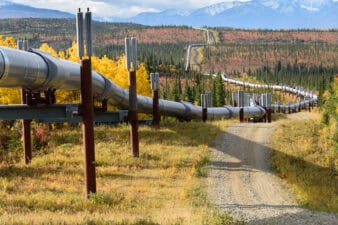
Baytex has a heavy investment in Canadian heavy oil assets at Peace River and Lloydminster and light oil assets at Eagle Ford in the United States.
Heavy oil production incurs very high fixed costs and running costs, but variable costs do not increase as fast as production volumes. Operating netbacks increase faster for heavy oils when oil prices increase, but the assets require higher breakeven oil prices to become viable.
Baytex requires US$42 and US$40, respectively, per barrel Western Texas Intermediate (WTI) oil prices to break even at Lloydminster and Peace River, while US$50 WTI is required for the company to start generating positive cash flow.
The company’s Eagle Ford light oil assets incur lower fixed and operating costs per barrel, breaking even at US$30 WTI and becoming cash flow positive at US$40 WTI, but variable costs also increase as production volumes increase.
Due to higher fixed costs, Baytex’s returns rise faster on its heavy oil assets than on light oil as oil prices increase, but at below US$50 WTI, the company becomes cash flow negative and cannot be expected to produce enough cash flow to repay its astronomical debts falling due starting in 2021.
Financial leverage
Financial leverage comes about due to the presence of debt on the company’s balance sheet.
Baytex is carrying a $1.9 billion net debt in its capital structure, while the equity is valued at $0.9 billion. Even though this debt isn’t due until 2021, the huge debt overhang is the biggest problem depressing the company’s stock valuation today.
Employing debt in corporate financing is advantageous when the corporation is profitable, and it magnifies equity returns. However, high leverage in a loss-making business magnifies the losses as interest costs remain fixed and threaten the company’s continued survival.
Investor fears of possible bankruptcy if Baytex fails to meet maturing debt obligations starting in 2021 is hampering share price growth prospects, especially as oil prices continue to be depressed and the company fails to generate enough free cash flow.
Baytex needs US$55 WTI to become free cash flow positive. At current oil prices, the company can’t be expected to generate any cash to retire the huge debt.
What to do?
Baytex is not likely to go bankrupt in the near term, and its significant debt maturities are there in four years’ time. The low oil price environment is very ugly for the energy firm, but operating results are showing management’s success at cutting production costs.
If you are bullish on oil prices for the second half of 2017, then Baytex might offer higher speculative returns.
For investors already invested in the stock, holding on can be a rewarding move as analysts still foresee a possible US$60 oil price in 2018.
At US$60 and beyond, heavy oil assets outperform most light oil plays, and Baytex’s returns are significantly magnified by higher operating leverage, giving the company a phenomenal recovery potential.
For those on the sidelines, keep the stock on your radar as the investment has great potential if oil prices rally, even by small margins.