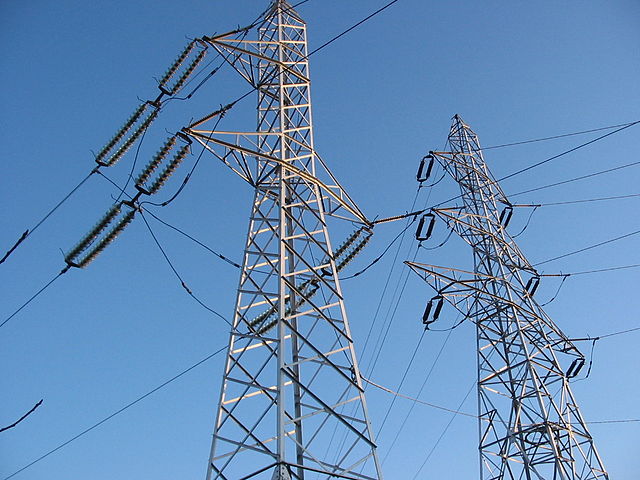
Licence: https://creativecommons.org/licenses/by/2.0/ Source: https://en.wikipedia.org/wiki/File:Romanian_electric_power_transmission_lines.jpg
A recent report in The Toronto Star suggests that Hydro One Ltd.’s (TSX:H) CEO Mayo Schmidt makes almost $4.5 million a year in salary and bonuses.
That’s roughly twice the compensation of Schmidt’s counterpart in Alberta and nearly 10 times the amount paid to the CEOs in charge of some of the country’s smaller provincial hydro operations.
In a response, Energy Minister Glenn Thibeault said, the “government recognizes that every dollar of public money should be spent with good intention and thorough consideration — both need to be taken into account whenever proposing salaries … We recognize that executive salaries are high compared to the vast majority of Ontario salaries, and we’ve introduced new regulations that require rigorous review of executive compensation frameworks.”
Who’s paying for what, exactly?
Hydro One is an electricity transmission and distribution utility serving Ontarians.
In the 1990s, then premier Mike Harris passed the “Energy Competition Act” which restructured Ontario Hydro into separate entities with a final goal of total privatization.
As a result, Hydro One was established as a corporation with the Government of Ontario as sole shareholder, making it a Crown corporation.
Then, under the leadership of Kathleen Wynne, the Government of Ontario began selling shares of its interest in Hydro One to the public, with a final goal of 60% of the company being held by private investors.
As of this writing, approximately 290 million shares of Hydro One have been “publicly floated,” meaning that the remaining 305 million shares, or 51% of the company’s shares, are publicly owned.
Therein lies the problem
The problem is that today, Hydro One finds itself in “no man’s land,” so to speak.
A little over the half of the company is owned by provincial taxpayers, while the other half, and soon to be majority, is owned by private interests.
Stakeholder interests are not shareholder interests
Regardless of whether ownership is in public or private hands, everyone wants to see that compensation paid to executives is reasonable and based on merit.
Rather, the point of contention between the two ownership groups is not about executive compensation, but that the public, as a key stakeholder in all of this, ultimately wants to see lower electricity bills.
Yet lower electricity bills for the public would have to come at the direct expense of private shareholders, who want to see the company turn a profit and return those earnings to them in the form of dividends.
How is Hydro One addressing this problem?
A review of Hydro One’s management information circular outlines how management compensation is addressed within the company.
Executive compensation is based of a combination of financial and non-financial measures. Financial measures include net income achieved and the ratio of earnings to dividends. Non-financial measures include rewards for customer satisfaction and employee safety and engagement.
The “red flag” in all of this is that there is nothing in place to reward management for keeping costs in check.
Somebody is asleep at the wheel
Ontario taxpayers should be outraged that Hydro One, majority owned by public interests, is not taking the appropriate measures to deliver a public service at a reasonable cost.
Keep in mind, Ontario has seen the cost of its electricity triple since 2003.
The one caveat here is that maybe the Ontario government is allowing Hydro One to rack up its electricity rates, helping to boost profitability of the organization in the short term, in order to then sell its public interest at a “peak valuation,” only to then clamp down on rates at some point down the road.
While this may be true, and that strategy may even prove successful, it comes at the direct expense of those who are faced with higher electricity bills in the meantime.
Make no mistake about it; this is a bad deal for stakeholders, and a good deal for shareholders — provided those shareholders don’t call Ontario home.
Stay Foolish.