
A diverse portfolio can stand up to many financial storms, and the current market conditions are providing an important stress test. If watching speculative stocks tumble is too hard to stomach, it could be the market’s way of telling you to buy passive investments that offer instant diversification.
Despite humble beginnings in the 90s, and another decade of being neglected, exchange-traded funds (ETFs) — passive index investments — now account for trillions of investment dollars. Can you guess which age demographic is the most enthusiastic ETF buyer? You guessed it: savvy and self-sufficient millennials, according to a Charles Schwab survey in the United States.
In selecting an ETF, my advice is to think of a tree and start with a solid foundation. The most consistent and widely used market index is the S&P 500, which Canadian investors can access through iShares Core S&P 500 ETF. The couch-potato approach is to buy broad market funds on a scheduled basis (dollar-cost averaging) and forget about it.
The problem is that some ETFs are destined to underperform. They may be tied too closely to one sector or try to double or triple returns, with terms like “2X” and “3X” in the name, which, in my opinion, should not be the first ETFs to own.
Peter Hodson wrote about this topic for the Financial Post, concluding that “not all ETFs are created equal” and encouraging investors to look up the details on fees, tracking error, liquidity, and sector concentration.
How about a simple question? Are you looking to beat the S&P 500? Yes or no? It’s okay to say no…
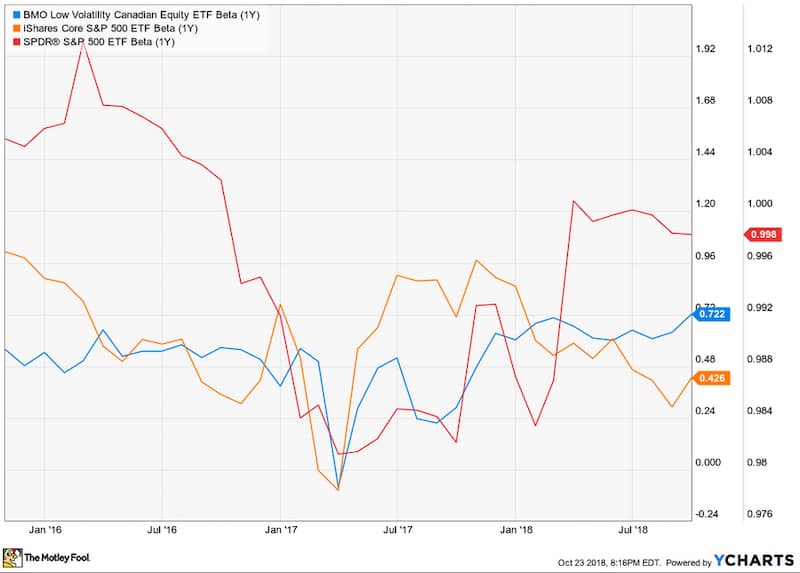
It’s a good segue into the BMO Low Volatility Canadian Equity ETF (TSX:ZLB), which is a basket of 45 TSX holdings, many of which are utilities that move slowly and pay dividends. Low price fluctuation makes for a low beta score. An ideal investment will have a low beta and a high return (called alpha). In practice it’s hard to find this combination.
Over five years ZLB is up 43%. Include the 2.68% yield and you are looking at a pretty respectable return of ~57% over that time frame. As I pointed out in March, ZLB has the dubious distinction of a beta (volatility) level that continues to creep up (graph is below). The beta is higher than another TSX ETF that attempts to track the S&P 500. I’ll be watching this and wondering whether the fund managers will swap out holdings to bring the beta down.
A fellow Fool contributor is bullish on ZLB, concluding this ETF could make your TFSA account “unshakeable.” I do think that ZLB can root a portfolio. The wacky October we’re experiencing has made ZLB ripe for the picking (I’m getting good use out of the tree analogy!). Trading near $28.38 per share, a bedrock of foundation in the form of the 200-week moving average means now is a buying opportunity.
The bottom line is that you shouldn’t take any flak from your investing buddies for buying a broad ETF during this market pullback, or ever, really. It’s not a sexy story, but time will be on your side.