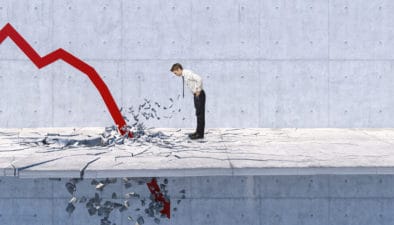
When markets go down, how do you react? It’s easy to panic when you see all that red on the screen. Most people have a tendency to make poor decisions at that point, selling their stocks at massive discounts, locking in the losses. While this can be a good strategy when used as a tax-loss selling move, it can be devastating when individuals do not re-enter the market out of fear of further losses.
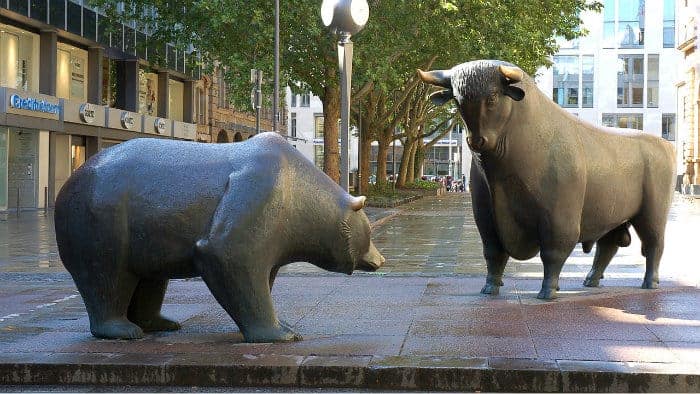
So, what should investors do to steel themselves against basic human emotions? The most important thing is to have a plan in place, so when markets shake you to the core, you do not do something ridiculous that damages your portfolio and your confidence irreparably. These four actions should help you to limit the damage to your portfolio when the bear roars.
Don’t buy everything at once
If you want to buy shares in a company, do it regularly over time. If you put all your money into a stock at once, it will be especially painful when it drops. Buy shares over time, maybe at the end of every month, and average out your cost basis over the course of several years. In this way, you’ll be able to take advantage of both the good times and the bad when you buy, all the while avoiding making emotion-driven decisions. You’ll never pick the best price, so why bother trying?
Buy solid, blue-chip, dividend-paying companies
Collecting dividends from companies such as Fortis (TSX:FTS)(NYSE:FTS) and BCE (TSX:BCE)(NYSE:BCE) can alleviate the stress and pain of a chaotic market. Fortis currently pays a dividend of around 4% and BCE pays one of almost 6%. Their payments have been rising for decades and will most likely continue to do so well into the future. Fortis has a very diversified, highly needed power generation and distribution business, which will only become more in demand over time. BCE is one of Canada’s largest telecoms, with a much-needed wireless business. Hold these companies through thick and thin.
Make your buy and sell decisions after the market close
Don’t do anything during the trading day. Most amateur — and arguably, many professional — traders do not perform well over the long term. High fees are incredibly destructive to returns, and this applies doubly to small traders. As a percentage of returns, the smaller a trade is, the more it costs. Just think: if you trade 100 shares of a company worth $9 per share, that is $900. If the trading commission is $9, that is 1% off of your total return. Compare that to a larger trader who might be selling 10,000 shares. You can’t win.
If you want to buy and sell, do it after market close. You will be unable to make a snap decision, which can save your bacon. You can also set a limit order at the price you desire the night before and sleep on the decision. Chances are, you will cancel it in the morning before market open.
Look at long-term charts to see how ridiculous the short-term moves really are
If you really want to see how pointless your day-to-day decisions are, open a long-term — at least 20-year — chart of any index and almost any blue-chip stock. Over those 20 years, you will quickly notice that the best thing to have done is nothing at all. Even the massive chaos of the financial crisis will look like a tiny blip as compared to the long uptrend as returns compounded over time. Put it in perspective. Over the long run, you’ll do fine if you buy shares of a good company, add to your holdings over time, and otherwise do nothing.
Don’t fear the bear
When markets collapse, that is people’s emotions running wild. Don’t be one of them. Slowly buy shares over time. Dropping stock prices of good companies are just on-sale prices. So, turn off that computer screen, collect your dividends, and read a good book while your portfolio grows.