Canadian oil stocks were hammered by the March 2020 stock market crash. The impact of the market crash was amplified by the price of crude collapsing sharply because of a marked increase in supply coupled with a coronavirus demand shock.
Surprisingly, since the March market bottom, many drillers have seen their stock prices bounce back strongly. Even the North American West Texas Intermediate (WTI) benchmark price plunging into negative territory last month did little to derail that recovery.
One Canadian oil stock that’s gained a whopping 55% since the market bottom is Parex Resources (TSX:PXT).
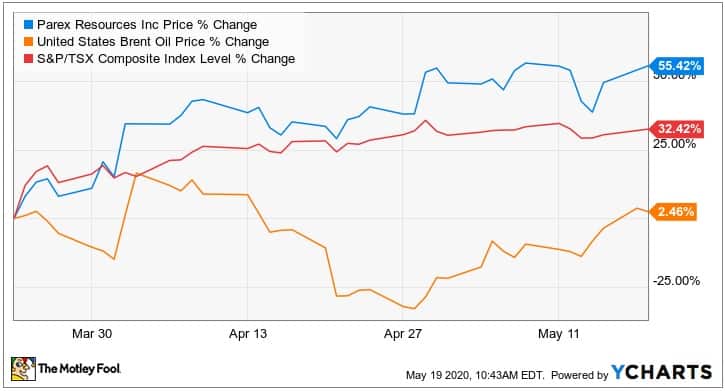
I have been bullish on the driller, which operates in Colombia, for some time. It was my top stock pick for 2019, when it delivered an annual return of almost 48% compared to 19% for the broader S&P/TSX Composite Index.
I reminded investors of Parex’ considerable strengths during the market crash. Not only is the driller now on sale, but it’s also poised to deliver further outsized returns as the price of oil rallies over the remainder of 2020 and into 2021.
Debt-free Canadian oil stock
Parex owns 2.4 million acres across more than 22 blocks in the strife torn South American nation of Colombia. One of its key strengths is that the driller is debt free and possesses a rock-solid balance sheet with considerable liquidity, a rarity among Canadian oil stocks.
Parex also reported solid first-quarter 2020 results, which is nothing short of extraordinary given the harsh operating environment. The driller was debt free at the end of the first quarter and had considerable liquidity holding US$397 million in cash.
Free funds flow positive oil stock
Despite shut-ins of uneconomic production and the impact of the coronavirus pandemic, Parex’ average daily oil output for the period rose 6% year over year to 54,295 barrels.
Parex was also free funds flow positive for the first quarter, generating US$26 million. That can be attributed to Parex’s quality conventional oil assets, low operating expenses and ability to access premium Brent prices.
You see, Brent trades at a premium to the North American benchmark. While it’s just US$2 per barrel at this time, it was as high as US$8 per barrel when oil prices collapsed.
Furthermore, unlike WTI, the Brent price didn’t plunge into negative territory in April, boding well for Parex’ earnings. That is particularly important to note because many upstream oil explorers and producers are burning cash in the current difficult operating environment.
Those numbers indicate that despite the fallout from the coronavirus, Parex will maintain its pristine balance sheet.
On sale today
Parex’s second-quarter 2020 numbers will be worse. This period saw the full impact of the coronavirus and oil price collapse. The fallout will be minimal for Parex, however, and likely won’t have a material negative effect on its market value unless oil prices plunge again.
What makes Parex particularly attractive is that the driller is trading at a deep discount to its after-tax net asset value per share. Currently, Parex’s share price is less than half of its after-tax NAV of $36.10 per share, highlighting the considerable upside available once oil rebounds.
Foolish takeaway
Parex remains the best-in-class upstream oil explorer and producer to profit from an oil rally. There are signs that oil prices will edge higher during the remainder of 2020. A combination of OPEC production cuts and rising demand as economies across the globe reopen will lift prices.
Analysts speculate that U.S. oil production will fall, with many shale oil drillers shuttering uneconomic operations and slashing exploration as well as capital spending. For these reasons, Parex will deliver solid returns during 2020.