The Canada Revenue Agency (CRA) extended the CERB (Canada Emergency Response Benefit) by another eight weeks earlier this month. The CERB will now be available until September to help Canadians who lost their jobs due to COVID-19.
This means you can get a maximum of $12,000 over a 24-week period if the CERB is not extended further. The CERB would have stopped for Canadians who have hit the $12,000 limit. Alternatively, if you were eligible for the CERB during the benefit period but did not claim it, you can apply before December 2 and receive retroactive payments.
However, the CRA also raised the eligibility criteria to get the CERB $2,000/month between July and September.
Are you eligible for the CERB extension?
The CERB was introduced in April and was retroactively paid to Canadians who lost their jobs due to COVID-19 since March 2020. So, if you have been receiving the CERB between March and June, and if there has been no change in your income or employment status, you will continue to receive the benefit.
However, you need to assure the Canada Revenue Agency that you are an active job seeker and have not been called back by your previous employer to rejoin the workforce. Some employers have claimed that employees are refusing to return to work, as they were paid lower than the CERB.
The Canada Revenue Agency will now compare payroll records with CERB applications to ensure that Canadians are not taking undue advantage of federal benefits and are not receiving the payouts even after rejoining the workforce.
Generate $2,000 a year in tax-free income
While the Canada Revenue Agency is trying its best to help Canadians survive these turbulent times, it is not prudent to just depend on government benefits. The ongoing pandemic has shown us it is important to have multiple income streams and create a nest egg to supplement your employment income.
You can in fact create a tax-free dividend stream by allocating stocks to your TFSA (Tax-Free Savings Account). The TFSA is a registered account where Canadians do not have to pay taxes to the CRA on withdrawal. These withdrawals can be in the form of capital gains or dividends.
The total TFSA contribution room stands at $69,500, and you can allocate a part of this amount to buy quality dividend stocks such as Enbridge (TSX:ENB)(NYSE:ENB). Due to the volatility in crude oil prices, Enbridge stock is trading at $42.22, which is 26% below its 52-week high.
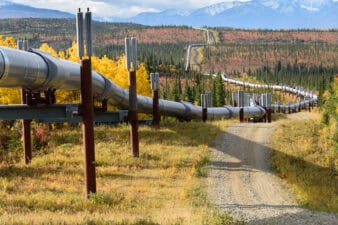
Enbridge is the largest pipeline operator in North America and transports the bulk of the region’s crude oil. It is well diversified and has other business segments that include gas storage, renewable power generation, and energy services.
The pipeline industry is capital intensive and has high entry barriers. It is also one of the cheapest ways to transport oil and natural gas, which means several oil producers rely on Enbridge’s vast network to transport the commodity.
Enbridge generates over 90% of its EBITDA from fee-based contracts that are volume-based, making it somewhat immune to commodity prices. This helps it generate a steady stream of cash flows, allowing it to pay dividends to shareholders.
Enbridge’s focus on dividend growth
Enbridge stock has a forward yield of a tasty 7.7%, which means to generate $2,000 a year in dividends, you need to invest close to $26,000 in this stock. Enbridge has increased dividends at an annual rate of 11% since 1995.
With a payout ratio of less than 50% in 2020, it can continue to increase dividends. So, if you generate $2,000 in annual dividends with an investment in Enbridge stock, this payout will increase to $14,500 by the end of two decades if the company continues to grow dividends at 11% a year.