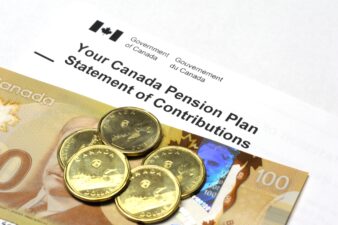
Canada Pension Plan (CPP) users will be contributing more to the plan next year. It will be the third year of CPP enhancements that took effect in 2019. Because of the 5.25% employer and employee contribution rate, the total contribution per individual in 2021 will be 9.26% higher. The contribution rate for self-employed users is double.
A CPP participant will feel the pinch slightly, since the annual payment will increase from $2,898 in 2020 to $3,166.45. If you were to include the employer’s portion, the total is $6,332.90. While your paycheque will be less, the good news is that the enhancements should work in your favour.
Maximum annual pensionable earnings
The CPP determines the maximum earnings amount for which an individual can contribute to the CPP. In 2021, the maximum annual pensionable earnings will likewise increase to $61,600, where $58,100 is the maximum contributory earnings and $3,500 (constant) is the basic exemption amount.
Understand this point: the size of payments depends on your earnings during your working years, the age when you start receiving the pension, and how much and how long you contribute to the CPP. If you earn more than the maximum annual pensionable earnings, or $61,600 in 2021, you can’t make additional contributions.
The real upside
While the CPP enhancement is piecemeal, from 2019 to 2025, there’s a gradual seven-year phase-in starting on January 1, 2019. A two-year phase-in (2024 and 2025) of the upper earnings limit will follow the five-year contribution rate phase-in (2019-2023) below the yearly maximum pensionable earnings.
The upper earnings limit for 2025 would be $82,700. However, the real upside is that instead of replacing only one-fourth (25%) of the average work earnings, the CPP will now be useful to cover one-third (33.33%).
If the pension replaces 33.33% of the average work earnings, and $710.41 is the average monthly CPP in 2020, your monthly retirement income should be $2,131.44. At 65, you can claim $613.53 monthly from Old Age Security (OAS) and therefore, you only need at least $807.70 in monthly investment income.
Desired retirement income
Assuming you have $174,650 to invest, purchase shares of Canadian Utilities (TSX:CU) to hit the target. This dividend aristocrat pays a 5.55% dividend, so you’ll earn a monthly passive income of $807.76. The $8.55 billion company is one of the most sought-after investments of Canadian retirees.
Canadian Utilities boast of the longest dividend-growth streak on the TSX, nearing 50 consecutive years of dividend increases. It owns a globally diversified portfolio consisting of electrical power lines (87,000 km), 64,500 km pipelines, and generating plants (21 with 2,500 MW in generating capacity).
Don’t forget about the water infrastructure (85,200 cubic metres daily capacity) and natural gas and hydrocarbon storage capacities. The business at home contributes 95% of total revenue, while the rest comes from Australia and others. Canadian Utilities derives 86% of earnings from regulated sources and 14% from long-term contracted assets. Your income should endure, even if you decide the hold the stock for a good 20 years or more.
Achievable goals
There’ll be a financial squeeze on users, while the implementation of CPP enhancements is ongoing. However, the increase in income replacement level means filling the income gap is achievable with the right investment. Your life in the sunset years would be comfortable.