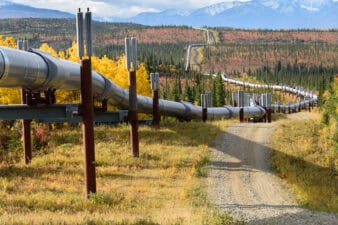
In one of his first acts as president, U.S. President Joe Biden dealt a blow to the energy industry by cancelling the permit for the Keystone XL pipeline.
Construction on the 1,200-mile (1,930-kilometre) pipeline began last year when former President Donald Trump revived the long-delayed project after it had stalled under the Obama administration.
When completed, the pipeline had the potential to deliver over 825,000 barrels per day and was meant to be the fourth phase of TC Energy’s (TSX: TRP)(NYSE: TRP) Keystone Pipeline System. The pipeline would have spanned over 1,200 miles from Alberta to Nebraska, where it would connect with existing infrastructure to reach the Gulf Coast.
But the final blow occurred on Wednesday, when TC Energy decided to officially pull the plug on the project.
Canadian government intervenes
For months, the Canadian government had attempted to persuade Biden to reconsider the pipeline.
Last year, the province of Alberta invested more than $1 billion in the project. The injection kick-started construction that had stalled due to opposition from environmentalists and Native American tribes along its route. Alberta hoped the pipeline would reinvigorate development in the oil sands.
Although Canada had been in continuous talks with the Biden administration, Alberta officials expressed frustration in recent weeks that Trudeau was not pushing Biden harder to reinstate the pipeline’s permit.
In a statement issued this week, Alberta Premier Jason Kenney said, “We remain disappointed and frustrated with the circumstances surrounding the Keystone XL project, including the cancellation of the presidential permit for the pipeline’s border crossing.”
Pipeline has long history of debate
Since TC Energy announced the project in 2008, the pipeline has been the target of environmental activists and the subject of numerous protests and legal actions.
Recently, state attorneys general of more than 20 states sought to overturn President Biden’s cancellation of the Keystone XL project. Proponents of the pipeline cited the massive creation of jobs as well as the potential disruption to the industry if the project were abandoned.
Biden, however, is maintaining his pledge to continue the growth of renewable energy that occurred during his terms as vice-president to President Barack Obama. During the presidential election, Biden promised to spend $2 trillion on renewable energy over the next four years.
In the past two years, at least four multi-billion-dollar pipeline projects that drew protests have been canceled or delayed after encountering regulatory and political roadblocks. According to an article in the The Wall Street Journal, some environmental groups are looking to capitalize on the momentum of the Keystone XL cancellation. The article reports that some producers are resorting to transporting oil by rail, which is more expensive and potentially more dangerous than pipelines.
North America still relies mainly on pipelines to transport fossil fuels. With increased pressure to curtail building new pipelines, both the U.S. and Canada will become more dependent on older infrastructure. Without massive capital expenditures, the aging infrastructure is more susceptible to disruptions. Any disruption could cause problems in the supply and delivery of fuel.
TC Energy braced for disruption
Investors in TC Energy seemed to shrug off the news of the project’s cancellation. The stock has been climbing this week to $64.45, as of this writing. During the past year, shares have traded in the range of $50.61 to $66.14.
No doubt, investors had time to brace for the news when they saw the writing on the wall with the exit of Trump and the entrance of Biden.
In announcing the termination of the pipeline, Francois Poirier, TC Energy’s CEO, admitted disappointment in the news, but countered it with optimism of new projects at the company. Poirier said, “Through the process, we developed meaningful Indigenous [groups’] equity opportunities and a first-of-its-kind, industry leading plan to operate the pipeline with net-zero emissions throughout its lifecycle. We will continue to identify opportunities to apply this level of ingenuity across our business going forward, including our current evaluation of the potential to power existing U.S. assets with renewable energy.”